Rock Rail: where public need meets private investment
Mark Swindell, Chief Executive Officer and Founder
| Rock Group
Mark Swindell, founder and CEO of Rock Group, sits down with Total Politics to explain why delivering better infrastructure is less about complex finance than connecting public need and long-term investment with the people who can get the job done
If UK infrastructure delivery had a Facebook status, it would probably say, “It’s complicated.”
There are planning rules and procurement processes. Political priorities and public finances. Investors, contractors, regulators, and consultants. Risk needs to be allocated, capital raised and contracts negotiated. Little wonder that major projects can take years to move from an idea to fruition.
However, during a sit-down conversation with Total Politics, Mark Swindell tells us that he thinks we may all be seeing infrastructure delivery as far more complex than it actually is.
“When I was a lawyer, I would come to presentations, and I would say, ‘Oh, this is a really complicated project.’” The founder and CEO of Rock Group recalls. “But I’m not a lawyer anymore. I know the tricks.” Investing and delivering infrastructure can be easier and more efficient.
Rock was founded in 2011, with Rock Rail following in 2014. Since then, it has brought significant institutional investment into new rolling stock and expanded into zero-emission buses and international markets.
But Swindell’s description of what the company actually does repeatedly comes back to something much more straightforward than complicated and often opaque financing vehicles. Rock, he argues, simply identifies a problem, finds people who want to solve it, and connects them with the capital and expertise that allows them to succeed.
“Now I’m an investor of my own money into getting infrastructure delivered I honestly think it is not that complicated,” he tells us. “It is just hard work, and we work out any issues and problems together.”
Swindell knows the old model well. Before founding Rock, he worked as a lawyer on countless PFI and public-private partnership projects. Later, working on the Mersey Gateway project, Swindell found himself looking at the relationship from the public-sector side. By the time he established Rock, he had come to believe there were better ways to combine the complementary strengths of the private and public sectors; Rock is proof of this.
The way Swindell describes the Rock approach is characteristically practical and straightforward. On one side are public authorities that need new infrastructure. On the other are pension funds and other institutions looking for assets in which they can invest for the long term. Between them he identified an opportunity to create a business that would not simply arrange the finance and walk away but invest alongside them and remain involved throughout the life of the asset.
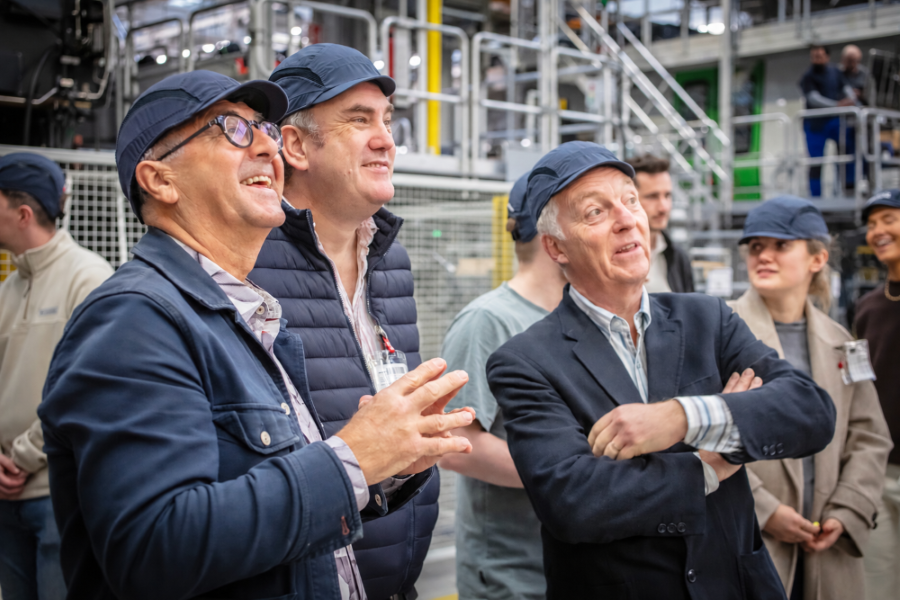 Mark Swindell, CEO, Mike Kean, COO, and Andrew Chivers, Consultant, during a visit to Siemens Mobility’s factory
Rock has since financed five major UK rolling-stock projects, taking new fleets through manufacturing, testing and into passenger service. When opportunities for new rolling stock slowed in Britain, it took the model into Germany and other European markets. Now, following its success in the recent TransPennine Express procurement, the company is investing significantly in UK rail once again.
That long-term involvement in delivery is clearly hugely important to Swindell and underpins Rock’s approach. Swindell explains that there are no wild celebrations in the company offices when a new deal is landed.
“A financial closing of a deal is no big shakes. It’s just the start of the job,” he tells us. “We’re not a finance house. We’re a business with engineers that actually get stuff done. That’s where we spend most of our time.”
And for the former lawyer, the real measure of success is found much further down the line, when real people step onto the train at their local station.
“Ultimately, our customers are really the passengers,” he says. “And if the passengers are loving the assets, then we’re happy.”
With an ongoing political debate about the future relationship between the public and private sectors, Swindell is resistant to grand theories about how those worlds should interact. When we ask what he thinks the government could change to unlock more investment in infrastructure, he simply rejects the premise of the question.
“Look, it’s not the public sector’s job to make my life easier,” he explains. “Being in the public sector is not an easy job. It’s hard. I certainly don’t think they need to make my job easier. It’s my job to make their life easier.”
Rock’s model is to do that by providing the long-term investment and asset expertise that can allow authorities to concentrate on the service they want passengers to receive. Rock’s expansion into buses offers one clear example. As local authorities move towards franchising, they can take greater control over routes and services without necessarily having to own and finance every vehicle themselves.
And Swindell believes the same principle can apply elsewhere. As government grapples with finding the right balance between private investment and public control, it feels the success of Rock’s approach could carry lessons for other sectors.
He tells us that the relationships Rock has forged with public sector bodies work because of the shared commitment to delivering for communities.
“It’s a much better relationship between the public and private sector when the private sector is a business, not a finance house,” he says. “We’re there for the long term. I mean, my own money is in this project, in this business.”
For all of the talk of capital, contracts and risk, Swindell believes infrastructure succeeds when the interests of the people involved are aligned around a clear outcome. That applies to government and investors. It applies to manufacturers and engineers. And ultimately it applies to the passengers who use what they build.
It also applies to the expert team that Swindell has assembled, which is successfully delivering infrastructure up and down the UK and increasingly in overseas markets.
“We’ve got a very successful business built around people that actually change things, change people’s lives. They take risks, and they work out problems,” Swindell says. “If you can work as a team, you can move mountains. That’s what it is. It’s simple.”
For more information visit www.rock-group.co.uk
