Don't buy shares in Prime Minister Badenoch just yet
4 min read
A year ago, the Conservative Party appeared trapped in a downward spiral, squeezed by Reform UK and facing questions about its long-term viability. Today, the mood is rather different.
Kemi Badenoch's ratings have improved, the Conservatives have recovered from their post-election low point, and some speculate a Tory comeback could be on.
For many in Westminster, those trends are enough to justify talk of Prime Minister Badenoch. But is talk of such a turnaround justified?
The Conservatives have clearly recovered from their post-election low point.
One of the biggest questions facing Badenoch when she became leader was whether the Conservatives’ problems were terminal. The evidence suggests not. Ipsos polling shows the Conservatives' vote share has recovered significantly from a year ago, rising from 14 per cent last September to 21 per cent this month. This is driven by the party losing fewer voters to Reform than last year.
Badenoch herself appears to be performing better than the Conservative brand. Her leader satisfaction ratings have improved markedly over the last year, and she is more liked than the party she leads. For an opposition leader less than two years into the job, that is not a bad place to be.
So the immediate threat of Conservative annihilation, much posited not more than a year ago and in between, appears, whisper it, to have receded.
However, recovering from a historic defeat and becoming a government in waiting are not the same thing.
While attitudes towards Badenoch have improved, attitudes towards her party remain stubbornly weak. Just a quarter of Britons believe the Conservatives are fit to govern. Only one in five think the party is concerned about people in real need, while more than half see it as a party that is out of date.
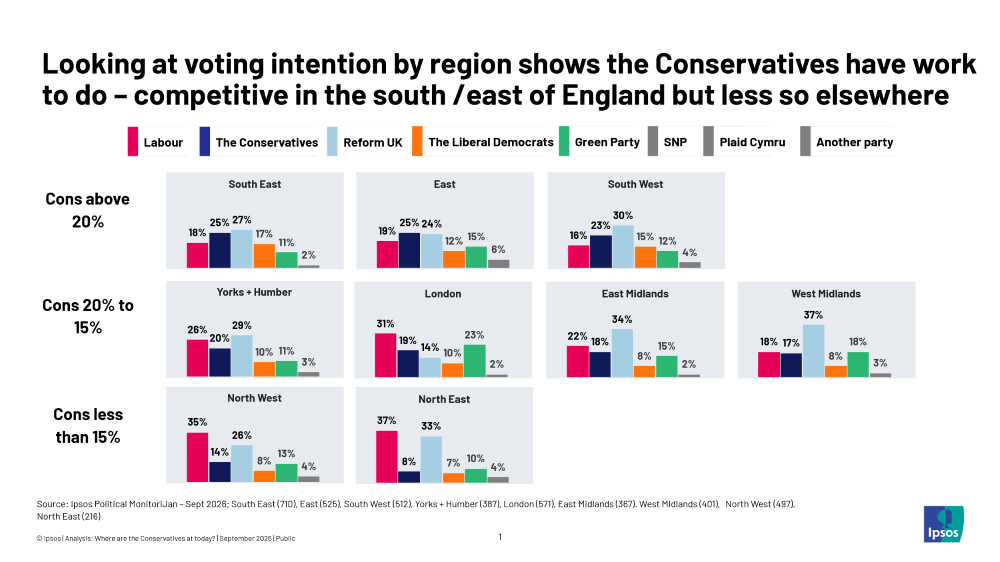
Today, only 20 per cent of the public agree that the Conservatives are ready to form the next government, while a majority disagree. By comparison, Labour entered the 2024 election with almost half the public viewing it as ready for office. The Conservatives and Badenoch have some hard yards ahead to get to that place – especially if you look at our regional analysis pictured below.
Another reason for caution is Reform.
Some Conservatives will look at recent polling and conclude the challenge from Nigel Farage's party has peaked. Certainly, the picture is less alarming than it was 12 months ago. Badenoch has stemmed some of the losses on the right and narrowed the gap between the two parties to just two points in our latest Ipsos Political Monitor.
But Reform still leads the Conservatives and the battle for supremacy on the right remains unresolved. Among voters who identify as right-wing, around six in ten would consider voting Conservative and a similar proportion would consider voting Reform.
Immigration remains the dominant issue for these voters, though not the only one. Concerns about the cost of living, the economy, health, crime and taxation all rank highly. The challenge for Badenoch is therefore not simply to compete with Reform on immigration. It is to persuade voters that the Conservatives have the right answers across a broad range of issues – though immigration is the most important.
As the Conservatives gather in Birmingham, there are reasons for them to be more optimistic than a year ago. There are signs that they could yet win the battle for hearts and minds amongst voters on the right. If they do, they could end up giving Labour a run for its money next time.
Andy Burnham's government is beginning to define itself more clearly. Its proposition to scrap the pensions triple lock to fund social care, alongside the PM's willingness to countenance a closer relationship with Europe – leaving the door open to rejoin the EU itself – presents an opportunity for Badenoch’s Tories to lay down a clear alternative vision. Older voters tend to be the most sceptical of both Labour policies and are likely to be a major target for Badenoch’s Tories.
The question facing Badenoch this weekend in Birmingham is no longer whether she can steady the Conservative ship. On the evidence available, she largely has.
The challenge now is turning recovery into renewal and growing support for the party, not merely stemming the tide. Some voters may be willing to listen again, but there is far less evidence they are ready to hand the Conservatives power.
That is the gap Badenoch must close. Until she does, investors in Prime Minister Badenoch may want to hold their horses.
Keiran Pedley is director of politics at Ipsos
