How I steered The House magazine through high political drama
6 min read
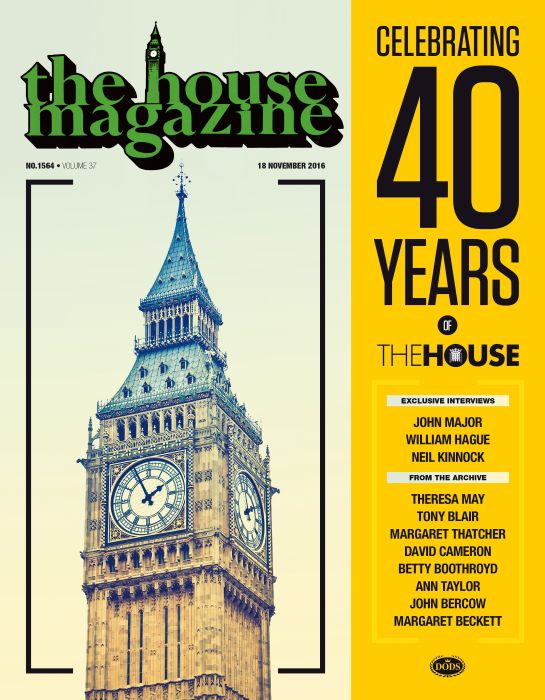
I was the editor from 2005 to 2017. The House had no editorial ‘line-to-take’ other than to report fairly and constructively.
We never experienced undue influence from the owners of the magazine and always respected the role of the Speaker of the House. The Portcullis on the cover acted as a kind of unofficial coat of arms or badge of honour.
This has remained so for 50 years, but our readership and the range of contributors has changed, as has the look of the magazine.
Patrick, later Lord, Cormack invited me to join the editorial board of The House shortly after being elected in 1997. When he stepped down in 2005, Mark Oaten and I became joint editors. We oversaw final copy of the magazine on alternate weeks. This worked for a while, but later Mark was forced to step back from frontline politics. Cormack was always at hand for support and advice.
I would chair the weekly meetings of associate editors, read final copy and write a 100-word introduction. Then, as now, we only went to press when Parliament was in session. Patrick continued to chair the advisory board, which met twice a year.
We took pride in telling Members of both Houses that it was “their magazine”. Most articles were written by parliamentarians, supplemented by carefully chosen outside contributors. We weren’t too sure whether journalists could be trusted. They were looking for negative stories, whereas we wanted to be constructive and positive. On the other hand, MPs’ writing skills were variable, and most of them did not like their copy edited.
The weekly editorial gatherings were pure joy. Gossipy and funny, they served the dual function of taking a look ahead, identifying topics we should cover, as well as group therapy, particularly when our respective parties were in trouble. Whatever political differences we might have had, they never clouded the discussions, nor did anything ever leak.
The career trajectory of the associate editors during my time is colourful. They included Michael Gove and Priti Patel, Austin Mitchell and Jess Phillips, Charles Kennedy and Alistair Carmichael to name just a few.
Paul Waugh was the first former lobby journalist who joined our meetings. He was succeeded by Kevin Schofield and later Francis Elliott. They played a significant part in turning us into a more mainstream political weekly. Kevin is now the political editor of HuffPost UK, Paul is the MP for Rochdale and a junior minister in the Department for Education, and Francis is the current editor.
In the early days George Gale’s cartoons were a hallmark of the magazine. Always courteous and never cruel, people would frequently ask for the original artwork. He died in 2003 and we increasingly moved to high-quality photographs.
There was a Hello! magazine element to the use of photographs. Parliamentarians liked being on the cover, with a big interview inside and more pictures. We’d offer the photographs for use on their own leaflets as well as extra copies of the magazine. One MP asked for 500 copies for distribution in their constituency. Another expressed their deep disappointment that we printed things exactly the way they said them. On another occasion a cabinet minister demanded that we explain to the whips that, whilst they did use the words we printed, they did not mean them.
The need to generate advertising revenue wasn’t always appreciated by our readers
Paul Heartfield’s photographs set a high standard. In 2009 we published a book of “Portraits from inside the House”. I particularly like the one of a young Sadiq Khan, taken in 2006, and Norman Tebbit and Trevor Phillips in 2008. However, not everyone was happy with the way the camera captured their personality. I struggled to find the right words when a particular cabinet minister thought we made him look like an “arrogant shit”.
The need to generate advertising revenue wasn’t always appreciated by our readers. More justified were the concerns about “advertorials”, and the magazine settled into a clear pattern of marking what was editorial and what was advertising.
There were and still are things only The House does.
Speeches and debates are covered in greater detail and parliamentary procedures are explained, but we also wanted to show that parliamentary work covers so much more than being in the Chamber. The weekly diary provided the perfect platform. Collectively they give an extraordinary insight into the daily life of a politician. Not all our contributors could be relied on to deliver copy on time. Every week I was prepared to write a diary at short notice, and sometimes I had to.
Austin Mitchell’s spoof “Diary of Alastair Campbell in the bunker over Iraq” was visceral and very funny; alas, we just couldn’t publish it.
In the early days there had always been a touch of “upstairs downstairs” about our reporting but that changed. A special edition of “Working for Parliament” was published in 2007. In over 100 pages, with photographs taken by David Partner, we gathered reflections from those who make the place work. There was Gladys Dickson, catering assistant in the Members’ Tearoom, who died recently, and Patrick Cree, head waiter in the refreshment department in 2007, who is still working.
Pocket and desk diaries, which may seem outdated today, were much sought-after. The desk diaries recorded the names of parliamentarians who had their birthday on any given day. One year, 26 November was the most popular birthday: Lord Bilimoria, Hilary Benn, John Gummer, Keith Vaz, Ann Keen, Joyce Quin as well as Gisela Stuart.
There were some difficult moments. Should we accept a paid advertisement from an organisation that accused the NHS of deliberately killing patients? No! What about self-styled freedom fighters, who we all suspected to be terrorists, but neither the Home Office nor the Foreign Office had banned? No! Should we publish an interview with an academic who accused a member of a political party of a string of lies, cons and deceits? No!
But what about Members of Parliament who produced fake invoices for services or claimed for mortgage payments even though the mortgage had been paid off? What started as a story about MPs’ expenses claims quickly developed into a full-blown scandal. Editorially, we allowed the newspapers to make daily running. Things moved fast and the trajectory was unpredictable. When it became clear that Speaker Martin’s position had become untenable, the House “noted” but largely refrained from comment.
The expenses scandal led us to suspend the annual House Magazine Awards, which recognised outstanding contributions by ministers, backbenchers and campaigners, and replace them with Life Time Achievement awards. It seemed wrong for MPs to congratulate themselves for doing their jobs at a time when the public had lost trust in them.
In 2009, Geoffrey Howe presented Denis Healey with the award. Denis thought that when you turn 80, all your enemies become friends.
I stepped down from Parliament in 2017 and was succeeded by Graham, now Lord, Brady as editor.
I never made it to be on the front cover, but the team did one better by producing a brilliant spoof copy as a leaving present in 2017.
Baroness Stuart is a crossbench peer
