The Comeback Kid: The Life And Politics Of Bill Clinton
2006 Bill Clinton portrait by Chuck Close
19 min read
He dominated global politics for a decade, became the first Democrat since FDR to win re-election, paved the way for Tony Blair and others and unleashed huge economic forces that shape the world to this day. Here, Mark White, John Rentoul, Bridget Kendall and Iwan Morgan write on Bill Clinton, while Barbara Perry explores the legacy of first lady turned presidential candidate, Hillary Clinton
Rise to power
This year marks the 30th anniversary of Bill Clinton’s 1996 re-election as president of the United States. It represented no small achievement: he was the first Democratic president to be re-elected to a second term since Franklin Roosevelt’s landslide victory in 1936.
The first president born after the Second World War, he grew up in modest and emotionally challenging circumstances. He never knew his own father, who died in a car accident before he was born, and his stepfather was an abusive alcoholic. Academically gifted, Georgetown University, Oxford and Yale were an important means of ascent. And there is strong evidence that even as a very young man, he aspired to the presidency.
On returning to his home state of Arkansas after his Yale law degree, he ran for Congress while still in his 20s and in 1978, aged 32, he was elected governor. However after embarking on a sweeping programme of reform that proved unpalatable to both vested interests and the people of Arkansas, he lost his bid for re-election in 1980, rendering him the youngest ex-governor in American history. Two years later, though, he mounted a comeback with input from New York political consultant Dick Morris and the adoption of a more centrist set of policies, and in so doing reclaimed the governorship. This would prove to be a recurring theme of his life in politics – victory followed by disaster and defeat followed by a doughty comeback.
After making the worst, most soporific speech of his political career at the Democratic Convention in 1988, he came back as a leading candidate in the 1992 campaign. After the negative verdict on his first two years in the White House represented by the Republican Party taking control of Congress in November 1994, he came back to win re-election as president by defeating the Republican candidate Bob Dole and independent Ross Perot. After the scandal and impeachment caused by his affair with White House intern Monica Lewinsky, he ended his presidency with approval ratings higher than more recent presidents have been able to achieve. Durability, then, was one of the defining features of his political career.
Clinton’s broader significance in terms of the history of western politics is his championing of the Third Way, New Democrat politics that would exert considerable influence on centre-left leaders elsewhere, not least Tony Blair and his government (see John Rentoul’s essay). What is important to recognise is that Clinton’s adoption of a New Democrat outlook was not a sudden development due to the need to win the 1992 election. Rather, he had been carefully developing and fine-tuning these ideas for several years, dating back at least to the mid-1980s and arguably earlier. This resulted in a set of precisely formulated ideas and policies in 1992, including the argument that there was nothing inherently advantageous or commendable for the Democratic Party to be seen as ‘soft’ on crime, welfare or national defence.
For anyone interested in the art of politics, Bill Clinton’s story is of considerable interest and significance. This is a subjective judgement, to be sure, but in my view he remains the most impressive campaigner in the last half-century of American (and British) political history. His encyclopaedic knowledge of the issues, his famed ability to make an immediate connection with people on the campaign trail, his empathy, his skill in debate (as George HW Bush discovered in the town-hall debate in 1992) were exceptional.
Like Franklin Roosevelt, he had a sixth sense for understanding political nuance. It’s why Tony Blair described him as the most talented politician he ever encountered. One story that reflects on this ability is a moment late at night during the 1992 campaign as his staffers were desperately trying to get him into his hotel for a few hours sleep before getting back on the campaign trail the following day. Clinton spotted a man close to the hotel entrance, went over to him and – much to his aides’ irritation – struck up a long conversation. They had met once, many years earlier. Clinton remembered the man’s name and what they had talked about. Another personal/political connection established. Another supporter enlisted.
Whatever one thinks of the effectiveness of his policies in the White House, Bill Clinton remains a fascinating figure in the history of the American presidency.
Mark White is director of the London POTUS Group and professor of history at Queen Mary, University of London
Clinton and Blair: Ideological soulmates
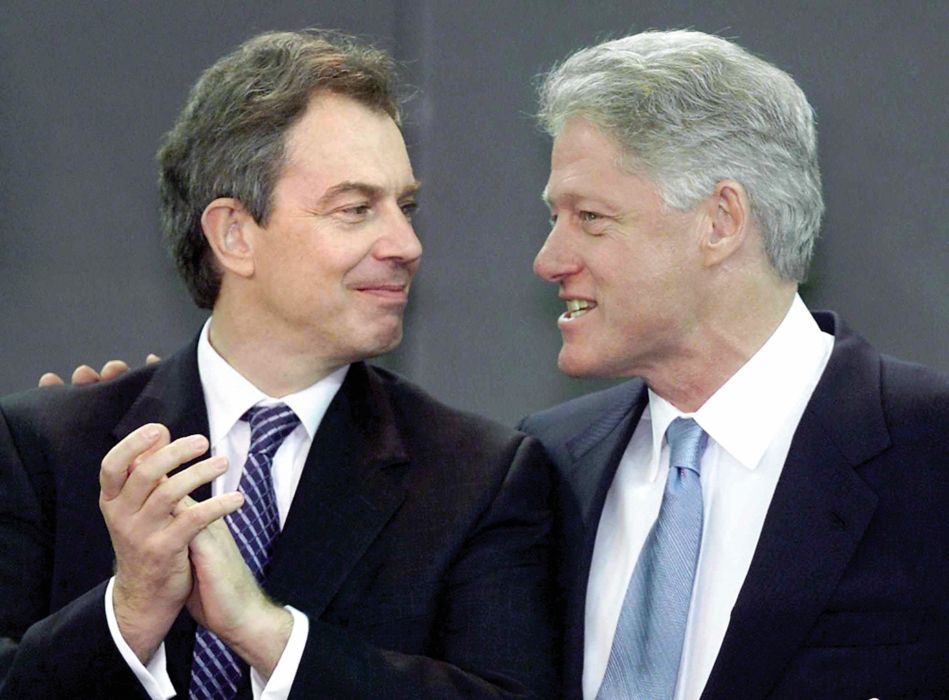 Tony Blair and Bill Clinton in 2000 (PA Images/Alamy)
One of the ways in which Tony Blair was lucky was that his rise to the top of British politics happened to follow soon after the rise of Bill Clinton in America. Blair was lucky to secure a tenancy as a barrister in the chambers of Derry Irvine, a well-connected Labour lawyer. He was lucky to secure a safe Labour seat at the last moment before the 1983 election, when many of the party’s able politicians had either defected to the SDP or lost their seats. He was lucky that John Major’s exchange-rate policy collapsed in 1992, creating an opportunity for Labour at the subsequent election. And then, a few weeks later, he was lucky that Clinton beat George HW Bush, who had started as the runaway favourite, in the presidential election. That allowed Blair to pose as a like-minded moderniser in British politics. Hence the significance of a trip to Washington by two leading Labour politicians, Gordon Brown and Tony Blair, in January 1993, to meet the Clinton transition team, to exchange ideas and above all, to project an image of youthful, shared purpose.
My good fortune was not quite on the same world-historical level, but I was lucky in that I covered that trip as a TV journalist for the BBC. I was there when the bonds between the Clinton administration and the future Labour government were being forged. I particularly remember speaking to Al From, head of the Democratic Leadership Council, who explained its mission in simple language. It was to create a “new” Democratic Party by subjecting the old one to “reality therapy”, forcing it to understand what it needed to do to win back the Reagan Democrat voters who had deserted the party. One of the ways to do that was to get tough on crime, and it was probably on that Washington trip that Brown devised the slogan, “tough on crime and tough on the causes of crime” – which Blair first used within days of returning to London.
The final piece of luck in Blair’s rise, although it may be tasteless to describe it as such, was the subsequent death of Labour leader John Smith in 1994. Everything had fallen in place for Blair, although there were those awkward conversations to be had with Brown that poisoned the New Labour project from the start.
But the way was cleared for Blair to win power with a huge electoral mandate, and to take office with a ready-made alliance with the leader of the world’s only superpower. The ideological common ground between Clinton and Blair was a great asset to the new prime minister. However much the critics mocked the vacuities of the “Third Way”, it was a real political philosophy that helped bind the alliance more tightly. Blair wrote in his memoir: “The Third-Way philosophy that we both espoused was not a clever splitting of the difference between right and left. Neither was it lowest-common-denominator populism. It was a genuine, coherent and actually successful attempt to redefine progressive politics.”
There were awkward moments (Blair’s visit to the White House as the Monica Lewinsky story was breaking) and tensions (over Blair bouncing Clinton into threatening the use of ground troops in Kosovo), but overall it was a successful relationship. In particular, it allowed Blair to use the power of a personal phone call from the president of the United States to the leading negotiators in Northern Ireland that helped secure the Good Friday Agreement.
In his first term as prime minister, the friendship with Clinton gave Blair the priceless asset of credibility on the world stage, and created an image of the two of them as a new generation with a common purpose.
John Rentoul is chief political commentator for The Independent
Observations of the Clinton Presidency, 1994-1998
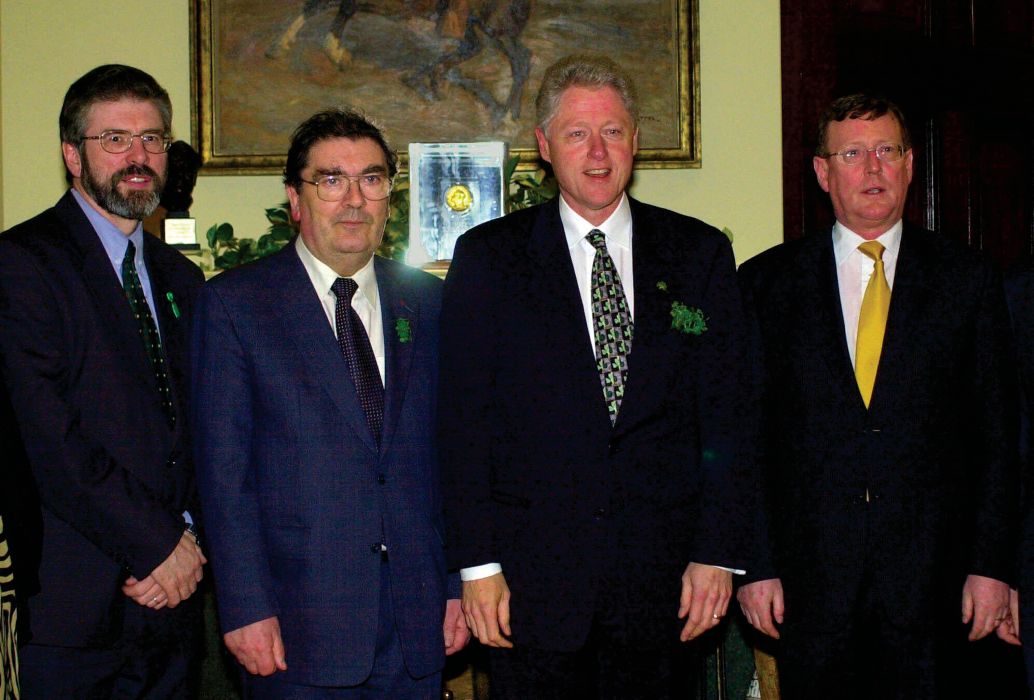 Bill Clinton poses with Gerry Adams, John Hume and David Trimble at the White House in 2000 (Associated Press / Alamy)
Bill Clinton was the third youngest man to be elected US president. His tenure began with a series of missteps that smacked of Washington inexperience. Relations with Congress were rocky; military brass were affronted by his ‘Don’t Ask, Don’t Tell’ policy (to give LGBT personnel a legal way to join up for the first time) which pleased no one; and a much-vaunted Universal Healthcare Plan, which he ill-advisedly handed to his wife Hillary to front, ended in failure. What followed in 1994 was the loss of the House in Congress to the Republicans for the first time in 40 years. I was able to observe these developments first-hand as the BBC’s Washington correspondent at that time.
In foreign affairs, Clinton was the first post-Cold War president of a country that still felt it was the leader of the free world. Democracy looked to be on the ascendancy around the globe. China and Russia, weak and hamstrung by their communist pasts, were to be courted as future trade prospects, not yet feared as potential rivals or competitors.
And since he was no longer pre-occupied by Cold-War threats abroad, Clinton was able to focus instead on the ballooning budget deficit at home. He slashed military expenditure and put the domestic agenda and economic priorities first. Globalised trade looked like a way to make Americans richer, and a pivot to Asian markets and a free trade deal with North American partners seemed to do the trick. By the time Bill Clinton stood for re-election in 1996, the economy was bouncing back.
This was not yet the social media age. It was still a world where perception of the state of the nation was largely shaped by national politicians and national newspapers and TV bulletins. So, although many less well-off Americans needed more than one job to make ends meet, whatever the difficulties in their lives, the zeitgeist was such that many of them felt more prosperous.
With no Democratic challengers to deplete his war chest, and a cunning media strategy to place TV campaign ads below the radar at the local not national level, Clinton won re-election handily – although neither in 1992 nor 1996 was he elected with more than 50 per cent of the vote, not least because he was in both elections up against more than one other presidential runner.
But the divide in the election results also reflected the fact that quite a few Americans were increasingly alienated from their government. Around the fringes of society there were rumblings, the start of trends which we would recognise as more mainstream today: a 51-day siege between the FBI and extremist cult leaders at Waco, Texas, in 1993; the bombing of a federal building in Oklahoma City by an ex-soldier called Timothy McVeigh in 1995 which was the deadliest case of domestic terrorism in US history; and a steady trickle of disgruntled citizens joining armed militias and calling for insurrection or small-scale domestic terrorism to protest against their own government.
In that Clinton era, it is also worth remembering that for some people, both Bill and Hillary were highly controversial figures. His time in office was pockmarked by a series of scandals which his Republican opponents tried to turn to their advantage. Probes into the Clintons’ Whitewater business dealings and allegations of sexual impropriety when he was governor of Arkansas made by a former employee, Paula Jones, got nowhere; but then his affair with a White House intern called Monica Lewinksy turned into a major and hugely embarrassing scandal. This eventually led to Clinton’s impeachment by the House (though acquittal by the Senate) and forced him into an apology to the nation.
Against this domestic turbulence, foreign policy could sometimes be a relief, and his foreign policy record is impressive. After the ‘Black Hawk Down’ fiasco in Somalia in 1993 (when US special forces sent in to stabilise the country ended up being captured and brutally murdered by Somalian war lords), he showed a marked reluctance to send in ground troops. But – like so many American presidents before and since – Bill Clinton often found himself drawn into foreign crises. He later said one of his greatest foreign policy regrets was not doing anything to stop the Rwandan genocide. In other arenas he was prepared to get stuck in diplomatically, sometimes reinforced by military action or the threat of it to bring parties to talks. He came to the brink of invading Haiti to restore an ousted president. A brief Nato bombing campaign against Bosnian Serbs led to the Dayton Peace Accords which ended the Bosnian war. It took rather longer to bring president Milošević to the table – 70 days of Nato airstrikes – but Kosovo did get its independence. In Northern Ireland, he was widely regarded as a key player in bringing about the Good Friday Agreement. And his military action against supposed Al Qaeda outposts in Sudan and Afghanistan and (with the UK) to hit Saddam Hussein’s regime in Iraq would pave the way for much bigger wars against the same targets by his successor as president, George W Bush.
Bridget Kendall was BBC Washington correspondent 1994-98
Clintonomics: A new Democrat’s new economics
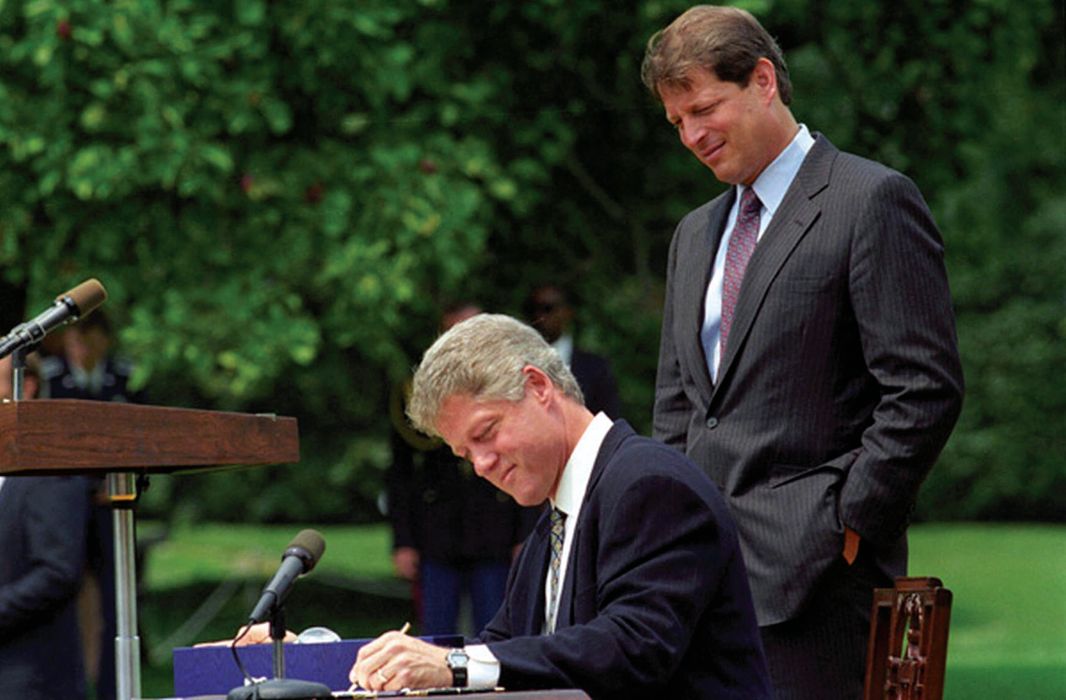 President Clinton signs the Omnibus Budget Reconciliation Act in 1993 (Cab Image/Alamy)
Bill Clinton promoted a new economics attuned to his identity as a new Democrat. He rejected tax-and-spend liberalism and Reaganite tax cuts to pursue a middle-way whereby government facilitated economic growth through enhanced public and private investment. Initially, he looked to strike a balance between the two but ended up prioritising the latter.
Clinton fought the 1992 presidential election on a manifesto promise to equip workers with the skills and infrastructure to meet the challenges of globalisation. In office, however, he switched to prioritise elimination of the giant fiscal deficits run by the US government since 1981. A group of advisers headed by Goldman Sachs co-chair and future treasury secretary Robert Rubin persuaded Clinton that deficit control was essential to boosting economic growth because investors considered big fiscal imbalances an inflationary threat.
Clinton narrowly secured enactment of the Omnibus Budget Reconciliation Act of 1993 that halved the deficit over four years by both cutting spending and increasing taxes. This sacrificed the public-investment programme and middle-class tax cut promised in his campaign. It also did little to boost economic growth and create jobs in the short term. The Democrats paid the price when the Republicans captured control of Congress in 1994, their first midterm victory since 1946. Nevertheless, prosperity soon picked up thanks to Federal Reserve credit easing once chairman Alan Greenspan was convinced that fiscal policy had become non-inflationary. Counted out two years earlier, Clinton won re-election in 1996 on the back of a booming economy (which was also instrumental in later saving him from impeachment in the Monica Lewinsky scandal).
Clinton’s second term saw the budget move into the black owing to buoyant receipts from full-employment and a Wall Street boom. He was thereby able to balance the budget at a high rate of revenue rather than the low rate favoured by the Republicans to control spending. This gave Clinton the margin to raise outlays on healthcare, education and social welfare without incurring deficits. Budget surpluses became so big that their continuation promised to eliminate the entire public debt by 2015.
To sustain the boom, Clinton joined with Alan Greenspan to promote liberalisation of financial rules, most notably the repeal of the Glass-Steagall Act of 1933, thereby removing the separation of commercial and investment banking and reducing oversight of derivatives trading. His administration was also active in promoting free trade. Having narrowly secured ratification of the North America Free Trade Agreement in 1993, it pushed through agreement for China’s entry into the World Trade Organization in 2000, considered crucial for 21st century expansion of commerce.
The 42nd president left office with: the lowest unemployment and inflation rates since the mid-1960s; the strongest economic growth and productivity rates in 30 years; a buoyant stock market; and four consecutive balanced budgets for the first time since the 1920s. This was the best record of any White House occupant since economic management had become a presidential responsibility in the 1930s.
Nevertheless, there were thorn bushes in Eden. Income inequality intensified in the 1990s as a new high-tech economy required advanced education to get good pay and free trade hurt employment in traditional industries where blue-collar workers earned good wages. The Wall Street boom ended with the dot.com crash of 2001 that cut off the revenue from capital gains and similar taxes needed for balanced budgets. The trend towards financial deregulation to facilitate share trading ignored the painful lessons of Great Depression history.
All these problems were only ripples on the surface of prosperity when Clinton left office, but they helped to generate the tsunami that overtook the US economy in the Great Recession of 2007-2009.
Iwan Morgan is emeritus professor at University College London
Bill and Hillary Clinton’s personal, political and policy partnership
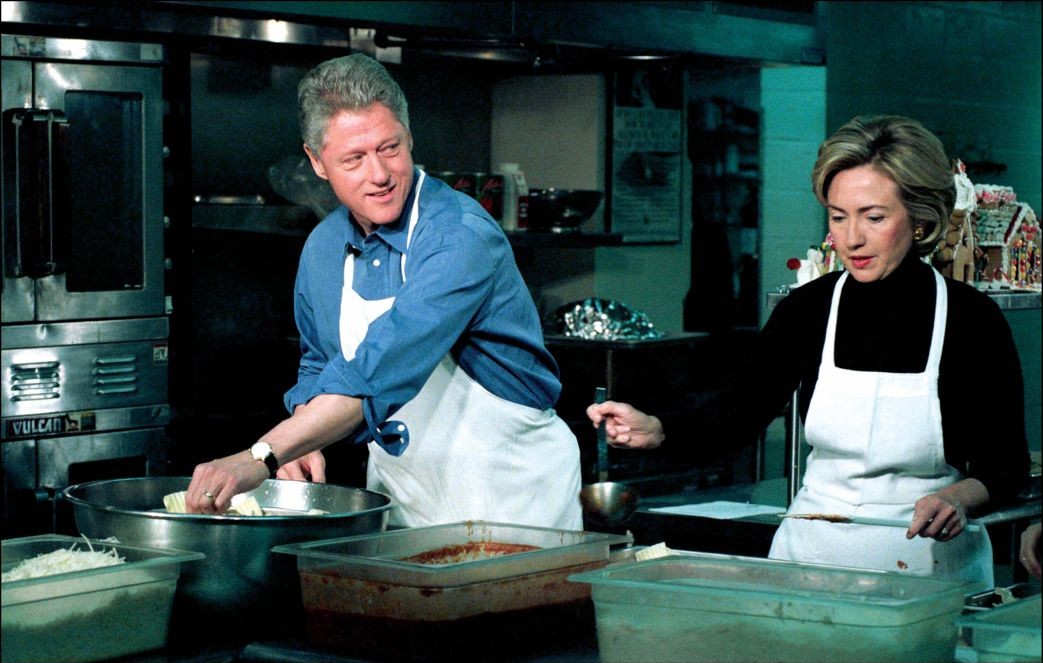 Clintons prepare lasagna at the DC Central Kitchen in Washington in 1998 (Pete Souza/KRT/ABACA/Alamy)
Bill and Hillary Clinton’s partnership represents one of the most consequential alliances in American political history. While helping her husband win five terms as governor of Arkansas and serving as the state’s first lady, Hillary practised law and advocated for children. She served as her husband’s “protector, financial guarantor and public relations trouble-shooter,” according to biographer David Maraniss. “The thing he lacks is discipline, both in his personal life and his intellectual or decision-making life,” claimed White House budget director, Alice Rivlin. “I think for a good part of his career, he was probably rescued by Hillary.”
She did so during his 1992 race for the Democratic presidential nomination, when an Arkansas entertainer claimed she had had a 12-year affair with Bill. Hillary, upset that an interviewer described her marriage as “an arrangement”, angrily responded: “You know, I’m not sitting here, some little woman standing by my man like Tammy Wynette. I’m sitting here because I love him and I respect him and I honor what he’s been through and what we’ve been through together. And, you know, if that’s not enough for people, then heck, don’t vote for him.” The Clintons’ friend Bernard Nussbaum observed, “He would not have been president, I don’t think, without her.” Yet when governor Clinton commented that voters could “buy one, get one free”, because Hillary would play an active a role in his White House, the negative response was swift from those opposed to the idea of Hillary as co-president.
The first lady established her unprecedented role in the White House from the day her husband took the presidential oath on 20 January 1993, becoming the first first lady to have an office in the West Wing, near the Oval Office. Less than a week after his inauguration, president Clinton named his wife chair of a task force, consisting of cabinet secretaries and other White House officials, to develop an affordable health-care plan for the 40 million Americans without coverage. Had it been achieved, it would have been the most consequential domestic-policy accomplishment by any administration since Lyndon Johnson’s landmark civil rights reforms back in the 1960s.
The process proved problematic, with hundreds of experts involved, secret meetings attracting criticism, and legislation being drafted without congressional input. In 1993, the president presented his 1,342-page American Health Security Act proposal to Congress. Hillary Clinton became the first first lady to testify as the lead witness on a major policy initiative before committees in both houses of Congress. She delivered masterful performances without notes or consulting with staffers who accompanied her.
The legislation unleashed a wave of opposition in Congress and around the nation. After a 20-month battle, both Clintons conceded defeat. “We knew we had alienated a wide assortment of health-care industry experts and professionals, as well as some of our own legislative allies,” Hillary later admitted. “I knew I had contributed to our failure, both because of my own missteps and because I underestimated the resistance I would meet as a first lady with a policy mission.”
Hillary Clinton then embraced more traditional policy advocacy: for children and women. She delivered a historic speech in Beijing to the 1995 United Nations’ Fourth World Conference on Women, declaring that “women’s rights are human rights, and human rights are women’s rights”. In pursuit of this redefined role, she travelled the globe, from Mongolia to Latin America to Africa to Europe to Central Asia to the Middle East to the Balkans.
American poet Robert Frost observed in 1962, “There have been some great wives in the White House – Abigail Adams and Dolley Madison – so great that you can’t think of their husbands, presidents, without thinking of them.” It remains unclear whether history will view Hillary Clinton as a “great” first lady, but it is undoubtedly true that her husband’s presidency will never be contemplated without thinking of her.
Barbara A Perry is the J Wilson Newman professor of governance at the University of Virginia’s Miller Center
These essays explore Bill Clinton’s life in politics, which is the theme of a special panel discussion event on Tuesday 23 June at 6pm in the River Room, House of Lords.
This event, organised by the British-American Parliamentary Group, the London POTUS Group and the Archives and History APPG, will be chaired by Lord Howard of Lympne, and introduced by Chris Evans MP. For those wishing to attend the event, email [email protected]
