How Will Britain Meet Its Defence Spending Targets?
UK MOD © Crown copyright 2026 Photo by LPhot Kevin Walton
11 min read
Ministers have promised billions more for defence but kicked key funding decisions to next year despite warnings Russia could attack Nato by 2030. Harriet Symonds examines whether Britain can afford to delay its military rebuild
Britain is facing a race against time to rebuild its armed forces, but the government is still no clearer about how it is going to pay for it.
With Russia planning to step up its military spending to $202bn next year and warnings that it could attack a Nato member before the end of the decade, ministers have accepted that Britain must spend considerably more on defence. Yet the most important decisions on how to fund the increase in spending have been pushed back until next year’s spending review.
At the Budget, Chancellor John Healey confirmed that the government would set out a route to spending 3.5 per cent of GDP on defence by 2035, in line with its Nato commitments, with a target date of 2030 for reaching 3 per cent.
Britain is currently spending 2.6 per cent of GDP on Nato-qualifying defence, rising to 2.7 per cent over the next few years. According to the Institute for Fiscal Studies, reaching 3 per cent by 2030-31 would require an additional £11bn per year.
Healey told MPs he was beginning work on how to reach the three per cent target “in a fiscally sustainable way”.
“That will include looking hard at public spending,” he said. “I am also determined to use more innovative financing, alongside the private sector and our international allies.”
But the announcement offered little immediate relief to a Ministry of Defence (MoD) facing competing demands to repair existing capabilities, replenish ammunition stocks and invest in the next generation of military technology.
The Chancellor used the Budget to fill the remaining £4.7bn funding gap in Labour’s £15bn Defence Investment Plan, announced in June.
The money will come from a further one per cent reduction in other departmental capital budgets over the next four years, raising £3bn, with the remaining £1.7bn coming from unallocated contingency in the Treasury’s capital reserve.
The decision means that money intended for long-term investment across Whitehall will instead be channelled into defence. The Department of Health and Social Care is among those affected, with £1bn raided from its budget, although ministers insist the NHS’ frontline services and major hospital programme will be protected.
Layla Moran, chair of the Health Select Committee, told The House that “lopping” £1bn from the NHS’ capital budget will have a “significant impact on the health service”.
“It seems inevitable that programmes will have to be delayed or cut and the government needs to be honest about the trade-offs it is making,” she said.
“If the government wants to reassure people that these projects won’t be affected it needs to be much more transparent about where this money will be found.”
The government also announced that the National Wealth Fund and British Business Bank will deploy up to £5bn in investment and lending over the next four years to defence, dual-use technology and other sectors supporting national security. A new Innovative Defence Financing Taskforce has been launched to maximise private and international finance for defence and national security.
The delay to 3 per cent means British defence companies are left waiting for decisions on major contracts. The uncertainty risks pushing back delivery dates, cutting jobs and increasing costs as manufacturers struggle to plan ahead.
Some Labour MPs had expected Healey to take more decisive action sooner given he resigned as defence secretary earlier this year over the lack of funding for the armed forces. His decision as Chancellor to defer the longer-term settlement has therefore prompted awkward questions from some MPs.
“The thing raising eyebrows is that this is what John Healey felt wasn’t good enough, so why has this now changed for him?” one Labour MP asks.
The government insists it has delivered the biggest sustained increase in defence spending since the Cold War. But that claim is being tested by the scale of the threat facing Britain and its allies.
Hostile activity against Britain, including cyber attacks, sabotage and espionage, is becoming an increasingly regular feature of national security.
“My concern is that they do need to go further and faster, if I’m being honest,” says Graeme Downie, the Labour MP for Dunfermline and Dollar.
“Given the increase in aggressive activity from hostile actors, be that Iran or Russia, in physical and in cyber attacks, it now seems to be becoming just a factor of life. It’s something that happens all the time.”
Tanmanjeet Singh Dhesi, chair of the Defence Select Committee, has warned that Britain risks leaving itself “seriously vulnerable” by delaying decisions on defence spending.
“There is a cost to inaction. Investment in our nation’s defence and security cannot be kicked into the long grass,” he said. “Our adversaries are not bound by fiscal years and spending cycles. We need to urgently rebuild our capabilities now, or we risk leaving ourselves seriously vulnerable in the event of a major conflict.”
His intervention prompted a clash with Wes Streeting, the Defence Secretary, who dismissed the criticism as “unfounded”. The exchange left some Labour MPs unimpressed.
“Wes’ comments were unfair and rude. Select committee chairs do important work and that should be respected by all, even if you disagree with what was said,” one Labour MP, who supports higher defence spending, said.
But MPs are not only concerned with how much money Britain spends. It is also about whether the government is investing in the right capabilities, and whether it can get them into the hands of the armed forces quickly enough.
When Al Carns resigned as armed forces minister earlier this year, he warned that the Defence Investment Plan was “looking at how to fight the last war not the next one”. He argued that Britain could find itself in a difficult military position within two to three years if its capabilities were tested.
The problem is that defence procurement cannot be switched on overnight. New ships, aircraft, armoured vehicles and drones can take years to develop, manufacture and bring into service. If Britain wants those capabilities available by 2030, the decisions to commission them must be taken now.
Even the additional billions being discussed will not necessarily translate into a rapid expansion of Britain’s fighting capability. Much of the immediate requirement is to make existing equipment serviceable and ensure that the armed forces have the kit, ammunition and spare parts needed to deploy it.
“The issue is the funding at the moment that is going to be added in is not just for new equipment,” says a defence expert . “It’s not to be spent on tanks, armoured fighting vehicles, frigates and planes. A lot of it is going on the kit that we already have to make it serviceable, so that when we need it, it’s all available.
“For the last 30 years, we’ve had massive gaps in our capability. We just haven’t ultimately been found out yet because we’ve never had to get it all out of the door at the same time.”
Emily Thornberry, chair of the Foreign Affairs Select Committee, argues that Britain has become “complacent” and can learn from Ukraine to be better prepared for conflict in future.
“There are really obvious vulnerabilities that we haven’t got an answer to yet and we’ve been complacent about.”
She adds: “The kit that we spend money on should be cheaper because it doesn’t need to be so hugely expensive. It quite often doesn’t need to be manned and that should be our priority.”
She also argues that Britain must invest heavily to rebuild the Royal Navy, which is the smallest it’s been since the English civil war, particularly as Russia steps up efforts to interfere with undersea cables.
“It’s ridiculous that we have such a tiny Navy at the moment,” she says.
Her argument extends beyond conventional military hardware, too. She believes some defence funding should also be ringfenced to fund the BBC World Service, which she regards as an important weapon in the fight against disinformation.
“There are really obvious vulnerabilities that we haven’t got an answer to yet and we’ve been complacent about”
“Britain’s gift to the world in an age of disinformation and a new type of warfare is to tell the truth and for the world to know what the truth is because the BBC is saying it, and because BBC Verify are there proving that certain lies are going around the world at a million miles an hour get stopped.”
Downie believes that by 2035 Britain could be spending considerably more than the government’s current targets suggest.
“We’ll be more at 5 or 6 per cent, not 3 or 3.5,” he predicts.
The argument over Britain’s military preparedness is also exposing a wider problem for ministers: how to persuade the public that the threat is serious enough to justify the money without prompting panic.
The government has begun to acknowledge that national resilience must come from the whole of government. Last month it launched its three-year ‘Be Ready’ campaign, urging households to build up enough emergency supplies to be self-sufficient for three days during a crisis.
But the launch was relatively low-key, prompting questions about whether ministers are willing to be sufficiently frank with the public about the risks facing the country.
The House understands that No 10 developed “cold feet” in the run-up to the campaign over concerns that the messaging could frighten the public, and had to be persuaded to proceed.
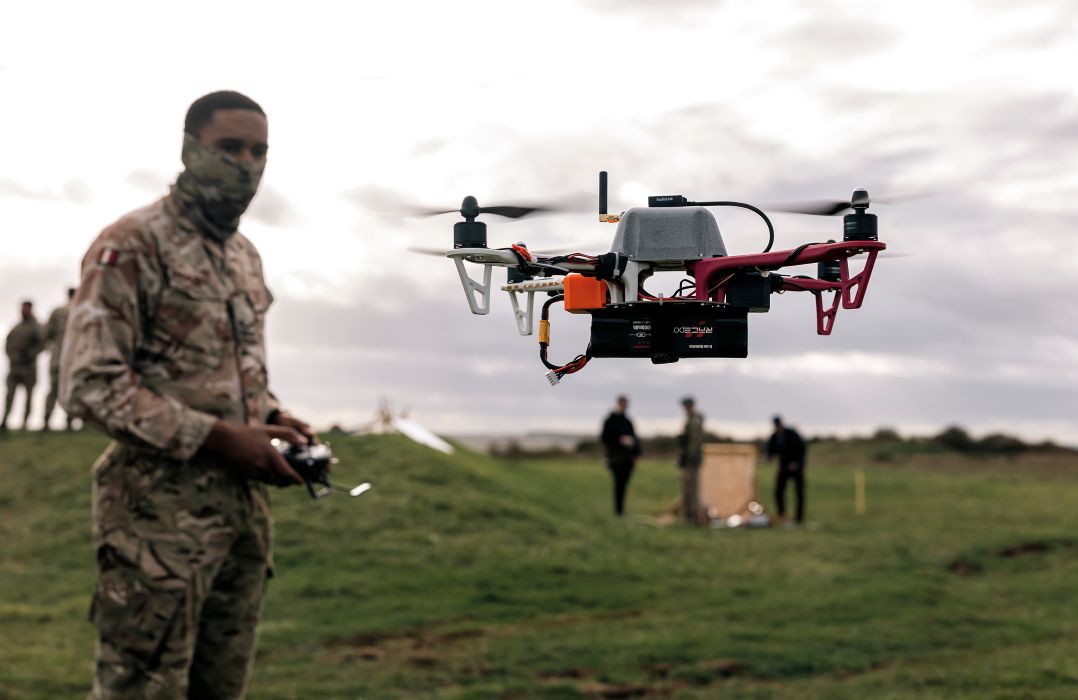 UK MOD © Crown copyright 2026 CPL TOMAS BARNARD
Those familiar with the launch believe it should have been co-ordinated with the National Emergencies Trust’s ‘Ready Together’ campaign, which focuses on community preparedness. Officials are now understood to be considering a relaunch to bring the two initiatives together.
The concern is that ministers cannot ask the public to take national security seriously while appearing reluctant to explain why it matters.
In the Chamber, security minister Dan Jarvis cited government research showing that only 13 per cent of people feel prepared for an emergency, while 84 per cent want more information from ministers about the steps they can take.
Downie argues that the government must do more to explain the nature of the threats Britain now faces, particularly as modern warfare moves away from the traditional battlefield.
“They need to start attributing Russian attacks to Russia, or Iranian attacks to Iran, or Chinese cyber-attacks to China,” he says.
“In order to justify to the public the spending that they want to make in the spending review, they have to lay the groundwork on why that’s important and what the threat is. If they don’t lay out the threat between now and the spending review, it will be really hard to justify the increased spending.”
He argues that the threat should also be presented as an economic and cost of living issue, rather than simply a question of military strategy. A report he has published in conjunction with Rusi, The Putin Tax, estimates that the annual cost of Russian hostile activity against Britain is at least £2bn to £2.5bn. It also found that just one successful major cyber-attack could cost every Briton about £100.
The Conservatives argue that the most straightforward way to pay for a larger military is to cut the welfare bill. They accuse Labour of prioritising benefits over national security, pointing to forecasts that welfare spending will rise from 10.9 per cent of GDP in 2025-26 to 11.3 per cent by 2031-32.
“We do everything to support our national security, but it can’t come at the expense of social security,” Andy Burnham said during Prime Minister’s Questions in September.
Shadow defence secretary, James Cartlidge, said: “John Healey resigned over the need to spend 3 per cent of GDP on defence by 2030. He completely failed to deliver on his own red line – leaving himself a massive black hole in defence spending.”
“The Conservatives are the only party that has taken tough decisions and laid out a serious plan to increase defence spending to 3 per cent of GDP by 2030.”
There are also questions about whether the government is making the most of opportunities to work with allies.
The decision not to join Canada’s proposed Defence, Security and Resilience Bank raised eyebrows, particularly given Healey’s previous support for the initiative when he was defence secretary. He had reportedly clashed with the Treasury over the issue before taking up his current role.
Britain and Canada have since agreed to develop a framework for co-operation between the Canadian bank and Britain’s own Multilateral Defence Mechanism, with the intention that the two institutions operate as distinct but complementary organisations.
For Lord Dannatt, the former head of the British army, the contradiction between ministers’ warnings and their willingness to delay spending decisions is difficult to reconcile.
“It seems strange that Wes Streeting can say we should plan to be at war in 1,000 days but former defence secretary and now Chancellor, John Healey, is prepared to squander 365 of those days until the next spending review,” he says.
That is the dilemma. The government has accepted that the country needs to spend more, and has promised to get there. But it has yet to explain in sufficient detail how quickly the money will arrive, what it will buy or what other priorities will have to be sacrificed.
The danger is that by the time the government has settled the argument over how to pay for Britain’s defences, the time available to rebuild them may have run out.
