Defence Committee Chair Tan Dhesi: "We Are Not In A State Of Readiness"
Tan Dhesi in his parliamentary office (Photography by Tom Pilston)
11 min read
Defence Committee chair Tanmanjeet Singh Dhesi tells Sienna Rodgers the UK is ‘not in a state of readiness’ for war and the Prime Minister must raise awareness about the threat level
War in Europe. A fragile ceasefire in the Middle East. Daily attacks under the surface that the public is only vaguely aware of.
Keir Starmer has acknowledged that the UK faces a threat “more serious, more immediate and more unpredictable than at any time since the Cold War”, and vowed to prepare this country for the fight.
Labour’s Defence Select Committee chair Tan Dhesi warns that “we are not in a state of readiness” and declares that “our government needs to do more” – both in terms of putting us on a war-footing and raising awareness about the level of threat we are under.
“The Prime Minister needs to lead that national conversation,” Dhesi tells The House. “We need to make people aware of what the threat level is. For example, the UK is the third most-targeted nation on the planet in terms of cyber-attacks.
“Thanks to the good work of our agencies, most of those attacks are foiled. But we’ve seen also recently how an attack can be debilitating.”
A recent wave of crippling cyber-attacks on major UK businesses, most notably Jaguar Land Rover (JLR) but also the Co-op and Marks & Spencer, has brought attention to this vulnerability.
“We saw with JLR, for example, and many other businesses have been impacted. The MoD itself has had, I believe, about 90,000 different attacks in the last couple of years. If it weren’t for robust systems, then the impact on our society, on our way of life, would be even greater, and that’s something for all of us to appreciate.”
The National Cyber Security Centre is reportedly investigating Russia as the possible culprit behind the JLR attack.
“It’s too early for people like myself just to come out with our own conclusions,” Dhesi replies when asked whether he believes Vladimir Putin’s state was responsible. “But I think Russia has proved on numerous occasions their ability and intent to conduct attacks. That’s something that shouldn’t be lost on us – that we face significant challenges. If we don’t invest, then we will be sorry.”
Dhesi would like to see a “whole of society” approach taken to these so-called ‘grey zone’ threats, as hostile activities below the threshold of war are called. This is what they have in Estonia and Finland, where “they feel the threat is a lot closer to them”, he says.
“They are the first to say that Putin won’t stop with Ukraine, and that they are constantly having to face cyber threats. But people within the UK also need to be aware.”
In the same vein, his committee recommended in its July report on defence in the grey zone that the government should create a new ‘homeland security minister’ post dedicated to national preparedness. The September reshuffle would have been the perfect opportunity to enact it, but no such role emerged. Was he disappointed?
“The job of the Defence Committee is to make very well-considered recommendations. Ultimately, it is the job of the executive as to whether they agree with them or not,” Dhesi replies.
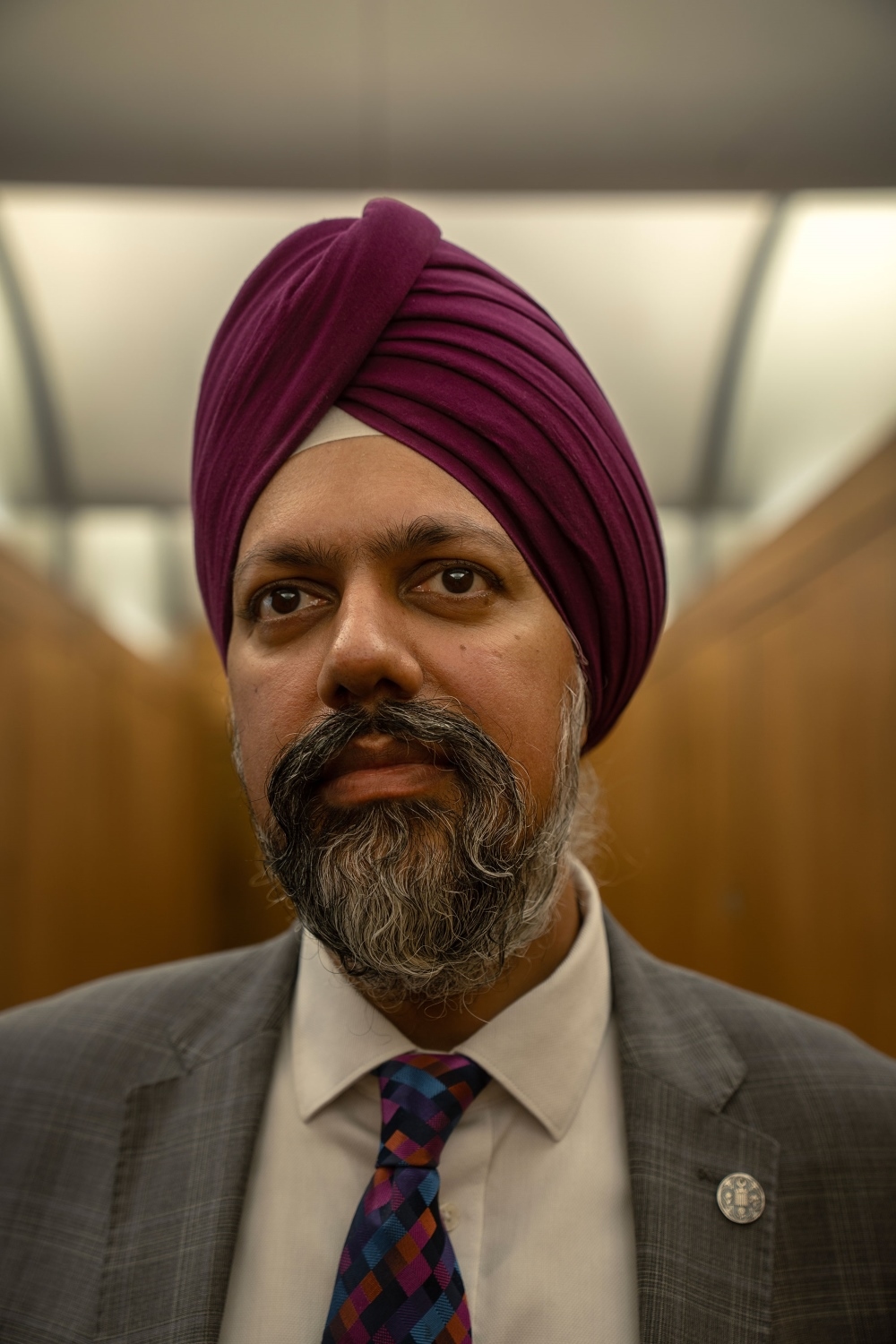 Tan Dhesi (Photography by Tom Pilston)
“But I had hoped that the government would have agreed to our recommendation. I know that in the fullness of time, if things are not quite delivered as they should have been, then I’m sure that The House magazine and others will be taking appropriate individuals to task as to why the Defence Committee’s recommendations were not taken on board.”
The committee is now looking into the disastrous Afghan data breach that took place in February 2022 but was only revealed over the summer, after an unprecedented superinjunction obtained by the UK government was lifted by the High Court.
The breach involved the details of 18,700 Afghans who had applied for resettlement to the UK and their family members, many of whom were then secretly brought over without the knowledge of the public or indeed most MPs.
“It’s one thing to have a superinjunction for a very short, sharp, limited amount of time, but it’s another thing for it to carry on for the best part of two years. That, I don’t think, is healthy for a democracy,” Dhesi tells The House.
Written evidence is now being considered by the committee. In one report submitted, which has been published, 49 affected Afghans said a family member or colleague had been killed as a direct result of the breach.
Next, Dhesi says, his group of MPs plan to discuss the leak with affected Afghan families and journalists banned from reporting on it until this year, as well as question ministers and ex-ministers on their role in it. They will be looking at whether the prime minister of the day – Boris Johnson – was involved, he reveals, as well as the defence and foreign secretaries and the attorney general, “now and before”.
Is he minded to believe the UK should offer compensation to those affected? Dhesi does not bite but confirms the committee will look at this question.
“The key thing for me is it’s absolutely shocking that it did occur, and then that, when it was revealed, people tried to keep it schtum, to keep it quiet, and that processes were instigated which meant that there was no scrutiny, there was no transparency. That is why many of the Afghan families feel that they have not been dealt with fairly, and that there hasn’t been justice in the system.”
The Ministry of Defence said a review had concluded that being named in the leak was “highly unlikely” to have made an individual a more probable target. Yet thousands – it is unclear how many – were resettled in the UK on the assumption that they were in more danger.
This has been labelled the “Wallacewave” by some online activists, after Ben Wallace who was defence secretary at the time. Should their immigration cases, as these critics suggest, therefore be reassessed? According to the BBC, the man who posted nine names from the list on Facebook, and was thus considered to have blackmailed the British state, is reportedly living in the UK and not believed to be facing any criminal charges.
“We can’t allow them to, as we would say, game the system. We can’t allow that to happen,” says Dhesi. “But those who did support our troops, who wanted a better Afghanistan; they wanted that free, vibrant democracy; they wanted rights for everybody, including women, including minorities… Let’s not forget what happened there.”
“It took backstabbing to a whole different level”
Along with keeping critical infrastructure secure while tackling cyber threats, Dhesi’s other key focus is – naturally – Ukraine. His committee recently sent a cross-party delegation of six there, not publicly discussed before now, which took some months to organise. The dangerous nature of the trip meant no committee clerks accompanied the MPs as they usually would.
After landing in Poland, they caught an overnight train into Kyiv, Dhesi reports. They spent the next two full days in meetings with senior parliamentarians, the National Security and Defense Council of Ukraine in the Rada, and defence industry figures.
“One of the most memorable parts of the visit was going into a bunker to see some of the equipment; some of the drones the Ukrainians are making,” he recalls. “I’m also very, very grateful to the director of the national procurement agency, who took us through how they have streamlined their procurement processes. There was a lot for us to learn.”
While critics would prefer to highlight Ukraine’s history of corruption in military procurement, Dhesi admires the way that the country has become agile in its “David and Goliath type situation” by giving “greater agency to brigades and to the troops on the front line” in terms of decision-making on equipment needed.
“Rather than something taking months, and sometimes longer, for an order of certain equipment to actually be delivered to them, their record is five days.”
For its own part, the UK has promised to eliminate procurement waste – a key line of attack against the Conservatives when John Healey was shadow defence secretary.
This sits within the broader context of its commitment to spending five per cent of GDP on national security by 2035. Dhesi will not say he is confident that this will be achieved, emphasising that the government has been “talking the right talk, but it’s about walking the walk as well”. Whether it is a shortage of welders or other skilled workers, “some of this will take not months but years for that pipeline to build”.
While spending pledges have been made for tomorrow’s defence, there is concern that today’s equipment is not being maintained. The government has “enacted various changes in systems” to improve our readiness, Dhesi says. But he adds: “We have had numerous briefings – some are classified – within the Ministry of Defence, in order to scrutinise some of those aspects. And we feel that more work needs to be done.”
The 10-year investment plan is yet to be published by the Labour government, to the disappointment of defence industry figures who are frustrated by its pace. Primes – the biggest firms – can withstand that, but defence SMEs (small and medium enterprises) are struggling in the meantime.
The UK government “must spend a much greater proportion” on SMEs, he agrees, comparing it to the Americans who “have a targeted spend with SMEs – and that is where we’ve been lacking, in order to really spark innovation”.
“The SMEs that we have spoken to, many of them have complained about how they have been treated. Some of them not receiving their payments on time, some of them facing severe hardships and difficulties,” he says, adding that the government must “cut red tape”.
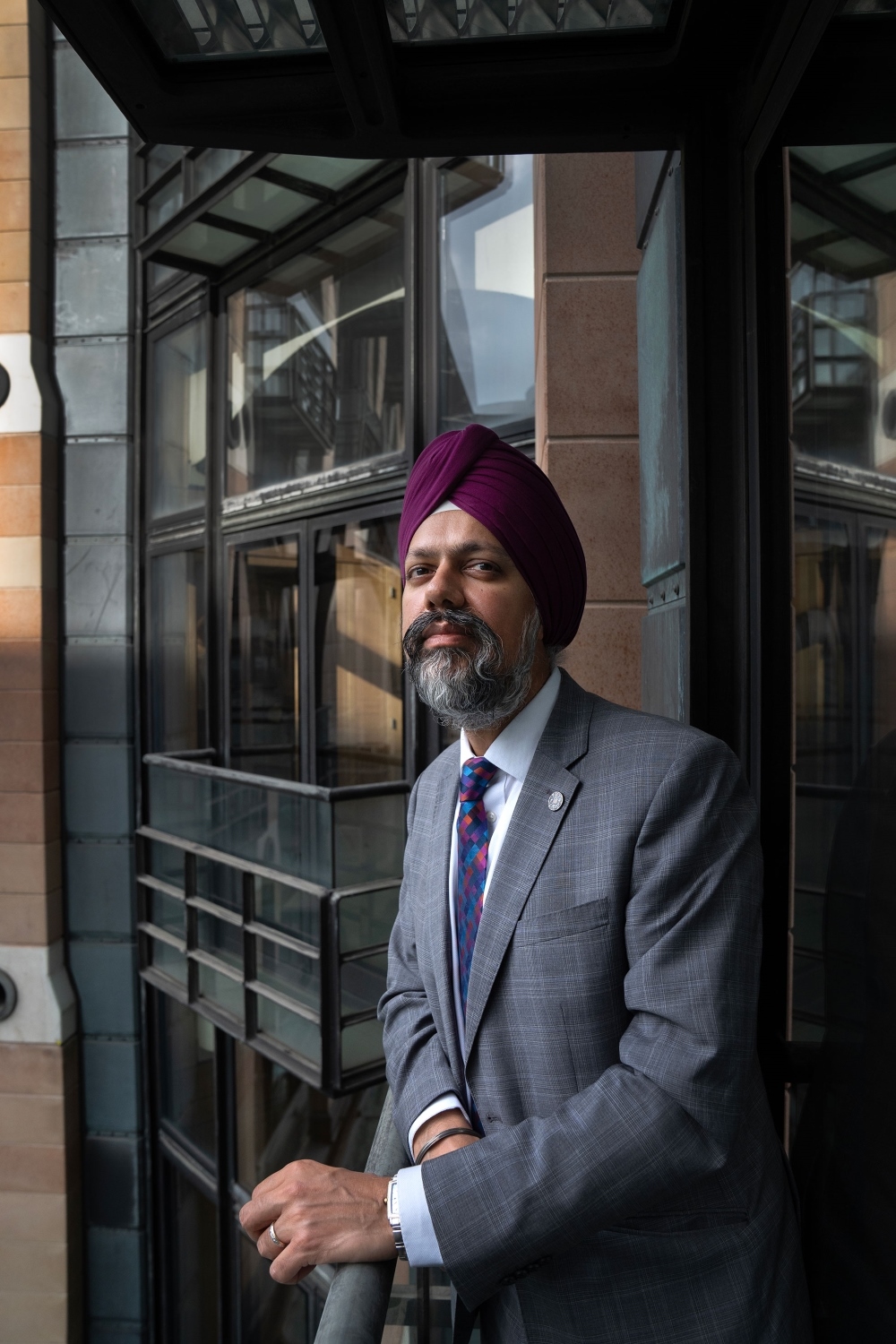 Tan Dhesi (Photography by Tom Pilston)
For Dhesi, this is personal. After university – mathematics at UCL and postgraduate degrees at both Oxford and Cambridge – and before entering Parliament, he worked in the construction industry for 20 years and ran his own business in Scotland.
“I know just how much hard work is involved to make an SME successful. What I needed then was a clear pathway from clients, a pipeline of work.”
Every journalist in Westminster will recognise his enterprising nature: Dhesi is proactive about sharing his parliamentary activities, regularly distributing clips of his interventions in the Chamber and chairmanship of the Defence Committee – a role he took up last year – via WhatsApp. The 47-year-old has done so ever since he was first elected as Labour MP for Slough in 2017, also becoming the UK Parliament’s first turban-wearing Sikh.
What was once a Labour stronghold became a marginal at last year’s general election, with Dhesi’s majority slashed from 17,000 on his first go to just 3,600. His main challenger was not the Conservatives, as in past contests, but Azhar Chohan of the Independent Network.
Asked about his opponent, Dhesi says Chohan had been working part-time as his immigration caseworker for some years and had helped at an advice surgery just days before announcing his candidacy. He clearly feels betrayed and does not mince his words: “It took backstabbing to a whole different level.”
The election was hard-fought and dominated by Gaza. “They knew that it’s a very emotive issue, and that people are seeing innocent people dying out there. Because of what was going on, they weaponised that one issue,” Dhesi says.
In one video from the campaign trail, posted on social media, Dhesi is seen leafletting outside a mosque while a self-identified supporter of Chohan urges congregants not to accept any materials from him. “We don’t care about housing, we don’t care about education, we only care about Palestine,” the campaigner is heard saying while recording.
“That was part of their whole modus operandi. It was to stop others – in particular, Labour candidates – from campaigning. In that election, I had it all, in terms of abuse, intimidation,” Dhesi says. He recalls that at one point children were sent to chuck water at him.
There is no suggestion that Chohan himself knew about or approved of any of these actions. Attempts were made by The House to contact Chohan but he could not be reached before publication.
“This is a real threat for our democracy. We need to wake up to this. This is an issue many of us have raised with the minister. I hope that someone will be taking action,” the Slough MP continues.
“We think about external threats, but we see, internally, individuals like that – some of their views are far from patriotic, far from wanting the best for Britain or wanting the best for the whole community. It was the most toxic thing that I’ve ever been involved in.”
