Douglas Lumsden: "I Don't Care About Shadow Cabinet Positions"
9 min read
Parliament’s newest Conservative MP, Douglas Lumsden, talks to Noah Vickers about winning an overlooked by-election and his fight for Scotland’s oil and gas industry
Douglas Lumsden’s victory over the SNP in June’s Aberdeen South by-election represented a rare glimmer of hope for a Conservative Party still struggling to win new ground two years on from a historic defeat.
The result marked the first Scottish Tory by-election win in more than half a century and, according to Lumsden, was a huge morale booster for his new colleagues in Westminster.
“Until I got down here, I didn’t realise how big an impact the by-election win would have on the party as a whole,” the 55-year-old MP tells The House in his sparsely decorated new office in Westminster Palace.
“I’d been stuck out campaigning full time for the last six weeks, banging on doors, talking to people. It was only when we won [and I] got down here that I realised how big a thing it was for the party… I think it gave everyone a boost down here.”
Both Lumsden’s campaign and a separate by-election in Arbroath and Broughty Ferry – won by the SNP – were overshadowed by a third contest on the same day in Makerfield.
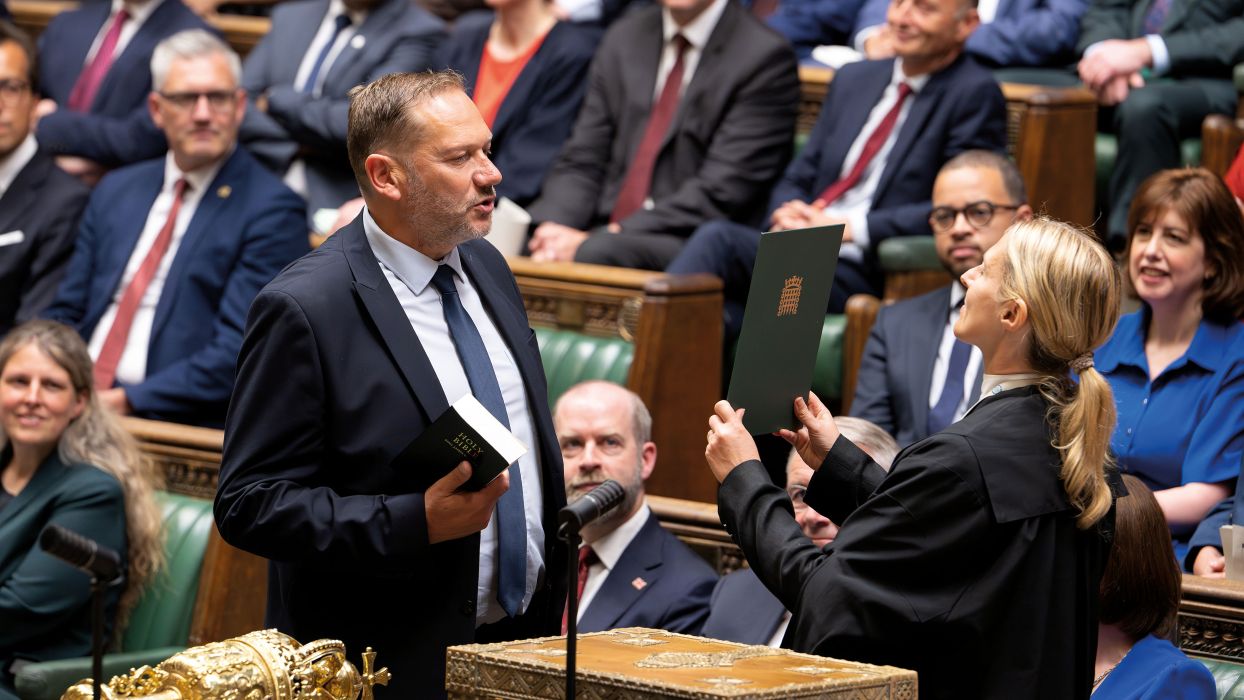
Waiting in Central Lobby to be sworn in with his fellow victors, Lumsden says he congratulated Andy Burnham, but didn’t at first get any congratulations back from him beyond a simple “thank you”. The soon-to-be Prime Minister may simply have assumed, at first, that Lumsden was just one among hundreds of MPs he’d never met before.
It was only as they began lining up to enter the Commons Chamber together, he says, that Burnham realised his faux pas, and swiftly gave an embarrassed apology.
For Lumsden, the fact that much of the media’s attention was on Makerfield throughout the by-election left him freer to focus on his campaign, with Aberdeen’s struggling oil and gas industry at its heart.
“That was the best thing – all eyes were on Makerfield,” says Lumsden, recalling the words of his party leader, Kemi Badenoch: “Kemi kept saying, ‘Makerfield’s about one person’s job. This by-election in Aberdeen is about thousands of people’s jobs’ – and that was completely right…
“We said we were going to make it referendum on the future of the oil and gas industry, and that resonated with so many people across Aberdeen.”
Lumsden, who before politics worked in IT for oil and gas firms, is a self-described “accidental politician”. Scotland’s 2014 independence referendum – and the SNP “not respecting” the result – was the trigger for him wanting to stand for office.
“I always say that I was inspired by two women to get involved in politics – one good, one bad. One of them was Nicola Sturgeon, who wouldn’t respect the result of the referendum, and the other was Ruth Davidson, who I’m friends with now.
“You could see what she was doing – it was a total rebirth of the Scottish Conservatives under Ruth, and I liked her style, her brand of conservatism.”
Elected to Aberdeen city council in 2017, Lumsden quickly became the authority’s co-leader in a unionist coalition with Labour: “What I thought would just be a dabble into politics was then a full-time role.”
Just four years later, he was representing his region as an MSP in Holyrood, where he briefly made headlines last year after submitting almost 1,000 written questions in January alone – more than half of the total asked by all 129 MSPs that month.
Questions included how many sauce and salt and pepper sachets had been procured for Holyrood’s canteen, the average loss or profit per jar of honey sold in the Scottish parliament’s gift shop, and a query about the height of Holyrood’s flagpoles.
Lumsden was accused of using AI to write the questions – which he denied – and of wasting £100,000 of taxpayers’ money in the process, as the average cost of answering a written question was in 2008 estimated at almost £100.
“We were just trying to shine a light on how much money the Scottish parliament is costing, for one – some of the hypocrisy that the Scottish parliament is saying, especially around net-zero and wastage,” says Lumsden.
“It was also trying to really put some of the government ministers under a bit more pressure and real scrutiny, because there was such a frustration that when you would ask written questions to ministers, they would come back not answering the question.”
For that reason, he explains that many of the questions submitted were essentially duplicated queries with the wording slightly changed, in an attempt to prevent ministers from dodging the information being sought.
Was that the point, then, of asking about salt and pepper sachets – to demonstrate wastefulness?
“Yeah, if they really cared about the environment, why don’t they just get salt and pepper pots? It was all those sorts of things.”
And there was really no AI used?
“Yeah, absolutely. How would AI come up with a question like that?”
The MP says he will not shy away from using written questions in Westminster for a similar purpose, but his key focus will be on energy policy, having already asked about what costs might be incurred if permission is not granted for oil and gas drilling at Rosebank.
While the government wrestles with whether to approve Rosebank and Jackdaw, Lumsden believes the answer is perfectly simple.
“We’re going to need oil and gas for the next 20 to 30 years, so we either use our own domestic production that protects jobs, is better for our energy security, [and] more importantly puts a lot of money into the exchequer – we can either do that, or we can import it from places like Qatar or the US.”
Yet Lumsden goes further. Approving Rosebank and Jackdaw, as far as he is concerned, would not go anywhere near far enough to save jobs in his constituency.
He points to a new report by industry body Offshore Energies UK, which identifies 111 further oil and gas projects capable of being “unlocked” with “a more competitive and predictable investment environment, including reform of the fiscal regime” from 2027.
“Ninety per cent of the oil and gas reserves have been taken out – but why leave that 10 per cent behind?”
“I would like to see that, because when you think of Rosebank and Jackdaw – especially Jackdaw – most of the work by the engineering companies has been done. It’s almost ready to be switched on, at this point,” the MP says.
“The investment’s been made, the platform’s been made, all the pipelines are in place. We need a pipeline of projects – pardon the pun – coming forward, to protect most of the supply chain jobs that are so important within Aberdeen and the North East.”
In his maiden speech, Lumsden told Parliament he had been sent to Westminster on a mission to “save” the North Sea oil and gas industry. But given that more than 90 per cent of the UK’s North Sea’s reserves have already been extracted, is it even an industry which can be saved? What would “saving” it look like?
“It’s really giving it some breathing space, to enable it to transition to other things,” says Lumsden. “OK, 90 per cent of the oil and gas reserves have been taken out – but why leave that 10 per cent behind?
“Nobody would go to the bar, for example, [and say] ‘I’ve bought a pint of beer, I’m two-thirds of the way through it. I’ll tell you what – I won’t take any more, I’ll buy another one from over there instead.’ You would surely use the resource you’ve got while you can…
“Geology should set the pace for the decline of the North Sea oil and gas basin. Once it’s gone, it’s gone. That’s fine.”
Since 2022, oil and gas companies have been required to pay the Energy Profits Levy, a windfall tax originally meant to end in 2025. Following repeated extensions, it is now due to be replaced in 2030 by a different mechanism called the Oil and Gas Revenue Levy (OGRL) – which would only be triggered when prices spike.
Industry leaders have urged ministers to bring the OGRL’s implementation forward to 2027, but Lumsden argues that all oil and gas profit levies should be abolished altogether.
“I know the industry say they can accept it [the OGRL], but why are energy companies being taxed in a different way from pharmaceutical companies, for example? There’s not an excessive profits levy on those companies,” he says.
“I think they should be treated like any other company. Yes, they’ll pay their corporation tax; yes, they’ll generate jobs that will pay income tax – all of that feeding into the exchequer. Why would we have a different set of taxes for an energy company? That is my personal view.”
The MP still wants to see a transition to renewables – and believes this can be a key point of difference for voters choosing between his party and Reform UK.
“We don’t go across all the time saying ‘net -stupid-zero’, because I think it would be a good thing if we did get to net-zero. It’s just how we get there. We’ll have to make sure we don’t trash the economy and make lives difficult for everyone on the journey there,” he says.
“If you carry out Reform’s policies to the letter – yes, they would, like us, probably maximise North Sea oil and gas production, but that is going to end at some point. And then what?
“They would have nothing at all. We’re saying yes, we should transition into renewables, but it may take longer than people first thought…
“Oil and gas jobs have been stopped, and there’s not the renewable jobs for people to go to, so what we want is more of a managed transition.”
Lumsden is not naïve to the fact that by-election results do not always mean very much once the next general election comes round. Single-issue campaigns are much harder to fight amid the noise of national politics.
For this reason, he shies away when asked about his future ambitions in Westminster, preferring instead to focus on his constituency.
“My ambition, really, is to try and do as much as I can for Aberdeen and the North East. I don’t care about shadow cabinet positions, cabinet positions, any of that. I just want to serve the North East,” he says.
“I don’t want to be elected down here and then lose the seat at the next general election. My focus is: I got almost 50 per cent of the vote last time, I want to make sure that we cement that and make sure we get re-elected.”
