Heatwaves Are Now Routine – So, How Are We Going To Adapt?
6 min read
A summer of relentless heatwaves, spiking mortality and wildfires brought home the reality of climate change to many Brits. Just how hot must it get before we actually start to do something? Ros Taylor reports
First, the good news: the summer of 2026 is “at the upper end, but not quite at the worst end” of climate projections that have circulated for decades.
And now for the less good news: “next year will probably be as bad”.
Experts like Richard Dawson, the professor of earth systems engineering at Newcastle University, and Sam Fankhauser, a professor of climate change economics at the University of Oxford, were less surprised than most as we sweltered.
For Fankhauser, the dawning realisation that climate change is no longer something to be feared in the future but to be faced in the present is welcome.
“In a sense – this will sound very cynical – it was a good warning shot... Never waste a good crisis.”
Now the climate has our attention, the question is: what we are going to do about it?
At one extreme of climate adaptation is the scenario portrayed in the Danish drama Families Like Ours, where forecasts of rising sea levels and flooding force the government to abandon most of the country and resettle Danes elsewhere. At the other is a Cobra meeting and an emergency message warning people not to start unnecessary fires. The government is going to have to think more urgently about the policies in between.
The key document ministers rely on to draw up policy is the 554-page report of the Climate Change Committee (CCC) ‘Independent Assessment of UK Climate Risk’, which was snappily renamed A Well-Adapted UK last year. The title is aspirational, not a description. The chair of the CCC’s Adaptation Committee, Baroness Brown of Cambridge, says none of the government’s adaptation plans have been fit for purpose. The next plan is due in 2028.
Adapting to much hotter weather demands a cognitive shift. The principle that people should be able to heat their homes, especially if they are elderly, is deeply embedded in public policy.
The Warm Homes Plan, the winter fuel payment and energy subsidies when fuel bills rise, all testify to our fear of the cold. Change has to start with the recognition that heatwaves, especially in England, are now routine events and not 1976-like outliers. (Even if the Atlantic ocean currents that keep the UK relatively warm do collapse, the CCC thinks that is unlikely until late in the century.) Unlike heating, cooling is not yet regarded as a need, still less a right.
The Green Party’s campaign to legislate for maximum temperatures in the workplace, which is one of the CCC’s recommendations, suggest this is starting to change. But while businesses will have to pay towards adaptation, the challenges that go beyond the immediate health harms of extreme heat – like avoiding water shortages, preventing mosquito-borne disease and persuading farmers to switch crops – rely on a combination of government investment and behavioural change.
“We can’t think about climate adaptation as a nice-to-have – it’s a must-have,” says Dawson.
“We can’t have our water supplies threatened in the way they currently are. About half the country’s population is under a drought order.
“One of the things we’ve been very good at in this country is writing a lot of plans. You don’t have to look too hard to find a lot of documents saying all the right things… Where we’ve been less diligent is in acting on those.
“These plans do not have very clearly defined targets of where we’re trying to get to and tracking progress towards that. What is the volume of water we want to have? What is the level of flood risk we’re prepared to have as a country? And what does a step-by-step action to achieve that look like?”
The experts who study adaptation say it is vital to start work on new reservoirs now, because they take so long to build. Nine new sites have been identified, but the challenge is to speed up the planning process. “It’s one-third new reservoirs, one-third fixing leaks and one-third behaviour change,” says Fankhauser.
Change has to start with the recognition that heatwaves, especially in England, are now routine events and not 1976-like outliers
“Reservoirs are wildly expensive. They will probably be paid for by water consumers. The leaks will end up on our water bills, although they will eventually show up as savings. The behaviour change, more efficient showerheads and that sort of stuff – that’s going to be cheap.”
And anything cheap will appeal to a government with little financial room for manoeuvre. In July, the Government Office for Science put out a little-noticed report on “putting people at the centre” of climate adaptation. Trying to learn from the Covid pandemic, it noted that people were sometimes reluctant to take advantage of government help and advice for emotional and social reasons.
In Appleby-in-Westmorland in Cumbria, which floods frequently, people usually turned to sandbags – which are not particularly effective – and did not accept the offer of flood barriers or water-resilient furniture. Interviews and focus groups revealed that they were worried about acting alone and feeling foolish if measures turned out to be unnecessary.
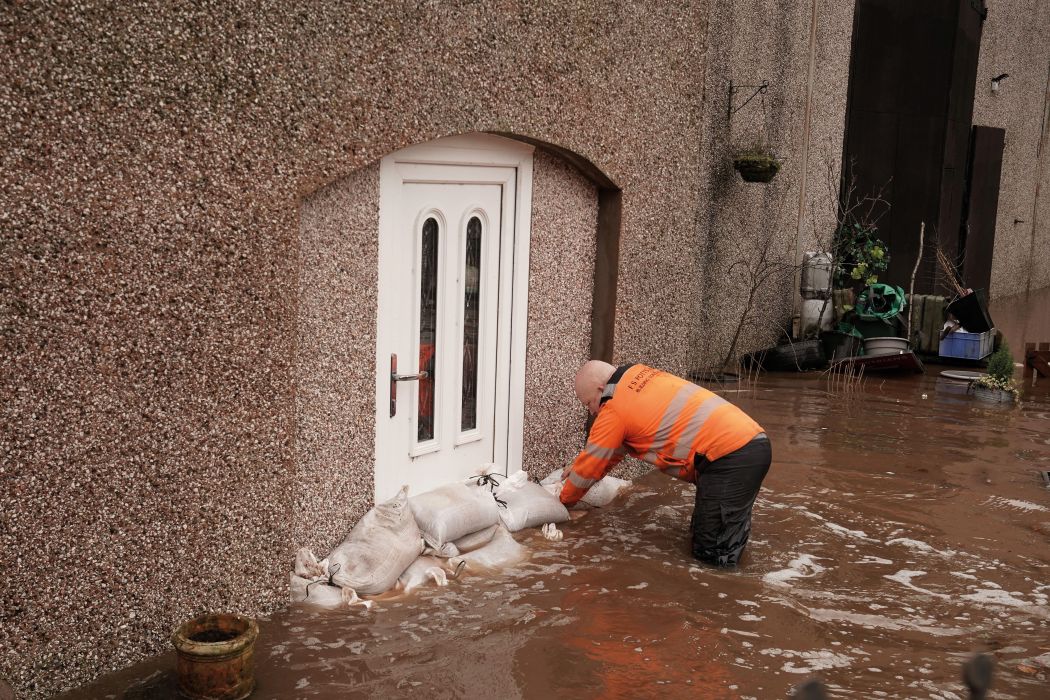 Flooded streets in Appleby (PA Images/Alamy)
Another early win, says Fankhauser, is to make sure new infrastructure and housing projects can handle high temperatures and are not built on flood plains. “It’s cheaper to do the adaptation now rather than the retrofit in 10 years’ time.” This was the thinking behind Eurostar’s order for new trains that can cope with temperatures of up to 55C. It will also be important to learn from how wildfire-prone regions like Canada and the Mediterranean handle fire risk. More challenging will be urban fires like Stourbridge, which the CCC did not anticipate.
Planners will also hope that things like air conditioning – which experts accept will be necessary – do not become divisive. Mark Maslin, the professor of earth system science at University College London, says that the extra demand for electricity must be met by a massive rollout of solar panels. Decisions about which areas should get more protection against floods will be difficult. Later in the century, when sea levels are predicted to rise further, some coastal areas may have to be abandoned to the water.
As for the emergency alarm sent to mobiles in the UK last month, which shocked many Britons, Dawson says it was “absolutely right to get that message out”, though he was surprised it went to everywhere in the country. “That learning can be hugely powerful,” says Fankhauser. “Drink water, stay in the shade, don’t light fires. Those are all things we can ingrain in culture, and we should.”
