Katie Lam: The Whole Concept Of Asylum Is Outdated
Katie Lam (Photography by Dinendra Haria)
11 min read
Tory whip and shadow minister Katie Lam talks to Sienna Rodgers about the poisoned chalice of being a ‘rising star’, why she believes the concept of asylum is outdated and how she would go about accepting refugees to Britain
“Oh god, oh no, not rising star!” laughs Katie Lam, rolling her eyes at the label, a compliment that can also be a curse. But when prospects appear as grim as they currently do for the Conservatives, those staying the course need hope – and they have found it in the 34-year-old Weald of Kent MP first elected to Parliament last year.
The standout moment for her admirers was the speech Lam, a shadow Home Office minister as well as a whip, delivered at the despatch box on rape gangs. Only a few sentences in, she was quoting perpetrators on their hatred of “white girls”, complete with expletives, and later the remarks of a judge who spelled out the sickening details of exactly what had happened to a gang-raped 13-year-old girl. “This is extremely graphic,” she warned colleagues, “but we must not look away or sanitise this evil.”
Safeguarding minister Jess Phillips said in response it was “a shame that she referred to only one sort of child abuse victim”, while Munira Wilson of the Liberal Democrats made the accusation explicit: “I share her disappointment that the Conservatives have sought to pick out one particular community. Day after day in this Chamber, they vilify Muslims.”
“It was a very intense day. In the moment – as in, when I was writing it – I didn’t really have time to think about the reaction because the turnaround time was so short,” Lam recalls. “Making sure that it was true was the thing I was really worried about. Which it was.”
Lam takes a similarly unflinching approach to immigration. The very idea of asylum, she suggests to The House, is outdated.
“If you take something like asylum, the whole concept of asylum – it’s a 20th-and-before-century idea for a 21st-century world,” she says.
“At least historically, you think about things like ballerinas defecting from the Soviet Union when they go on tours to the US or whatever. As soon as they get to a safe country, they can claim asylum…
“Whereas, if your only gating item for whether somebody is allowed to claim asylum is, ‘Can they get to your country?’, in the world that we live in now, everybody on the face of the earth can get to our country within 24 to 72 hours.”
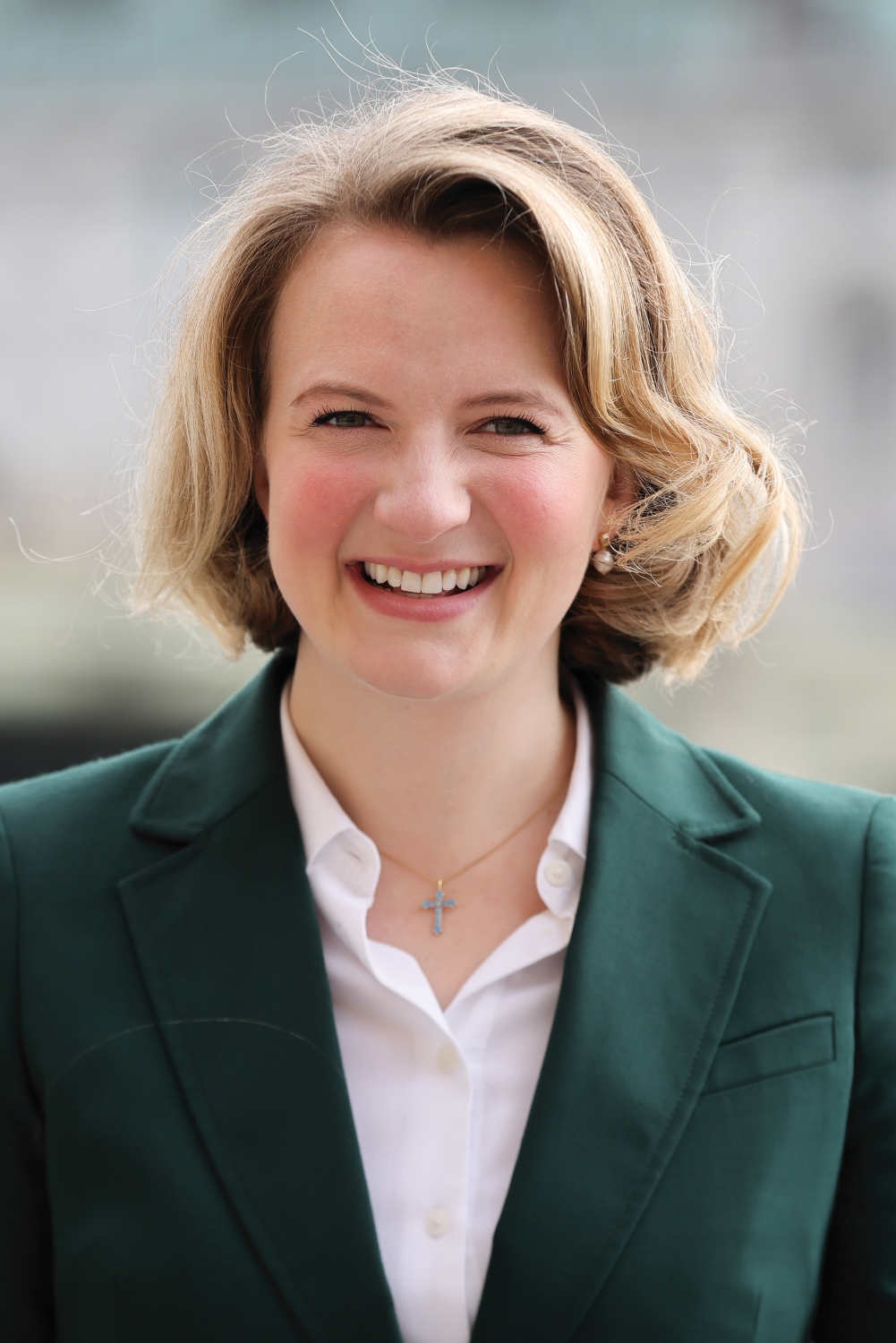 Katie Lam (Photography by Dinendra Haria)
Lam is speaking on Parliament’s terrace, coat pulled over her head – and perfectly coiffed bouncy bob – to protect her. She has a friendly manner and exudes warmth; as each question comes, though, she adopts a perfectly neutral expression while waiting for its conclusion.
Her childhood in Guildford was “really stable”. Her mother, a primary school teacher, and father, a small business owner, made a model family, and Lam always got along well with her parents – still together – and younger sister.
“It was just a very happy childhood, really. I never had much drama with my parents, because I always liked going to school and I was always happy to practise the piano or whatever it was they wanted me to do.” She was, naturally, a head girl.
No teenage rebellion, then? “No, not really,” she says. “It was really, really nice. I didn’t appreciate it at the time, but as I’ve grown older and known more people who didn’t grow up in a context like that, I appreciate it more and more.”
Her parents were not party political but interested in current affairs and crucially, she remembers, “always took me very seriously”: “They were never like, ‘Oh, well, you can’t have an idea about this because you’re eight’.”
Was she coming to them with her thoughts on Edmund Burke or Thomas Hobbes? “No, I’m not at all a particularly academic conservative, really. I don’t know a huge amount about theoretical politics. I’m much more led by what I instinctively feel is true and right.”
She was clearly independent-minded at a young age; although her mother is Catholic and father not religious, she attended a local comprehensive Church of England school and started going to the church there before being baptised aged seven and confirmed as a teenager.
“For most of my childhood, I was actually really religious. Then I kind of grew out of it, then I grew into it again,” she says, as a discreet crucifix attests.
Her upbringing was “middle in every sense”, though her wider family was more unusual: her paternal grandparents, who met delivering leaflets for the Labour Party, were “open border socialists” and “massive Europhiles”, she says. With much of her grandfather’s Dutch Jewish family killed in the Holocaust and her grandmother’s left-wing one forced to escape political persecution, both “had a very traumatic 20th century”.
“My grandmother’s life came good in the end but was essentially ruined – her childhood was ruined. By the Second World War, her uncle was killed; all of my grandfather’s family, apart from one cousin and his parents, were murdered in Sobibor and Auschwitz. It’s almost impossible to imagine that context and what that would do to you,” Lam says.
“It’s not inevitable, but it’s natural that you might have a certain view of immigration and the border and how important it is to let people come here. And I have a lot of sympathy for that.”
One might assume that these family stories, such as her grandmother being a refugee who spoke no English when she arrived, would make her more inclined to welcome, say, small boat arrivals. Why is that not the case?
“There’s a difference between sympathy and thinking the right thing to do is to let everybody come into this country,” the MP replies.
“If the trade-offs were easy, the Conservatives would never have got the country into this position in the first place”
She stresses that her grandmother arrived legally, lived with an English family, learned the language, and apart from with her parents “never spoke German again”. Having decided to stay in the country after her family returned home, Lam says, “she wasn’t a member of the German diaspora. She was just British.”
“I think that you can, and I do, feel desperately sorry for, well, realistically, the billions of people around the world whose lives are materially worse than ours. But they also just can’t live here.”
It is not just a question of numbers. While Lam argues that the immigration figures are a key problem, she confronts the cultural side head-on too.
Asked what she would say to pro-migration activists who accuse her party – and others – of treating Ukrainians differently to Gazans, for example, she replies: “I think they are, and I think they should be.” Some of that is proximity, she explains, and also the time-limited nature of the Ukrainian arrivals, who are expected to go home and help rebuild their country after the war. But there is more to it.
“There’s nothing magic about the soil here. It’s not like as soon as you land in the UK, you immediately become British and you act like a Brit. You have to be introduced to that culture.”
So, Lam says asylum is a 20th-century concept. What, then, does she believe the system should look like? Which legal routes would she open and what would be reasonable numbers for Britain to accept?
“The best way to work that out is to go from the bottom up, rather than the top down,” she says. “You ask first, how many people can you take? You start with a pragmatic question, and then that’s also, to a degree, a cultural question…
“You start by finding out those numbers, which is probably a mixture of local NHS trusts, local authorities, the social housing lists, things like healthcare appointments. Then you would tot that number up across the country, and that would be the number that you can hold.”
Specifically, she suggests we could take all of our refugees from the UN’s refugee resettlement programme, which sees the United Nations High Commissioner for Refugees identify and refer vulnerable people from a host country to a willing third country.
“The UN already decides, essentially, who the people are who are in most need around the world. You would say to them in any given year, ‘Our capacity is X, this is how many people we could take’,” she says.
Lam was a spad in No 10 to Boris Johnson, now infamously of the “Boriswave” that saw legal migration shoot up post-Brexit, and worked for Suella Braverman as home secretary. Was she frustrated at the time by the government’s approach to immigration?
“Yes,” the MP replies. “I never worked on immigration policy, so not directly. But particularly in the Home Office, much less so in No 10… I worked very closely with people who did work on immigration policy. The Home Office doesn’t function very well, and it was very frustrating.”
It is widely expected that the Conservatives will announce at conference a plan to leave the European Convention on Human Rights (ECHR). (“We aren’t in a position to reform it unilaterally,” Lam notes.) But is it not the Refugee Convention that would need addressing too?
“With all of these things – Brexit has also been like this – none of them is, in and of itself, a solution. The question is, are they in the way of a solution?”
She continues: “Much more important than any particular treaty or body or international group is, what do we think the principles of this system should be like? Who should be able to come to Britain? Who decides that? How can they get here? Can they stay? What is and isn’t incumbent on us, or what do we owe those people if we let them come here? What should we effectively pay for and provide? And also, if we feel they break that arrangement, what happens next?
“If you come here from Afghanistan and you rape a small child, do we say, ‘We’re sending you back to Afghanistan, something terrible may well happen to you when you go there, and that’s awful, we don’t agree with that, but we also can’t have people here who rape children’?”
Does she believe that would be awful, if something terrible happened to them? “Well, we don’t support torture in any context, but… you have to make a choice,” she replies.
“You’ve got to make some really hard, personally challenging and in some ways upsetting choices, because the trade-offs are difficult, right? If the trade-offs were easy, the Conservatives would never have got the country into this position in the first place.”
 Katie Lam (Photography by Dinendra Haria)
Lam, a backer of Robert Jenrick’s leadership bid last year, defends leader Kemi Badenoch who has an “insanely difficult job”. “The 2024 general election was a clear articulation people were very angry with the Conservative Party. I sympathise,” the whip says.
So, what is her dream role? Does she hope to be leader one day? “Honestly, I know it sounds really naff, but I just want to fix the country. I don’t really care what form that takes. I think as long as you have a clear vision and support from the top, you can do something like Michael Gove did in education,” she says.
Her own school was “always Ofsted good” but became “outstanding” and “much more ambitious” under Gove’s reforms, she enthuses. It now displays a board of every pupil who went to Oxbridge – which she, who read classics at Trinity College, Cambridge, is on.
Potential leadership bid aside, we can watch out for Lam’s next musical. For she is also a lyricist and scriptwriter, and the last one she co-wrote should enter production in the coming years.
She can sing too: her go-to when driving and feeling a little tired is the whole of the Sound of Music. Will we see her at conference karaoke? “I don’t tend to do karaoke because…” she hesitates. Because it would be showing off?
“Because I enjoy it too much. Karaoke is my great vice, so I try not to indulge. Once I start, I don’t really want to give the microphone back.”
