Keir Starmer Says Centre-Left Politics Is Not "Dying Out"
Prime Minister Keir Starmer addressed the Global Progress Action summit on Friday morning (Alamy)
3 min read
Prime Minister Keir Starmer has said he does not accept that centre-left politics is “dying out”, but admitted that social democrats like his Labour Party must now “directly” confront major challenges like migration.
On Friday, Starmer addressed the Global Progress Summit in London, held each year to host centre-left world leaders to discuss the major issues faced by their respective countries and how they can cooperate to tackle them.
The Prime Minister listed examples of centre-left parties that have won elections around the world in recent months, including Mark Carney in Canada, Anthony Albanese in Australia, and Jonas Gahr Støre in Norway.
“So I’m sorry, I don’t accept that argument that somehow our politics is dying out,” Starmer said.
“But I do accept that it is now time for social democrats to confront directly some of the challenges and some of the lies, frankly, that have taken root in our societies.”
He described the summit as a gathering of people bound by the common cause of the “patriotic renewal of our nations”, which he said was “underpinned by the values of dignity and respect, equality and fairness”, as well as the belief that “social democratic means are the best way to pursue that goal”.
Starmer used his speech to highlight the rising threat of populism, following the ‘Unite the Kingdom’ rally a couple of weeks ago, organised by far-right campaigner Tommy Robinson. Starmer described the far-right’s language as “naked in its attempt to intimidate”.
He argued that the far-right was trying to claim the left-wing “common cause with working people” and “deep roots in the trade union movement and our communities”, despite having “nothing in common with them or their values”.
“It’s part of a strategy,” he said.
“They want politics to be a choice between ‘globalists’ and ‘nationalists’. To draw a dividing line between the ‘elites’ and the ‘people’.”
He warned that centre-left governments would need to respond by "not turning inwards" and cooperating with each other.
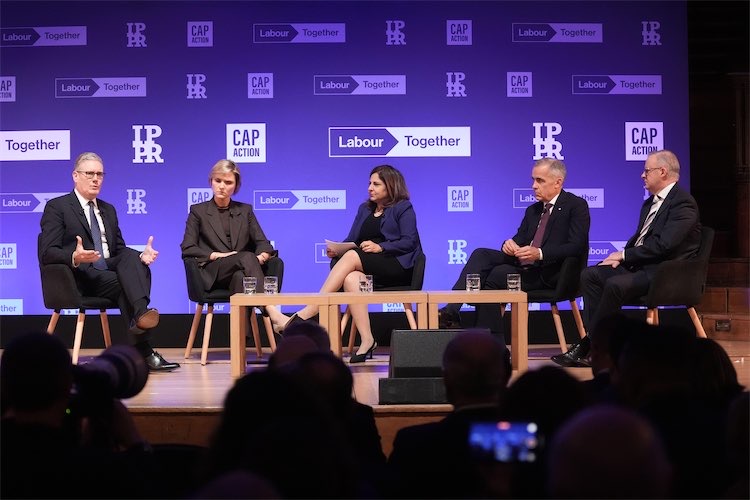 Keir Starmer also joined a panel with Canadian Prime Minister Mark Carney, Australian Prime Minister Antony Albanese and Icelandic Prime Minister Kristrún Frostadóttir (Alamy)
He also confirmed that the government will bring in digital ID cards by the end of this Parliament, saying it would make it easier for people to use vital services, as well as help tackle illegal immigration.
While digital ID will be mandatory for Right to Work checks by the next general election, there will be no requirement for individuals to carry their ID or be asked to produce it.
In his speech, Starmer said: "It’s been too easy for people to come here, slip into the shadow economy and remain here illegally.
“Because, frankly, we have been squeamish about saying things that are clearly true."
He added that the British public wanted the government to combat the issue of migration, but that “we won’t solve our problems if we don’t also take on the root causes”, including tackling poverty, conflict and climate change.
The Prime Minister is expected to focus much of his speech at Labour Party conference in Liverpool next week on these issues, as well as the rise of Nigel Farage's Reform UK.
In a panel discussion following Starmer's speech, Canadian leader Carney said his party wanted to emphasise building at a time when the country faces a housing shortage. Albanese of Australia said that alongside the UK, his government wanted to pursue “progressive patriotism” as well by creating new industries and jobs.
