Narco Subs: The Hidden Threat The UK "Should Not Underestimate"
10 min read
South American cartels are powering cocaine-filled ‘narco subs’ further than ever before. Sophie Church and Sally Dawson find the UK unprepared for what’s to come
In September last year, sailors from the Royal Navy’s HMS Trent pulled alongside a blue, semi-submersed vessel in choppy waters south of the Dominican Republic. They jumped aboard and opened the hatch. Inside were two tonnes of cocaine.
South American drug cartels have been using ‘narco subs’ to traffic drugs since the 1970s. Back then, the vessels were relatively crude. Built in shipyards deep in the Colombian jungle, these narco ‘torpedoes’, resembling German U-boats, would attach to freighters via hooks on their noses and be towed into ports. Supply routes were simple, tracking up from the Colombian coast and into the US.
But cartels have innovated. Today’s narco subs sail along the surface of the water. Made from fibreglass and wood, and with sheets of lead between the deck and upper surfaces, these vessels can go undetected by radar, sonar and infrared.
How many more have got through which you’re not aware of?
Typically showing only 50cm over the surface of the sea, the narco subs appear invisible to the naked eye, says lieutenant colonel Oscar Esteban, head of the Anti-Drug Trafficking Department of the Unidad Central Operativa of Spain’s Guardia Civil: “Sometimes we are close to the narco submarine and we are not able to see it. We know that it’s there, the narco sub position is there. But you can’t see it.”
By exploiting emerging technologies, South American cartels are sending narco subs further than ever before.
Speaking exclusively to The House, a spokesperson from the Colombian Navy’s Naval Operations Command says the increasing demand for cocaine in the UK – which has the highest number of cocaine users in Europe – “makes it an attractive market for criminal organisations”. They warn that our vulnerability to this threat, therefore, “should not be underestimated”.
South American cartels have long targeted the UK via the use of ‘at sea drop offs’ where larger ships carry packages of drugs over the Atlantic, and drop them into the sea near the British coast for smaller boats to pick up and ferry ashore.
The Home Office’s ‘Project Kraken’ – a joint initiative between the Border Force Maritime Command (BFMC), the National Crime Agency (NCA) and local police forces – was set up to fight these practices at sea. Founded in 2008, it encourages coastal communities and maritime workers in the UK to contact Border Watch if they see suspicious packages floating in the water, or boats meeting at sea.
Kraken has struggled to make an impact, however. In a 2021 report by the independent chief inspector of Borders and Immigration, a stakeholder described the project as, aptly, “dead in the water”, having not heard from it in “several years, if at all”.
Co-ordination on the ground has also been patchy. An internal report of the Border Force’s Operational Assurance Directorate found in 2022 that while some marina managers had contact numbers for Kraken’s field intelligence officers, phone numbers provided at three marinas contacted were found to be out of date.
In July last year, a plot to retrieve six bales of cocaine dropped from a container vessel off the coast of Cornwall was foiled by the BFMC, after a high-speed pursuit of the smuggler’s vessel ended in a sprint past sunbathers on Gwynver Beach.
Seven men – six English and one Colombian – were subsequently found guilty and jailed for more than 130 years in total. The case, involving 230kg of cocaine with an estimated street value of £18.4m, attracted national headlines.
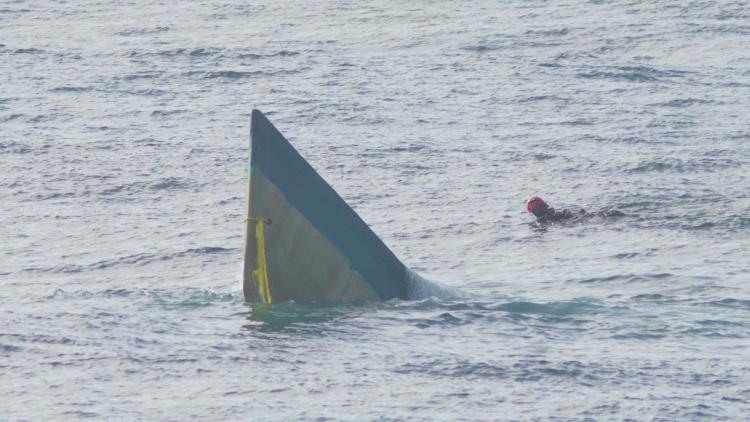 January 2025, Costa da Morte, Galicia: A narco sub breaks in two during a recovery attempt, destroying any evidence on board (credit: Alamy)
Local Lib Dem MP Andrew George tells The House that no effort has been made to use local people to help foil future plots, however.
“I would have thought that when you get a news story which is relevant, that’s when the Border Force needs to jump in on the back of it and make sure – particularly in those areas like mine – that the local media really do push it.”
And yet, he says, “They haven’t been in touch with me. There’s been no concerted effort. I would have thought that would be an obvious thing to do.”
With one of the longest stretches of coastline among English constituencies, George is aware of St Ives’ vulnerability to drug trafficking. In the same year as Project Kraken was established, the MP voiced concern over the government’s decision to substantially withdraw customs officer presence from West Cornwall and the Isles of Scilly. That February alone, five separate packages of cocaine were washed up on Cornish beaches in a three-week period.
Does the MP think that public awareness of Project Kraken has improved since its 2022 relaunch? “I’m confident that the public awareness is extremely low,” he says. “The project hasn’t made much effort to communicate with me – I would have thought that my constituency would be one of the targets for a project like that.”
George is concerned that case is just the tip of the iceberg: “It was a very good catch. Full marks to the service for what they did. But obviously in the backs of everyone’s minds is, ‘Well, okay, so you got that one. How many more have got through which you’re not aware of?’”
Small boat crossings may also be proving a distraction. According to a Written Question answered by a Home Office minister in May 2024, of the more than two dozen ageing Border Force vessels tasked with patrolling the UK’s 11,000 miles of coastline, since April 2022, five have been on a dedicated rotation in the Channel to support small boat rescue operations.
When asked for updated figures for 2025, the Home Office failed to respond.
While UK agencies may not be tackling the existent drugs trade effectively, Esteban warns narco subs are now delivering drugs in ever greater quantities.
“In the future they may be able to make a narco submarine capable of reaching the coast of the UK with five tonnes of cocaine,” the head of the anti-drug trafficking unit at the Guardia Civil says. “Nowadays, I don’t think that they are thinking about that. But any prevention is good because we don’t know how this will evolve in Europe.”
In 2019, Spain intercepted a ‘single use’ vessel carrying three tonnes of cocaine in Galicia. Designed to sink upon reaching its destination and capable of carrying up to three people, this was the first known incident of a narco sub crossing the Atlantic.
In the future they may be able to make a narco sub capable of reaching the UK with five tonnes of cocaine
Esteban says his team are now receiving “almost two alerts each month” to the presence of narco subs in Spanish waters. Just a few weeks ago, three soaking wet men were arrested on the coast of Galicia. They claimed to be pilgrims walking the Camino de Santiago, but with wetsuits in their bags, were suspected by police to be narco sub pilots from a gang arrested earlier that day in a boat loaded with three tonnes of cocaine.
One sub intercepted off the Gulf of Cádiz with the help of the Portuguese navy in March, and carrying six tonnes of cocaine, was of a more sophisticated design. Five people were discovered on board and, unlike prior iterations, this sub was capable of making a return journey.
“They benefit more if they build this kind of vessel; it’s more comfortable, they have better systems of navigation… We have evidence that they are used to go from South America – Venezuela, Suriname – to the Gulf of Cádiz and come back,” Esteban says.
Cartels have also designed subs capable of being operated remotely, representing a new challenge. In July, the Colombian navy seized an autonomous semi-submersible in its waters for the first time, The Guardian reported. The vessel came complete with a Starlink modem and antennas. It had two surveillance cameras attached: one on the bow and one inside, and was unmanned.
With no crew aboard the subs, ownership of the vessels is difficult to trace. The risk of a cartel member co-operating with whatever authority captures the vessel is also eliminated.
However these improvements in navigation systems – to avoid collisions or arrange a rendezvous – are also one of the few ways through which narco subs can be detected via the signals that are emitted; that and the emissions generated by their diesel engines.
Officials believe this sub, discovered off Colombia’s Caribbean coast, was on a test run to bring cocaine from the United States to Europe. If narco subs have already made it across the Atlantic, crossing to Cornwall, Brittany or Ireland wouldn’t be difficult, says Sam Byers, a senior fellow at American research institute The Center for Maritime Strategy.
“You’ve made the leap of being able to do it in a trans-oceanic fashion. If they think the market is there, they think they can get away with it. They’ve already cleared that technical hurdle,” he says.
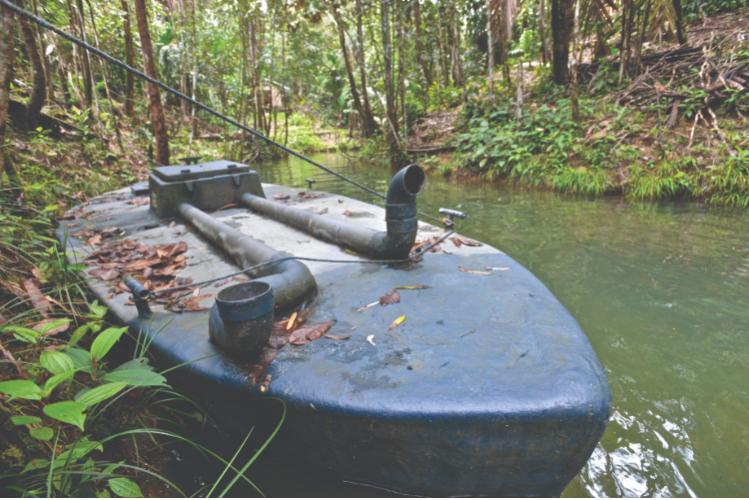 Bahia Malaga, 2017: A Columbian narco submarine (credit: Alamy)
“We’re reverting back to the historical norm in a lot of ways, where technology has developed and the cost has come down to a sufficient point where it is actually possible for smaller non-state actors and smaller companies to do more interesting and sophisticated things at sea if they’re lucrative enough,” he adds.
Though cartels are not currently thought to be using artificial intelligence to power subs, Dr Irene Mia, a senior fellow at the International Institute for Strategic Studies, expects them to in the future.
“Some of these groups are actually a stronger community than some of the states they are originating from,” she says. “We should definitely expect them to use AI much more effectively, and other types of technology.”
The Colombian Navy says international co-operation is now “one of the most effective tools” for defence against narco subs – a point reiterated by the Guardia Civil’s Esteban, whose team shares intelligence with the NCA, the US Drug Enforcement Administration, and Europe’s Maritime Analysis and Operations Centre among others.
Mia points to the success of Operation Orion, where law enforcement agencies from 62 countries seized 225 tonnes of cocaine from the vessels after uncovering a new route to Australia.
“There is more awareness now on the need to actually co-operate,” she says. “It needs to be international co-operation, and multi-level. It needs to be intelligence, police, navy, army, and also enforcement [services].”
In August, the Home Office announced it had seized three tonnes of cocaine worth £66m in a joint operation with the EU. The action, dubbed ‘Operation White Sea’, has seen European partners sharing intelligence on suspicious looking vessels and co-ordinating sea patrols in the eastern Channel, southern North Sea and European waters.
However, international law has not kept pace with evolving threats, say experts. “If you believe that the vessel is engaged in slavery, you can stop a vessel. If it’s engaged in piracy, you can stop a vessel,” says Mike Beardall, chief executive officer of the Naval Review and a former commodore in the Royal Navy. “But if it’s just engaged in trade and is flying a flag on the back of it you cannot stop it.”
Instead, patrols have to wait for the vessel to enter that country’s territorial waters before law enforcement can approach or board. “At the end of the day, the better the legislation is, the more power they have to try and take down these gangs,” says Beardall.
With cartels producing narco subs to ever more sophisticated standards, and demand for cocaine showing no signs of abating in the UK, a more “concerted effort” to tackle the problem could be due.
