To Safeguard Europe's Security, Ukraine's Reconstruction Will Prove Vital
6 min read
A prosperous, well-functioning Ukraine will guarantee Europe’s security – creating the right climate for investing in reconstruction is vital. Words by Lord Ashcroft
The images of war in Ukraine have become so familiar that it is easy to forget what lies behind them. Every missile strike is not simply another explosion on the evening news. It is another power station knocked offline, another bridge destroyed, another family forced from its home, another factory unable to produce, another business unable to employ.
For over four years, Russia has not only sought to defeat Ukraine’s armed forces but also to dismantle the country’s capacity to function as a modern state. World Bank-led estimates indicate that direct damage has exceeded $195bn by December 2025. A significant portion of this damage, amounting to $90.6bn by February 2026, has been inflicted on energy infrastructure through Russia’s strategic drone and missile campaign. Beyond energy infrastructure, Ukrainian homes have also been targeted resulting in over three million households being damaged or destroyed.
In total, the latest World Bank-led assessment estimates Ukraine’s economic losses from this cumulative damage at almost $667bn, while recovery and reconstruction needs stand at nearly $588bn over the coming decade. More than $96bn will be required to rebuild Ukraine’s transport infrastructure alone, while clearing debris, unexploded ordnance and landmines could cost a further $28bn. The figures are staggering, and Ukraine will not be able to recover alone. The country’s budget is already heavily dependent on external financing for essential public spending, and even a future ceasefire and lower defence spending will not generate the resources needed for reconstruction. Neither Kyiv’s public finances nor conventional donor support can carry a bill of this magnitude. Reconstruction has therefore become not only an economic challenge, but a strategic security challenge for both Ukraine and Europe.
Significant efforts have already been made to support Ukraine’s current and future reconstruction. Short-term support has been mobilised throughout the war. The European Bank for Reconstruction and Development has invested €11bn since 2022, while the World Bank is implementing a $3.39bn financing operation with plans to mobilise up to $6bn. The European Commission, the European Investment Bank and other international institutions continue to provide substantial assistance to help Ukraine sustain its economy and public services.
While public funding has kept Ukraine’s wartime economy functioning, the more important development has been the creation of frameworks capable of attracting private investment. Central to this approach are war-risk insurance, public guarantees and blended finance models, all designed to reduce the risks of investing in a country still under attack. Launched in 2024, the European Bank for Reconstruction and Development’s war-risk reinsurance facility has already supported more than €500m in coverage across nearly 10,000 insurance policies. With its initial €100m guarantee fully utilised, the scheme is being expanded to €150m with additional categories of assets. This demonstrates how targeted public guarantees can mobilise private-sector risk-taking even while the war continues.
However, significant challenges remain. Despite the funding already committed, there is still an estimated financing gap of around $10bn for priority recovery projects in 2026 alone. Meanwhile, Ukraine’s Ministry for Development reports that damage continues to outpace repairs in lower-priority sectors, with heat supply receiving only 1 per cent of the $1.6bn required to maintain existing systems.
Ukraine must address structural weaknesses, including a large informal economy and inefficient state-owned enterprises that discourage private investment
There are also systemic barriers to investment. Continued Russian attacks make it difficult to insure assets, protect supply chains or persuade investors that projects will survive long enough to generate returns. Even if a lasting peace eventually arrives, governance challenges will remain. Procurement rules are too often circumvented, projects are not always sufficiently prepared and competition for contracts remains limited. Ukraine must also address structural weaknesses, including a large informal economy and inefficient state-owned enterprises that discourage private investment. Labour shortages present an additional challenge, with almost three-quarters of businesses reporting serious staffing difficulties following the displacement of millions of Ukrainians. At the same time, the country must continue to support displaced citizens and a growing population of military veterans.
Yet despite these formidable challenges, recent developments have begun to establish a credible framework for sustainable investment by both the public and private sectors. The 2026 Ukraine Recovery Conference in Gdańsk demonstrated this by securing not only additional financial support but also stronger commitments to facilitate private capital and accelerate structural reforms. The conference reinforced an essential truth: the rule of law and independent anti-corruption institutions are indispensable to investor confidence and the country’s long-term recovery. Significantly, the World Bank’s $3.4bn package of budget support is tied to Ukraine successfully implementing these reforms.
The conference also placed greater emphasis on the role of municipalities and regional authorities in delivering reconstruction, recognising that decentralised decision-making and transparent local oversight will improve both the effectiveness of investment and investor confidence. Alongside these commitments, the European Commission disbursed the first €3.2bn instalment of its €90bn Ukraine Support Loan, while the European Investment Bank announced more than €470m for housing, border infrastructure and private-sector development, with guarantees expected to unlock a further €500m for small and medium-sized businesses.
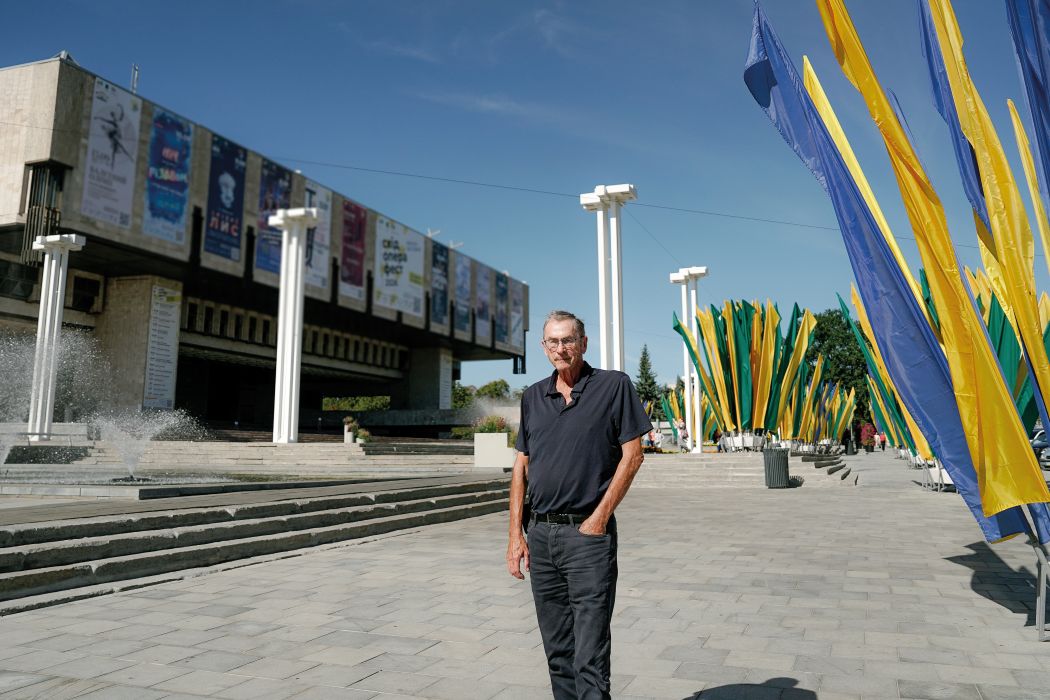 Lord Ashcroft in central Kharkiv in September 2026
Notably, while earlier recovery conferences were understandably dominated by solidarity, emergency support and promises of future assistance, Gdańsk marked a clear shift towards delivery. It brought together governments, development banks, sovereign investors and private capital around projects that can be financed and implemented while the war continues. Ukraine’s government announced around 160 agreements worth more than €10bn. Perhaps more importantly, the conference demonstrated a more credible pathway for unlocking private investment through public finance, guarantees and war-risk insurance, turning reconstruction priorities into genuinely investable projects.
Ukraine’s reconstruction has moved beyond a debate from how much money is needed to how that money can be mobilised effectively.
For Britain and its European allies, this should not be viewed as charity. A prosperous, democratic and economically resilient Ukraine is one of the strongest guarantees of long-term stability on Europe’s eastern frontier. Investing in Ukraine means investing in the security of our own continent, strengthening free markets against authoritarian aggression and helping build a partner capable of contributing to European prosperity for decades to come.
Britain has a particular role to play. Drawing on its relationships with Washington and Brussels, together with the strength of the City of London and its financial sector, the UK can help position Ukraine as a centre of European security, technological innovation and economic growth. A strong, reformed Ukrainian state will not simply be a beneficiary of European security – it will be one of its principal guarantors. But that future depends on reconstruction that is coordinated, commercially viable and built to last.
Ukraine has already demonstrated extraordinary resilience under fire. Its allies must now show the same determination – not only by helping Ukraine win the war, but by helping it build the peace that follows.
Lord Ashcroft KCMG PC is an international businessman, philanthropist, author and pollster. For more information on his work, visit lordashcroft.com. Follow him on X/Facebook @LordAshcroft
