Inside The Government's Plan To Restore HS2's Birmingham-Manchester Link
Aerial view of HS2 construction site in 2026 (Amazing Aerial/Alamy)
9 min read
Andy Burnham was outraged when Rishi Sunak cancelled HS2 to Manchester. Now he’s Prime Minister, how – and when – will he restore the route? Noah Vickers reports
When Rishi Sunak announced in 2023 that High Speed 2 (HS2) would not in fact reach Manchester, and would instead be cut short at Birmingham, Sir Keir Starmer wasted little time in dampening expectations of a reversal under Labour.
“Given the hole that they’ve put in this project, I can’t stand here and commit to reversing that,” he told reporters the following day.
Throughout Labour’s first 18 months in office, and with the costs of HS2’s remnant phase to Birmingham climbing ever higher, Starmer’s government steered well clear of any talk of re-extending the railway to the North.
But then in January this year, something changed. The government finally set out its long-delayed plans to build Northern Powerhouse Rail (NPR), a project linking Liverpool, Manchester, Leeds and other cities. Buried deep within that press release – some 44 paragraphs down – was another, far quieter announcement.
“To support and build on the strategic ambition for the project, the government has set out its intention in the long term to build a new rail line between Birmingham and Manchester,” it said.
“This is not a reinstatement of HS2, further work is required to establish how it can best support our rail ambitions for across the North, and its delivery would happen after the completion of NPR.”
Such was the success of Starmer’s government in downplaying this announcement, that The House has spoken with several Labour MPs – including those with interests in transport or with Midlands constituencies – who are still unaware, or confess to having forgotten, that this is official government policy.
And if ever there was a person to inject some urgency into the plan, it would be Andy Burnham. As mayor of Greater Manchester, he was appalled by Sunak’s decision and swiftly commissioned work exploring how the line could be built more cheaply and with private finance.
The resulting 64-page document, produced by a private sector consortium led by Arup, recommended a reworked line which could deliver 75-85 per cent of the benefits of the cancelled scheme at 60-75 per cent of the capital costs.
It would do this by using cheaper, ballasted track to achieve a maximum speed of 185mph – slower than HS2’s originally planned 224mph (downgraded this year to 199mph), but faster than the existing West Coast Main Line’s 125mph.
Following January’s announcement, ministers confirmed that a feasibility study into the Birmingham-Manchester route is “now underway and will develop options for the line of route, specification, delivery and funding arrangements”. The study is due to conclude by the end of 2027.
But exactly how much the study has achieved so far, despite Burnham’s arrival as Prime Minister, is less clear. One source following the project closely claims that although a team has been appointed to carry out the work, little progress has been made on it due to “bandwidth issues” within the Department for Transport (DfT). Asked about the study’s status, a DfT source insists the work is “underway” and confirms that funding has been allocated towards it.
The DfT also maintains that construction work on any new line would only begin when NPR is complete, which will be in 2045 at the earliest. For many Labour MPs, including those with constituencies along the route through Staffordshire and Cheshire, this isn’t good enough.
Arup’s 2024 report warned that the West Coast Main Line is already “operating close to the limit of its train-carrying capacity, due to a series of major bottlenecks between Birmingham and Manchester”, making it “the least reliable railway in Britain, with fewer than 50 per cent of trains operating on time”.
Not only do the MPs want to see more reliability for their constituents, but they also want the project moved forwards in order to reduce the uncertainty for communities standing in the path of the new line.
“It’s madness,” says one of the region’s MPs. “People want to know what’s going on… There is a wider point though about being realistic about what can be done, how quickly, how much it costs and how we’ll pay for it.”
Huw Merriman, the former HS2 minister who now chairs the High Speed Rail Group industry body, argues that there are clear economic incentives to starting work on the scheme sooner rather than later.
“I would say time is of the essence. The government is delivering NPR, which would include the last 15 miles of HS2 into Manchester, and delivering HS2 up to, and beyond, Birmingham. It is also delivering East-West Rail, which also connects a number of lines that go up north.
“So you actually need the big connector that goes from Birmingham up to Manchester... You’re only going to capture the full economic benefits of these projects, the investment case for the taxpayer, if you complete the job, and that’s what the prize would be.”
Bev Craig, the mayor of Greater Manchester, agrees that the timescale for the new route should be accelerated.
Craig is currently lobbying the DfT to confirm that Manchester Piccadilly can have funding for a new underground station to receive NPR trains, rather than settling for the cheaper option of extending the existing station at surface level.
Her predecessor, Burnham, last year told The House he would “never accept” a “low ambition set for us by a cut-price infrastructure option”. But Starmer’s government kicked that decision further down the road when they announced NPR in January, which has left Craig, somewhat ironically, in a position where she is now waiting to hear from Burnham’s government whether the scheme can go ahead or not.
“There’s no point having a slow train to Birmingham. That’s the worst of all worlds”
She points out, however: “That underground station has a much stronger economic case when we look at a brought forward, faster route to London from Manchester, so for me, we don’t have time to wait for 2045 – I’ll be making that case much, much sooner.”
There are also unanswered questions over what speed trains on the new route will achieve.
One MP in the region claims that the DfT’s preference is for a standard 125mph service, partly to give them more freedom over how bendy the line can be – as higher speeds require straighter track, which limits any ability to manoeuvre round sensitive sites.
“They can avoid things,” the MP says, “and they don’t have to go through as many ancient woodlands and they don’t have to put in the same type of expensive environmental mitigation, so it’s not going to come back at more than 125mph – the same as the rest of the rail network.”
This would tally with comments made in January by the rail minister Lord Hendy, who told peers: “It will probably not be a high-speed railway. It is certainly not a railway to the specification of HS2 phase 1, which has cost an extraordinary amount of money because of its specification.”
Craig warns the government, however, that the new route must provide a higher-speed service for the people of her city.
“There’s no point having a slow train to Birmingham,” she says. “That’s the worst of all worlds, and that’s no slight on Birmingham.”
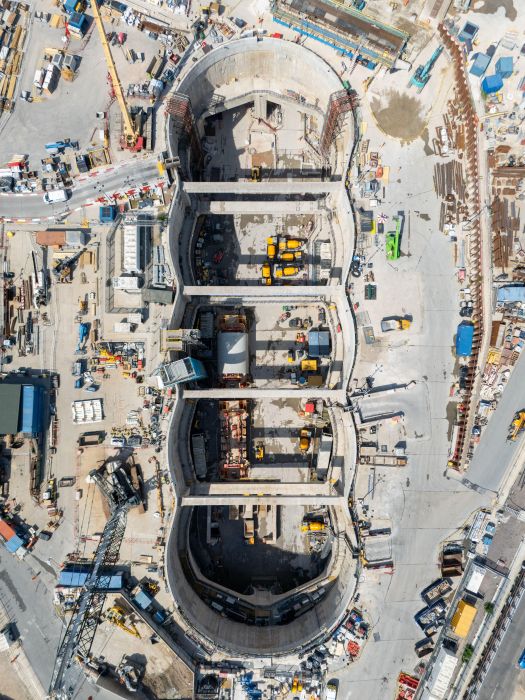 Old Oak Common HS2 station construction site, London, 2026 (Amazing Aerial / Alamy)
She points to the 35 per cent productivity gap between London and Manchester and compares it with the 20 per cent gap between Paris and Lyon. The two French cities have been linked by a TGV high-speed rail service since the early 1980s.
“The single biggest intervention that helped Lyon’s economy thrive was the investment into TGV and having fast trains into Paris,” says Craig. “We believe that having fast trains from Manchester into London would grow the UK’s economy.”
A DfT source said the government “is yet to decide what will be delivered and to what specification”, while insisting that “a range of different route and specification options will be considered, including some which may be classed as high speed”.
The line’s speed will partly be dictated by how many stops the route includes. With the exception of a stop at Crewe, the original HS2 proposal was to bypass Staffordshire and Cheshire, and as the feasibility study continues, the region’s MPs may begin lobbying for new stations as concessions for any local disruption caused by the project.
The number of stops may in turn have a bearing on how the scheme is funded, as more stations means more opportunities for land value capture – thought to be one of several mechanisms the DfT is exploring in an effort to reduce the burden on the taxpayer.
“When it comes down to it, the financing is probably going to be the most important thing on this, because building railways is expensive,” says Merriman. “The public will need to be persuaded that it won’t be on them as taxpayers. By funding it in a different manner, in a public/private partnership, the argument for it can be won.
“Let’s not be naive about it, that’s going to be a key challenge. Due to the legacy of HS2, this has to be a completely different railway, done in a different way, with new homes, jobs and workspace planned alongside the railway and working in collaboration to harness the new powers of mayors and local government, so that people can see the positives of it.”
As work on the new line proceeds, there may also be increasing calls to restore HS2’s former ‘eastern leg’ to Leeds via the East Midlands, curtailed by Boris Johnson in 2021 and scrapped entirely by Sunak two years later. Unlike the Manchester route, the land purchased for that leg is now slowly being sold back to the public – though as the process is still at an early stage, much of it remains in government hands.
One MP on the Manchester route claims that colleagues in the East Midlands are “really eager” to explore whether the eastern leg could be restored in some form, while admitting that conversations are at a “very embryonic” stage.
Approached for comment, several East Midlands MPs deny knowledge of such discussions – and nor is there uniform enthusiasm for the idea, as one says: “I think it’d be a mixed view amongst constituents.
“Lots of residents feel very messed around by the hokey cokey done by the previous government and there’s a lot of residual upset about it in our communities.”
But another tells The House: “I would definitely support it to the west, but I also think the case for the east is a strong one. We would be delighted to engage in any further discussion, if it was possible.”
