What Is Behind Labour's Northern Powerhouse Rail Delay?
Greater Manchester mayor Andy Burnham warns the Treasury must not give his region a 'cut-price' infrastructure option (PA Images / Alamy)
9 min read
Labour’s long-delayed plans for Northern Powerhouse Rail have left MPs and mayors frustrated. What’s the hold up? Noah Vickers reports
Northern Powerhouse Rail (NPR) is a project out of time. Its name harks back to the era of George Osborne, who in 2014 unveiled a plan “to build a new high-speed rail connection east-west from Manchester to Leeds”. Based “on the existing rail route, but speeded up with new tunnels and infrastructure”, the then-chancellor’s ambition was to create “the equivalent of travelling around a single global city”.
Over the decade that followed, as attention turned to High Speed 2 (HS2) and its soaring costs, work on NPR stalled. In 2021, Boris Johnson’s government confirmed that the route would run from Liverpool to York via Manchester, Bradford and Leeds – but to bring the price down, it would only include limited sections of new, high-speed track. The rest would comprise upgrades to existing lines.
Since taking office, the Labour government has been preparing to make an announcement on how and when it will deliver the scheme – but has repeatedly delayed doing so.
Rachel Reeves’ autumn 2024 Budget promised to “maintain momentum” on the plan by progressing its design, with further details to come “in due course”. The Chancellor then pledged at her June 2025 spending review to make an announcement on NPR “in the coming weeks”.
Next, the announcement was pushed back to September’s Labour conference, but delegates had to make do with Reeves promising simply to “push ahead” with the project. Last month’s Budget passed with only a fleeting mention for NPR. The proposals appear now to have been kicked into 2026.
The delays have become a growing irritation for the party’s northern MPs, eager to show their constituents how Labour is taking action to modernise their infrastructure.
“It is tragic,” says Bradford East MP Imran Hussain, “because Bradford is one of the largest cities in the country that lacks proper connectivity. We’ve got a population of over half a million.”
The economic benefit, he says, cannot be overstated. “The frustration for us is that the can keeps getting kicked down the road – we need an answer on that now. If we are serious as a government about addressing inequality in all parts of the country, then this is the single [best] thing we could do.”
The early part of the new year, as far as Hussain is concerned, “must be the absolute last deadline – and I’ve made that clear to the government”.
Others in the party say failure to deliver the scheme will do them no favours when voters go to the polls in 2029.
“People want to see an improvement in their economic circumstances, and in the opportunities available to them,” says Labour MP Elsie Blundell, elected last year in Heywood and Middleton North. “If we want to win the next election, we must commit to Northern Powerhouse Rail as one way of delivering those things.”
Reform UK, meanwhile, has made clear it will axe NPR if it forms the next government, arguing that the scheme is a waste of money.
Any government is petrified of committing to something that looks, or is, HS2
What is behind Labour’s delay? Prime Minister Keir Starmer last month told the BBC he wants “to get it right” before publicising the plan, “because what we saw with HS2 was a government that didn’t get the big decisions right”.
Inconveniently for Starmer, however, NPR’s fate is intrinsically connected to HS2’s. The projects were originally intended to go together. NPR trains travelling east from Liverpool, and HS2 trains coming north from Birmingham, would have shared a tunnel stretching from Manchester Airport into Manchester city centre.
When Rishi Sunak made the decision to axe the ‘northern leg’ of HS2 in 2023, the benefit-cost ratio (BCR) for that tunnel suddenly became weaker in the Treasury’s eyes, as it would now only be carrying NPR trains.
“Because of HS2’s never-ending disasters, any government is petrified of committing to something that looks, or is, HS2,” says one source familiar with the scheme.
Greater Manchester mayor Andy Burnham and West Midlands mayor Richard Parker have both argued for a lower-cost, privately funded version of HS2’s northern leg to be authorised by the government – but have so far failed to convince ministers.
“If that was to get built, then suddenly the BCR for this new tunnel [from Manchester Airport] would go through the roof,” says one source close to the discussions.
“The reason why there is a problem is because we’re trying to build NPR without HS2 – yet it was people inside the Treasury who convinced Rishi to cancel it… who said that this was a way of releasing money for NPR, and in fact, it’s done the exact opposite.”
It is understood that the Treasury is now deliberating over whether the stretch of NPR between Liverpool and Manchester could be delivered in a cheaper way than has previously been costed. In practice, it is thought that could mean chopping Manchester Airport out of the route – which Burnham says would be a “ludicrous” idea.
“Manchester Airport is the long-haul airport for the North of England, and good connectivity to it is essential for Bradford, Leeds, Liverpool, as part of their own selling point for investment in their regions,” he tells The House.
Using that tunnel, the mayor argues, would allow the airport to be linked up with HS2 in years to come, providing links not just east and west but also south to Birmingham.
“If you do that, you don’t need a third runway at Heathrow, because large parts of the Midlands and the North of England would find it far more convenient to use Manchester Airport,” he claims, pointing out that the latter already has two runways and is operating below capacity.
“The idea that they would chop out Manchester Airport [from NPR], while moving the M25 to accommodate a third runway [at Heathrow], I think would be one of the most London-centric things ever, if that is what the Treasury are deciding to do.”
I have made this plain to the Treasury. We will never accept anything other than an underground station at Piccadilly
Officials are also thought to be considering whether or not to agree to Burnham’s demand that NPR trains use an underground station below Manchester Piccadilly, rather than coming in above ground.
“I have made this plain in recent days to the Treasury,” he says. “We will never accept anything other than an underground station at Piccadilly.”
When HS2 was planned to come to Manchester, it was expected to use land next to Piccadilly. The mayor is adamant that the site must not now be used to accommodate NPR.
“For us, that land is the prime economic development opportunity of the North of England,” says Burnham, “and so we’re never going to accept that we would give up that land for a sprawling railway station.”
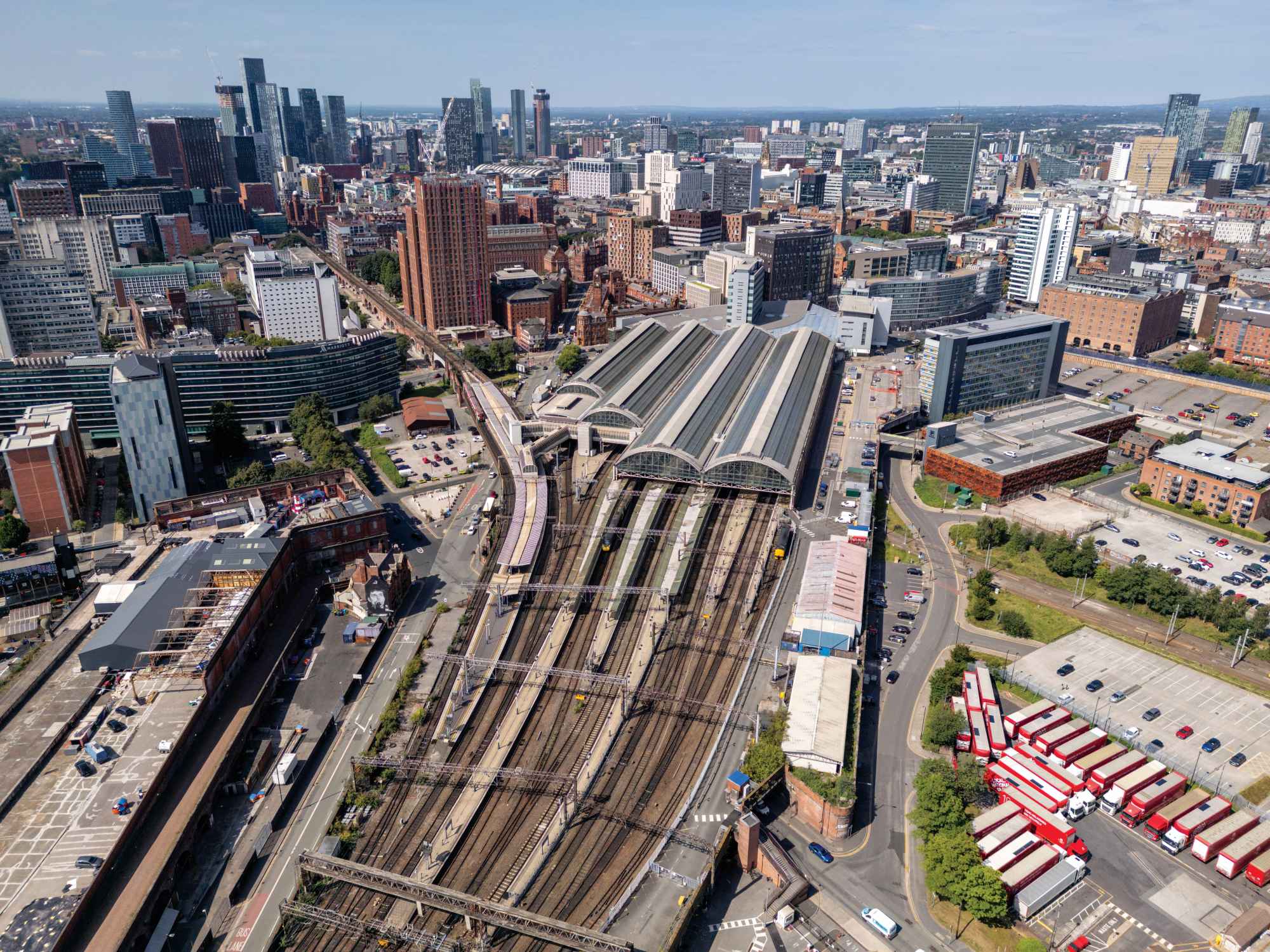 Manchester Piccadilly station (Maurice Savage / Alamy)
He will refuse, he says, to see a “low ambition set for us by a cut-price infrastructure option”, adding: “Maybe that’s the sticking point, but it’s not one that we’ll be moving off.”
Sources suggest that when the government’s NPR announcement is finally made, it may state that further feasibility work is needed for the link between Manchester and Liverpool, including the tunnel from the airport – which would continue the delays on that section.
That eventuality could create political problems for the government, as the ground would be laid for an escalation in tensions between Starmer and Burnham, in the run-up to a potentially painful set of local elections for the party and amid ongoing speculation over Labour’s leadership. Manchester Central MP Lucy Powell, the party’s deputy leader, is also a strong backer of NPR.
One source close to the project laments that Burnham “didn’t even stop to think that if he really wants to be serious about the ‘northern arc’, or the Liverpool-Manchester link, it’s not going to be made easier by him trying to make out he’s going to want to kick the Prime Minister out”.
Does Burnham believe his posturing over recent months for Labour’s leadership has helped or hindered the case he is making for NPR?
“I don’t think they’re connected in any way, shape or form,” replies the mayor, who makes no attempt at suggesting his ambitions for the top job have gone away. “This is about the long-term future of the North of England. You would hope the UK government is as invested as we are in making the North of England the most it can possibly be in the rest of this century.
“I don’t believe anyone down in Whitehall is looking at it with the eyes of short-term political considerations… It wouldn’t be right to do that, and I don’t think people are doing that.”
Approached for comment, neither the Department for Transport nor the Treasury denied that the airport tunnel and the underground station at Piccadilly are proving to be sticking points in their deliberations over NPR.
In response to Burnham’s remarks, a government spokesman agreed that the North “has been stuck with second-rate transport for too long” but said “we are fully committed to righting that wrong, investing in upgrades and getting spades in the ground”.
They added: “We reaffirmed our commitment to the Northern Growth Corridor in the Budget, and we continue to engage with mayors to deliver NPR. This is a major investment, and we are committed to getting it right – taking time to plan carefully, learning from past mistakes to truly deliver for the North.”
Transport Secretary Heidi Alexander meanwhile tells The House that the NPR announcement will be made “in the coming weeks and months”, adding: “It is critical to getting the economy of the North of England firing on all cylinders.
“If we could make the North of England as productive as London and the South-East, it would have a material difference on our economic output as a whole. I’m confident that in the not-too-distant future we will have more to say about that.”
