"A stunning revival": Baroness Andrews reviews 'Billy Budd' at Glyndebourne
'Billy Budd', Glyndebourne Festival 2026. L-r: Mr Flint, Sailing Master (William Thomas), Captain Vere (Allan Clayton) and Mr Redburn, first lieutenant (Dingle Yandell) | Image: © Glyndebourne Productions Ltd / photo: Tristram Kenton
4 min read
Powerfully sung and beautifully performed, Glyndebourne has mounted a moving production of Britten’s theatrical and musical masterpiece, Billy Budd
As this year marks the 50th anniversary of the death of Benjamin Britten, it is fitting that Glyndebourne has mounted a stunning revival of his theatrical and musical masterpiece, Billy Budd, in a production first performed at the festival in 2010 (directed then by Michael Grandage) and now reprised by Ian Rutherford.
Throughout his life Britten hated violence and distrusted power. His visit to Belsen in 1945 marked him for life. Written in 1951, and commissioned for the Festival of Britain, Billy Budd took him even deeper than his 1945 opera Peter Grimes into the darkest chambers of the human heart. Inspired by Herman Melville’s novella, it is a morality tale about power, repressed desire and luminous grace.
The astonishing virtuosity of the score (the sea, ever present in its rise and fall) is brilliantly captured by the London Philharmonic Orchestra, conducted by Nicholas Carter – matched in genius by the precision and poetry of the libretto, (a unique partnership with EM Forster together with Eric Crozier). The end result is a breathtaking fusion of music and narrative.
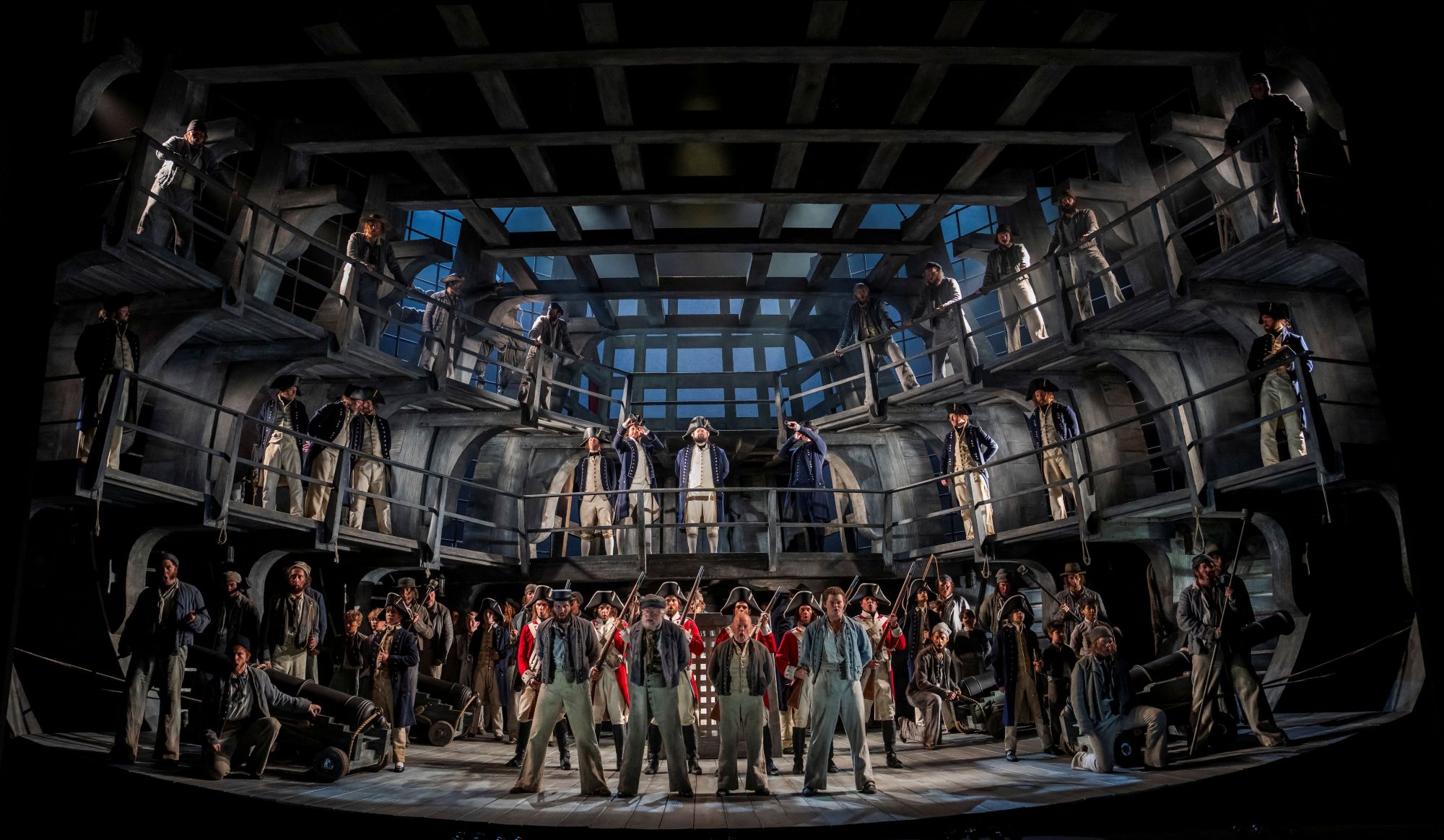 'Billy Budd', Glyndebourne Festival 2026
Image: © Glyndebourne Productions Ltd / photo: Tristram Kenton
Transporting the audience to the vicious reality of life in the 18th century British navy, at war with France, the opera opens onto a claustrophobic scene inside the three-decked belly of the man-of-war The Indomitable. We see its pathetic crew – largely press-ganged, homesick, bullied and brutalised – still trusting in the seamanship and fairness of their captain, Starry Vere. British tenor Allan Clayton, in glorious voice as Vere, brings a magnetic stillness and agony to this most conflicted role.
This floating world is a place of violence and despair – conveyed marvellously by the male chorus – liberated in their exultation – “This is our moment” as The Indomitable finally comes within sight of the “Frenchies”. The tension rises with the martial orchestration, as the crew gear up for the fight they have been aching for – to be bitterly frustrated when the mist denies them victory.
The astonishing virtuosity of the score is brilliantly captured by the London Philharmonic Orchestra, conducted by Nicholas Carter
But when Billy Budd (the baritone Thomas Mole, inhabiting the role beautifully as he moves from lyric joy to bewildered despair) is press-ganged into their midst, the crew recover their own humanity. Billy’s startling beauty, sweetness, his innocent delight as top foreman (“aloft with the birds”) are an immediate torment to the master-at-arms, Claggart – a menacing, hate filled presence (sung powerfully by bass-baritone Sam Carl) who sublimates his own desires into brutality. Billy, in his innocence, sees good in everyone. He brings hope to a wretched universe. In turn the crew look out for him knowing that under stress, his stammer will silence him.
Claggart, forces the ‘novice’ (Laurence Kilby’s expressive tenor), whom he has already broken, to accuse Billy of mutiny – playing into the paranoia driven by previous mutinies in Spithead. In a chilling aria, he confronts us with his belief that, while Billy lives, there will be no room in the world for his malignance. He must destroy Billy or be destroyed by him.
And this is the heart of the matter.
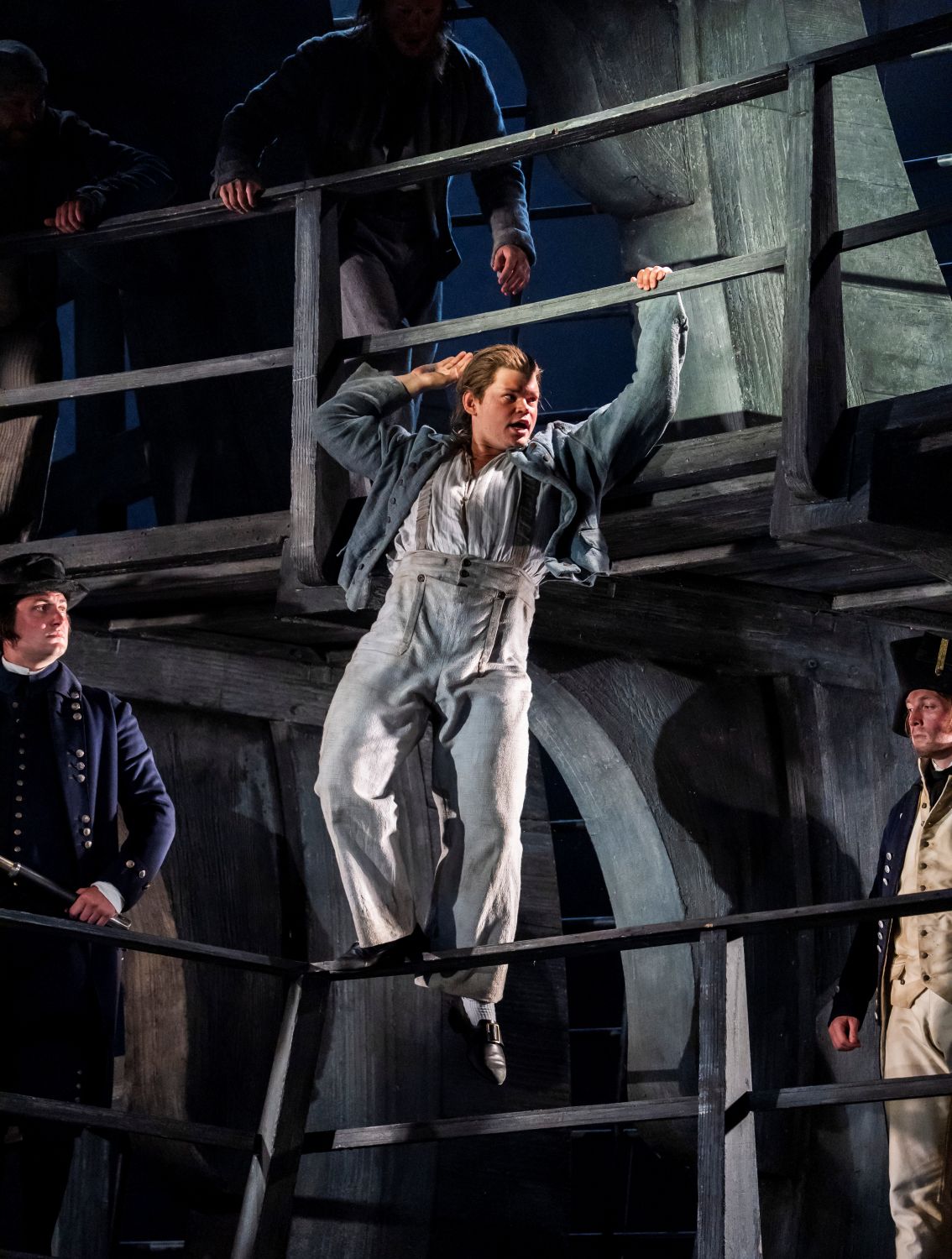 Thomas Mole as Billy Budd (centre) | Image: © Glyndebourne Productions Ltd / photo: Tristram Kenton
Faced by Claggart’s lies in front of an agonised Vere, who knows he is innocent, Billy is struck dumb and, in his frustration, strikes out, killing Claggart. Vere, conflicted by his own feelings for him, yet bound by the Articles of War, refuses to speak up for him. A drumhead court condemns Billy to hang. Vere, by failing to make the humane and moral choice, has been, like Billy, hopelessly undone. Words are now useless. Only music will do. Offstage, as Vere tells Billy that he will hang, the appalling pain of the moment resonates through a series of lingering and enigmatic chords.
As his noose is being prepared, it is Billy who redeems Vere. Alone on the stage, as he waits for “oozy, weedy depths” to claim him, in his final aria he forgives the captain. The crew is less forgiving – surging forward with broken and wordless cries of rage. Vere’s retrospective epilogue makes it clear too that he has never forgiven himself. Yet the creed by which Britten lived triumphs: love conquers hate and lives on in his music.
Baroness Andrews is a Labour peer
Billy Budd
Composer: Benjamin Britten
Venue: Glyndebourne
