Inside Prosper UK's Mission To Pull The Tories Towards The Centre
Andy Street speaks at a Prosper UK event in September 2026 (John Rose/Alamy)
10 min read
Prosper UK is on a mission to pull politics – and the Conservative Party – in a centre-right direction. Will it succeed? Noah Vickers reports
In a hotel bar in Newbury, confusion reigns. Seven men have gathered in the bar’s function room to talk about how they can play their part in a new political movement. The trouble is, several of those attending aren’t entirely sure what this movement is, or what its actual objectives are. It’s called Prosper UK and it has so far attracted almost 30,000 supporters across the country.
Co-chaired by former West Midlands mayor Sir Andy Street and the ex-leader of the Scottish Conservatives Baroness (Ruth) Davidson, Prosper styles itself as a “modern, forward-looking centre-right movement with the ideas, energy and reach to shape the country’s next chapter”.
Its mission statement is that “the UK deserves better than a choice between Andy Burnham and Nigel Farage at the next election”, and it is explicit in wanting “the Conservative Party to provide that alternative”.
However, the group argues, the party can only do so “by appealing to the centre ground and reaching beyond its traditional base, to voters who have backed other mainstream parties and to voters who have drifted away from politics altogether”.
Prosper’s top team includes Amber Rudd, Sir David Gauke, Lord Barwell, Margot James and Sir David Lidington – the former home secretary, justice secretary, Downing Street chief of staff, digital minister and de facto deputy PM to Theresa May respectively. It’s an impressive roster, but one that some believe is also indicative of Prosper’s limitations.
The group “looks a bit like a network of ex-MPs wanting to go back to the ‘golden years’ of Cameron”, says one current Conservative MP, which “doesn’t really resonate because a) they weren’t that golden, b) the political landscape is unrecognisable, and c) the party of 2026 is unrecognisable”.
Notably, all of these senior figures were opposed to Brexit during the 2016 referendum – an event that dramatically ruptured the Tories’ voter coalition and later forced several of the party’s leading lights into the political wilderness. Gauke and James, for example, were both stripped of the Conservative whip by Boris Johnson after they rebelliously attempted to prevent a no-deal Brexit, while Rudd voluntarily surrendered the whip over the same issue.
Though Prosper does not yet have a formal policy on Britain’s relationship with Europe, it is currently consulting with its supporters on it, asking for their “practical views on where co-operation with the EU should be strengthened and where the UK should remain independent”.
Prosper’s launch, back in January this year, was partly drowned out by Tory MP Suella Braverman deciding to defect to Reform UK on the very same day – but the planning had been in place for many months.
“Andy was the person who did the ring-round and really set the ball rolling… sort of late summer last year, getting people together in August and September,” says Davidson.
“Part of the frustration had been that we saw Labour come in, they were talking about growth, but actually doing policies that were the antithesis of that.”
She adds, carefully: “The Conservative Party was picking itself back up off the ground and was talking a lot in the culture kind of space, rather than the economic space at the time.
“We all coalesced around a simple truth, which was we felt there was a gap in British politics and that millions of voters, even coming out of the back of an election where they’d all had their say, still felt politically homeless.
“We wanted to bring those people together and take that conversation out of the Westminster bubble – take it into the West Midlands for Andy, Scotland for me, out into communities across the UK and start listening to why people felt they were so disenfranchised.”
Sir Andy, drawing on his decades in senior roles at John Lewis, says he would not have launched Prosper if he were not certain there was an “addressable market” of people ready to back them.
He is also clear that Prosper is not a think tank or a pressure group – it is a ‘movement’, which is gathering support not just from disaffected Conservative voters and members but also from people who voted for and currently support other parties, like Labour and the Lib Dems.
As well as publishing policy reports, Prosper is holding regional events across the country, and it is hoped that this will eventually give rise to a nationwide structure of local Prosper branches – starting, naturally, with the places where they are accruing most members.
Hence, Newbury – a Tory/Lib Dem swing seat which swung decisively away from the Conservatives in 2024.
Of the seven men gathered in the hotel bar – most of whom look over the age of 50 – four are Conservative members or supporters, one is a former Conservative who has moved to the Lib Dems, and two say they are non-aligned centrist voters.
At least a couple of the group say they first heard about Prosper thanks to Rory Stewart mentioning it on The Rest of Politics, but they are less sure about how exactly it intends to fight for the centre-ground perspective they hold dear.
The assembled supporters are given a brief overview of ‘Rethink the Rates’, a campaign Prosper is running to reform Britain’s “outdated, unfair and broken” system of business rates. But no sooner have they been asked whether anyone would be willing to assist in that campaign, the questions begin.
“What I would like to know is, is this a cross-party group?” asks one attendee. “My recollection is that when I first heard about Prosper UK, it was intended to be cross-party, but I’ve only heard the word ‘Conservative’ so far in this room.”
Another chimes in: “Is it another party? We don’t want a further dissolution of the parties under first-past-the-post.”
“I haven’t got this straight in my own head,” says a third attendee, a little later on. “Some of this messaging is quite confused, regarding where Prosper is and where it’s going.
“Is it politically aligned? Isn’t it politically aligned? Is it speaking for business? Is it speaking for centre/centre-right politics? What is the driver and how do I sell this to people?”
“I think that’s a real challenge,” a fourth supporter admits. “I’ve been to the higher-ups, saying, ‘You need clearer messaging, people’.”
Structurally, it could be argued that Prosper is not all that different to the Jeremy Corbyn-supporting Momentum movement, in that it has its own membership and is trying to steer a particular political party in a particular political direction.
“It looks a bit like a network of ex-MPs wanting to go back to the ‘golden years’ of Cameron”
Sir Andy points to a key difference: “Momentum was within the Labour Party, fighting for a particular version of what they believed in, but the whole point about Prosper is that it has to be additive to the Conservative Party…
“The minority of people who come to our events are existing Conservative supporters, so this is trying to extend the remit of the Conservative Party.”
Has Tory leader Kemi Badenoch welcomed any of what Prosper is doing?
“We wanted to make absolutely sure we spoke to Kemi before we launched,” Sir Andy replies.
“We wanted to explain what we were trying to do.
“Critically, on the day we launched, Ruth answered a very direct question from Laura Kuenssberg, ‘Do you want Kemi Badenoch to be prime minister?’ Answer: ‘Yes’, so let’s not try to disguise that…
“We explained to Kemi we were trying to be additive, trying to attract these people who perhaps the party wasn’t yet winning back – people who voted Lib Dem, people who lent their vote to Labour, and of course people who sat it out.
“So, this point about trying to broaden the church, bring them back so that we can have a Conservative government again, was there.”
But Sir Andy admits that Badenoch’s reaction to Prosper’s launch was somewhat on the “cool” side.
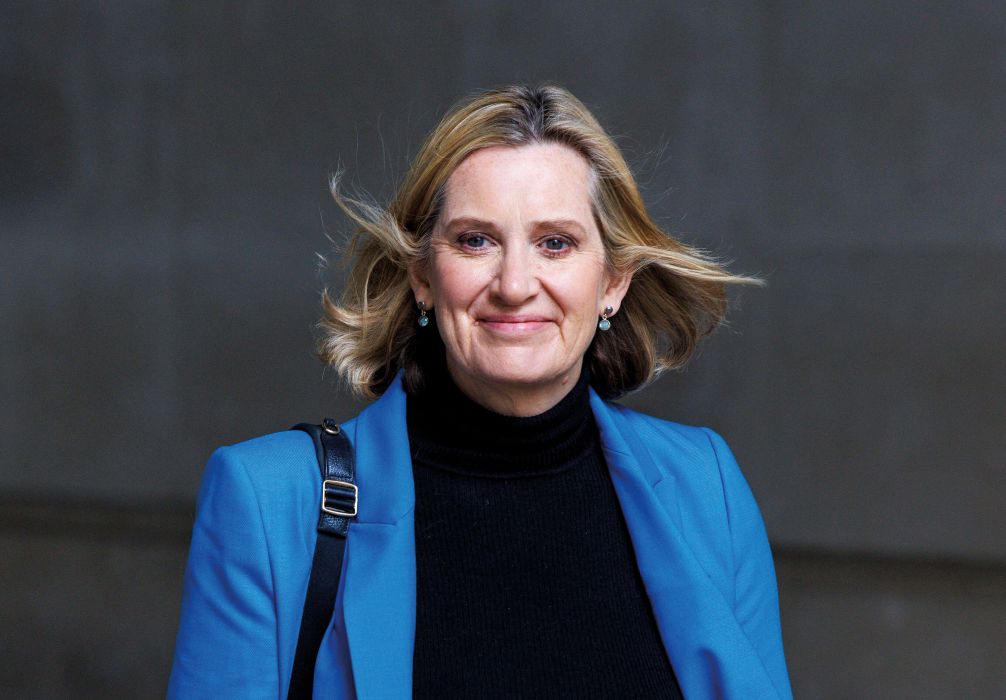 Amber Rudd (Mark Thomas/Alamy)
“I’m the leader of the Conservative Party, not anyone else,” she said when asked about Prosper in the week of its launch. “And it is what I think needs to happen that they need to support, because that is what Conservative Party members have voted for.
“Anybody who is trying to push an agenda that is not the platform I stood on is not being helpful.”
Sir Andy says he understands, however, the position his party leader is in: “She’s trying to do two things at once. She’s trying to reinforce the boundary with Reform and at the same time win back those people, so she’s got to be careful about too openly shifting to our view of the world.”
He adds: “Lots of her lieutenants in the leadership of the party have openly engaged and welcomed ideas coming forward.”
Prosper has produced policy papers on welfare, devolution, immigration and, more recently, a report on how young people should be helped in navigating a labour market reshaped by AI. It is also calling for reforms to make student loans fairer and for the triple lock on state pensions to be replaced.
How is all of this research being funded?
“If only there was one crypto-billionaire, it would be easy,” Sir Andy laughs. “It’s just coming from a relatively large number of – by political standards, currently – small donations from business people or individuals… We’re not in hock to anybody.”
Davidson adds that some of its signed-up supporters have donated either on a one-off or regular basis.
Under electoral law, Prosper is a members’ association, and is required to report to the Electoral Commission all permissible donations it receives from a single source which exceed £11,180 in a calendar year. As no single donor has yet reached that threshold, no declarations have been made so far, according to Prosper’s chief executive Simon Saunders.
In the meantime, a general election may still potentially be almost three years away. What else will Prosper do until then?
The answer may have slipped out at a recent Prosper event at Arundells, the former Salisbury home of Sir Edward Heath.
Asked by the former Conservative MP Ben Howlett whether Prosper’s growing supporter base could ultimately be used to influence Tory candidate selections, Sir Andy is said by Howlett to have rejected any suggestion of “entryism” but confirmed that Prosper does want to “help select council candidates and, over time, support people with similar views to come forward” as parliamentary candidates.
“Andy was describing something we are happy to be open about,” says Saunders, when asked about this by The House.
“Over time, we want people who share our outlook to join the Conservative Party, get involved with their local associations, support local candidates and, if they want to, put themselves forward as council or parliamentary candidates through the party’s normal selection processes.”
At the Conservative conference in Birmingham, Prosper is holding several events and receptions both inside and outside the secure zone, in an effort to reach not only conference-attending Tory members but also people interested in Prosper who happen to live in the West Midlands.
Despite its tens of thousands of politically homeless supporters, Prosper has ruled out ever becoming a political party of its own.
“We’re not here to be a shadow Tory Party. We’re not. That’s not what we were set up to do and it’s not what we wish to do,” says Davidson.
“We have a kind of plan up to the election. We will make sure that we have a plan for beyond the election as we get closer to it.
“But everything that we know, all of the research we’ve done, all of the amassed experience we have on our board – which is pretty substantial – indicates that if the Conservatives don’t fight in this economic space, they won’t have a huge amount of success at an election.”
