Labour MP Jonathan Hinder: Rejoining The EU "Dissolves On Contact" With Reality
12 min read
Labour MP Jonathan Hinder defends the police, opposes rejoining the EU and dismisses electoral reform as a middle-class hobby horse. But, as he tells Sienna Rodgers, the Andy Burnham era of ‘soft left’ government won’t stop his ambitions of turning Blue Labour into a bigger movement – one with members, money and influence
If you do not support Nigel Farage and his Reform party, but do “believe in biological sex”, you may well belong in Blue Labour.
That is the contention of Jonathan Hinder, the 2024 intake MP and former police officer who has taken over as chair of Blue Labour, the group of Labour parliamentarians united by socially conservative and economically left-wing views.
The Blue Labour caucus is a small one, comprising fewer than 20 Labour MPs – and making that number grow is not Hinder’s focus right now. “We have to accept that we’re in a Parliament where we’re going to be a minority amongst Labour MPs,” he tells The House.
Instead, he plans to take a pragmatic approach, building alliances with fellow Labour MPs where they can find common cause – whether that is on reindustrialisation, for example, or Brexit, controlling immigration or reforming property taxes.
“That can mean working with a much broader group than actually associate with Blue Labour in terms of the MPs group, and that’s really important in terms of keeping the party aware that there is this tradition within the Labour Party still, which we think is the authentic socialist tradition,” Hinder says.
“Showing that that exists is very, very important from an external-facing point of view, because I think there are a lot of people who might be disappointed at some of the turns that the party is making on some things, but they can at least know that there is a group of people who are still carrying that torch.”
This is where the Blue Labour chair’s plans are more ambitious: outside of Parliament. There is “real interest” in their ideas, he argues, including among young people, as shown by how regularly he is invited to speak at universities now.
“For people who would consider themselves on the left, but they just don’t go in for the identity politics stuff, like, ‘Where do I fit in? I’m not Reform, not right-wing, because I believe in biological sex or whatever, so where am I?’
“We’re in the space which a huge proportion of the population of this country inhabit. There’s a very high ceiling to the support we could get if we build up the organisation outside of Parliament.”
Under his leadership, Hinder wants Blue Labour to be regularly putting out policy positions and holding events. And with a “bit of strategy and hard work”, he hopes to develop it into an organisation with staff, funding and – notably – a membership.
A little like Labour First, the ‘old right’ group within the party? There will be some similarities, but the fundamental mission is different, he explains: “We’re not about trying to beat other parts of the party in an internal election. It’s very much about the ideas. It’s why sometimes I am reluctant to describe ourselves as a faction.”
The 35-year-old MP for the red wall Lancashire seat of Pendle and Clitheroe was born in Manchester to “two loving parents”. They had an on-off relationship that saw him move around until each of them settled in the area he now represents.
His father was an active Labour member, the “backbone” of the local party in Ribble Valley, and both parents are what he would describe as “proper Labour” – not ‘Blue’, exactly, but “they just wouldn’t have any time for the way that we’ve gone down the identity politics route”.
“My dad worked in financial services sales, and my mum was a health researcher working with the NHS and universities. Both came from very working-class backgrounds but gave me a fairly middle-class upbringing. There was never any doubt that I would go to university,” Hinder says.
So, after attending a grammar school, he read history and politics at Merton College, Oxford. It happens to be among the most academic colleges: “I didn’t realise that before I applied.” Today, he is highly critical of universities and has argued that there are too many in Britain.
Always an avid follower of politics, Hinder was known as the “sad nerd” at school for his interest in it, staying up late for election nights and watching Question Time followed by This Week. Did he ever root for Diane Abbott on Andrew Neil’s sofa? “I wanted to be, but clearly not my brand of Labour politics, even then.” He does explain, though, that some years later he “wasn’t as dismissive of the Corbyn project as some were”.
“For me, the more radical economic position – whatever you thought of the detail – was somewhat refreshing as someone who’d grown up in an era when I felt very underwhelmed by New Labour,” he says. “It was nice to have someone who was saying there is a more authentic left-wing position to take.”
He didn’t enter politics immediately after graduating but instead, in a somewhat surprising choice, turned to policing. Despite having no family members in the force, it seemed a good way to “make my mark on the world”, he says.
Rather than go into the possibly more glamorous detective side after a couple of years in uniform, over the course of almost a decade Hinder continued taking response team roles – shift work, answering 999 calls – and progressed from constable to sergeant and inspector.
This is the “bread and butter” of police work, he says, and “definitely more draining than some of the more specialist roles”. Asked for a memory, he recalls how, early on as a PC, he arrived first to a scene where a mother had killed her three children – “a once-in-a-career incident for anybody, never mind only a year in”. He saw people die at road traffic collisions and stabbings.
“There is quite a lot of trauma involved in it, and it’s something that I would like to do more on – changing the public perceptions of policing,” Hinder says. “Policing is an incredibly difficult kind of job, such an important public service, but it’s not necessarily seen that way by people on the left, in many cases. It’s like the ‘fascist bully boys’ or whatever.”
Does he have an emotional reaction to anti-police sentiment on the left, including slogans such as ‘Acab’ (all cops are bastards)? “I just think they’re idiots, basically.”
The Labour MP accepts that there are “massive cultural issues” in the police as well as “ridiculous over-reach on the public order side of things”. He says he never witnessed misogyny from colleagues, however. “Was there a laddie culture at times?” he asks. “Yeah, definitely. But I never saw anything of the ilk that really made the news in recent years.” He prefers to emphasise that “the vast majority are trying to do the right thing”.
“When I was trying to get bright people to join policing just before I became an MP, we’d have people call us up after the latest high-profile incident and say, ‘Oh, I actually don’t want to join anymore.’ It was such a crying shame because it was like, ‘These are the reasons why we need you to join,’ but that itself is putting them off.”
At the heart of such problems is, he concludes, “rubbish leadership”. The pervasive approach is one of, “We’ve got this many vacancies, and so we’re going to set the standard at a certain point to fill these vacancies”, he says.
Asked what he made of police officers showing support for the Black Lives Matter movement, Hinder replies: “My main thought at the time was, I can see why this has happened, I totally get where people are coming from, but Britain and America are very, very different places.”
There are “all sorts of very misleading statistics” in Britain on stop and search, he says. He was frustrated by the crackdowns on the police power, which he defends: “Most stop and search is being done around the big cities. That’s where the highest amount of street crime is. Not very much stop and search gets done in Pendle and Clitheroe. And those cities tend to be much more ethnically diverse.”
“There’s a very high ceiling to the support we could get if we build up the organisation outside of Parliament”
After the mixed message from the Conservatives on it, he continues, “Now it’s like, ‘Actually, we do want you to be doing more stop and search, and don’t be as focused on diversity initiatives.’ But the political debate is all over the place. So, when it comes down to the PC on the street who’s trying to work out what the priorities are, God help ’em.”
So, what does Hinder make of the country’s new leadership? He called for Keir Starmer to go, despite his No 10 being favourable to the Blue Labour tradition, yet did not back Andy Burnham.
“I definitely think the PLP did the right thing. There was no route to recovery under Starmer,” he says. “[Burnham] can talk to the working-class people that I feel like Labour has lost and is in the process of losing, so it’s like night and day on the doorstep for me in my constituency compared to the Starmer days.”
But amid a shift in focus towards uniting the progressive vote, he has his concerns.
The ex-copper does not like the new Prime Minister’s idea of repealing the ban on alcohol in football stands: “Keep it as it is – I’ve policed enough football matches in my time.”
Perhaps more seriously, the notion of rejoining the EU – especially on the basis of a manifesto commitment, as has been suggested – repels this Labour MP.
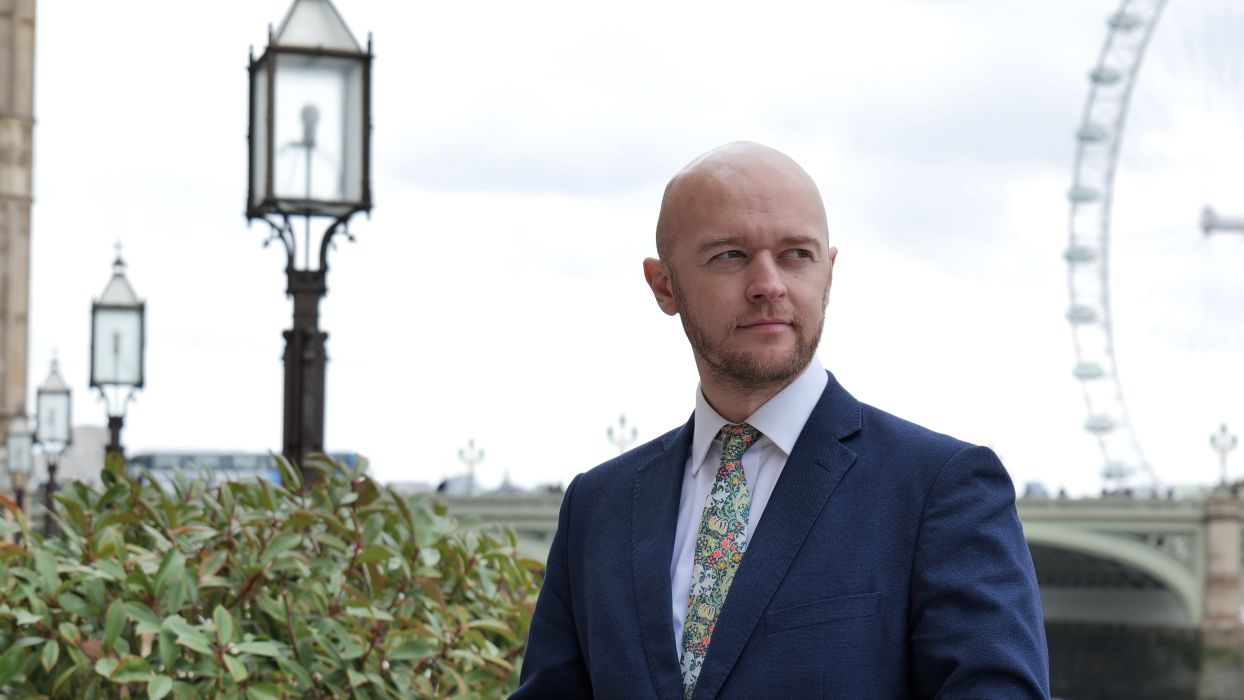 Photography by Joe Crabtree
“Reopening the whole thing fully – I feel like we’ve stopped short of that so far, but might be on the road to it – I just think will be a disaster,” he says.
“We’re going to be having the next general election on first-past-the-post, and we saw how low a vote share can still deliver you a big majority. Can you imagine that being given as a reason to cancel out a referendum in which 34 million people voted? There’s absolutely no question of that.
“I don’t think any of this is going to happen because as soon as you confront the reality of what rejoining the EU means – open borders, tens of billions of pounds being sent to Brussels, potentially joining the euro, not having our own trade policy – it just dissolves on contact.”
Hinder believes “there are a lot of people in our own party who are just about the left bloc”, which is “quite corrosive to politics” – tantamount to “trying to turn us into America, where it’s the progressives versus the conservatives, and they’re all just fighting each other fiercely every election for that 52-48 sort of percentage”.
What does he make of Burnham’s commitment to electoral reform? “I’ve previously been sympathetic,” he starts. “Now I think it’s an excuse for Labour to turn in on itself and just be in our progressive middle-class comfort zone… Obviously, we’re never going to have a majority Labour government again, if we do this ever, so do we want to be in coalition with the Greens?”
Speaking just before Shabana Mahmood’s widely anticipated decision to water down her immigration reforms, a disappointed Hinder appears somewhat resigned to having lost the argument within Labour.
“I supported what she put down, and I think the politics of this are bad because the write-up will understandably be ‘Labour have U-turned on immigration reform’. If we think the Boris wave was a Tory disaster, we should be trying to make sure that we’re cleaning it up as best we can,” he says.
“It’s not about kicking people out the country. It’s about saying you’re going to have to wait longer to get the entitlements that come with being a permanent resident of this country… But I feel like that battle, the political argument, has been lost within the party.”
Asked about the European Convention on Human Rights and Human Rights Act, Hinder is happy to support Labour’s principal approach – working with other countries on reform – but still wants quitting to be an option. “Nothing should be off the table,” he argues.
While immigration levels have dropped markedly, down from over 900,000 in 2023 to 171,000 last year, Hinder still favours a one in, one out system. Net migration is “still pretty high”, he says, “and we need a breather”.
“Too many people on the left have got this warped idea that because British people don’t want to work for poverty wages, we should pull the mass immigration lever, thereby pillaging the developing world of their talented workers.”
Of all Blue Labour’s policy areas of interest, the debate over sex and gender may be the most controversial.
Hinder campaigned against the Pathways clinical trial of puberty-suppressing hormones for children diagnosed with gender incongruence. Although gender-critical campaigners thought they were winning the argument earlier this year, when the trial was paused over safety concerns, it has since resumed and there is little sign of the government intervening to stop it.
“I’m waiting to hear back from the new Health Secretary, Yvette Cooper, on this particular issue, specifically to dig into the concerns that were raised, which resulted in it being paused in the first place, because it was never really, in my view, bottomed out – why it had gone ahead, then it had been stopped, and then it had been restarted,” Hinder says. “It’s not quite clear to me that we’ve actually satisfied ourselves that those concerns have been dealt with.”
While he reckons recruitment – which is currently underway – will be difficult given the criteria established for participants in the trial, he also admits: “If I’m being totally honest, it doesn’t look like we’re going to be able to stop it now.”
Hinder predicts it will leave a damaging legacy. “I think it’ll be a stain on the whole country,” he declares.
“I won’t take any satisfaction in 10 years from people saying, ‘I was a 12-year-old, and I shouldn’t have had this. Where were the bloody adults who were going to protect me?’ But that’s what is going to happen.”
