Lib Dem MP And Ex-Soldier Mike Martin: "War Is The Most Human Thing"
9 min read
Liberal Democrat MP Mike Martin has an unusually colourful past and an uncompromising view of Britain’s defence challenges. Zoe Crowther speaks to the former soldier about why he is concerned about the automation of warfare and why he wants his party to be ‘ruthless’
Mike Martin has walked the West Bank, driven a Land Rover across the Congo basin and sailed halfway around the world.
It’s fair to say the Liberal Democrat MP for Tunbridge Wells is more in the Paddy Ashdown mould than Ed Davey.
Davey told The House earlier this year he admired Ashdown’s version of “gritty liberalism”. But his internal critics believe he is not “gritty” enough: in October, two MPs resigned.
But speaking from his appropriately turret-like Commons office Martin, a former soldier, studiously avoids criticising his under-fire leader.
He challenges the criticism that the party is ducking difficult decisions in an ill-fated attempt to maintain a broad appeal – but he does so in reference to his own position and style.
“I would count myself as a muscular liberal, right?” Martin says. “If you look at me talking about defence, I don’t think anyone would accuse me of not being very clear-sighted about the challenges we face and what we need to do about it. Ultimately, to defend and fight for what is important, our citizens need to be able to have choices and be empowered to do stuff. You can’t do that if you’re not protected and defended, and sometimes that means you need to be bloody ruthless about what you’re doing on the international stage.”
Has the party communicated effectively enough to the country what it stands for? “Self-evidently we’ve gone down in the polls, haven’t we, since the last general election,” Martin says. “I’m not happy about that. Neither is any other Lib Dem MP or councillor or member or activist.
“It’s been a very noisy media environment, and to carve out a space in that media environment, you need to be quite bold in the way that you stake out your positioning and policy. That hasn’t been done… I think it is being done increasingly and that realisation has taken hold.”
Martin has little tolerance for indecision and incompetence in government, and has an air of impatience that is perhaps formed by his many years of military experience and a life of travel and adventure.
He is one of the eight Liberal Democrat MPs who have served in the armed forces. The MP served multiple tours in Afghanistan as a political officer, using his language skills, which include Pashto, to pioneer a programme developing relationships between British officers and Afghan community leaders, including Taliban. Martin went on to work in defence “from all angles”, including for a risk management company in Somaliland and Myanmar, for an international development charity, and a brief stint in the Foreign Office.
Away from his military career, Martin found the time to walk the length of the West Bank – “That was fascinating. I’d actually just spent nine months in Afghanistan and needed a bit of thinking space” – undertake a 2,500-mile north-south crossing of the Congo River Basin in an old Land Rover – “That was just a madcap adventure, to see if we could do it because everyone said it was impossible” – and sail halfway around the world.
“I met a guy working in a boatyard in Venezuela when I was living in South America. He was sailing his boat back to Europe and basically taught me how to sail.”
Martin lived in Australia and Fiji during the Covid-19 pandemic before finally returning to his wife’s home town of Tunbridge Wells with their baby daughter, before being selected as a Lib Dem parliamentary candidate in 2022 and getting elected in 2024.
For Martin, military service and political service are one and the same. “But one has violence and one doesn’t,” he says. “The psychology of the two is very similar. In politics as in war, you’re trying to tell stories, build coalitions, lead people, motivate your team. They are both very intense environments, both full of human stories and ‘what the fuck’ moments.
“War is a human endeavour. In fact, it’s the most human thing. War and sex are the two things that are really uniquely human. We have almost a culture around them.”
While Martin describes war as a “human thing”, it is becoming increasingly automated.
Ukraine is integrating artificial intelligence into its uncrewed aerial systems and defence networks to counter Russian forces, improve strike accuracy, and bypass electronic warfare jamming. The 2026 documentary NAZA, directed by Yuval Abraham and Rachel Szor, depicts interviews with anonymous Israeli intelligence and military insiders who detail how AI and mass surveillance systems were used to track, target, and authorise airstrikes in Gaza following the October 7 attacks on Israel.
One of the whistleblowers said they felt using AI to determine targets was more ethical than humans making the decision: “Having AI decide who lives and dies is better than leaving the decision to someone whose friend was killed by Hamas last week.”
Martin, having spent years in warzones, fundamentally disagrees. “The British government’s current position, which I support, is that there will always be humans in the loop when making decisions about targeting, i.e. killing people,” he says.
“If we abdicate decisions to kill people to a machine, we’ve got huge problems if that machine gets it wrong and kills loads of people… Who’s committed the crime?”
Martin says he is concerned the British government will find it difficult to maintain its position if it is forced into an automated arms race with Russia or China.
“The advantage of auto AI systems is they can make decisions much, much, much faster than humans can. And in warfare, the speed of decision making is a massive advantage.
“The MoD is a black hole”
“I would be worried that if we went up against Russia and China and they did release fully autonomous weapon systems without humans in the loop, then the only way we could survive would be also having our own autonomous systems. There’s a real problem there around an arms race, and in bits of Ukraine you’re seeing something pretty close to that – autonomous systems operating without human supervision.”
The Ukrainian army has also been using gamification to incentivise frontline troops by integrating video game-like features into military operations and awarding units with points for successful strikes.
Martin understands this approach. “That’s an effective way of doing war, actually,” he says. “As distasteful as we might find it as civilians, ultimately war is about killing people. And if you’re not killing your enemies, then they’re killing you, and that’s a fundamental truth.
“Before I went to Afghanistan, I was really worried about having to kill someone… and then as soon as I got in my first firefight, I immediately understood that of course, if I’m not trying to kill them, they’re trying to kill me.”
Martin’s time as a political officer at war means he knows what traumatised soldiers look like. He therefore understands better than most how the impact on the psychologies of those involved in the Ukraine war could extend well beyond peacetime.
“If we end up with peace in Ukraine, we’re screwed, we’re absolutely screwed,” he says. The army veteran warns that a post-war Russia could pose an even greater threat to European security, with hundreds of thousands of brutalised Russian troops potentially redirected towards another conflict.
“There’s going to be 700,000 drunk, brutalised Russian troops that Putin will not want on the streets of Russia. So he’ll have to point them at another problem. We have got huge, huge problems coming down the track, and the government is really not aware of the magnitude of the problems.”
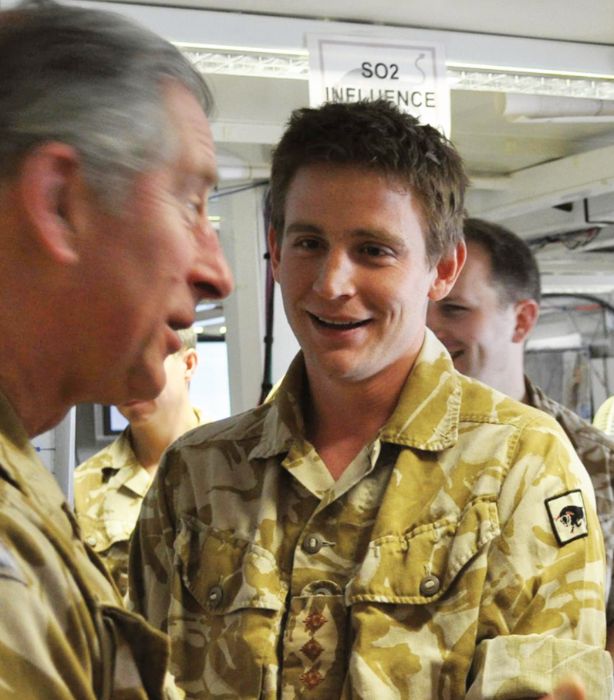 Mike Martin with the then Prince Charles in Helmand, 2010
The level of the UK government’s unpreparedness is clearly at the top of Martin’s concerns, alongside his frustration at incompetence in the Ministry of Defence (MoD). Martin was originally motivated into politics to try to address “the way Britain misused its military power” in Afghanistan, seeing being in Parliament as the next step up in influence to change the way military power is wielded.
While he was serving in the army, the army commissioned him to write a PhD on what lessons needed to be learned from the conflict. While the PhD itself was welcomed by the army, when he tried to publish it as a commercial book, the MoD attempted to block its publication and claimed it breached the Official Secrets Act.
Martin subsequently resigned from the forces in order to publish the book, which argued that British and Nato forces fundamentally misunderstood the conflict and failed to recognise it as a local, tribal civil war driven by disputes over land and water.
“I know full well that when the army said it had classified material in it, they were lying,” Martin says. “It was the MoD, because I saw the email trail, and they were just embarrassed by it.
“It was typical MoD… They do this all the time. Their instinct is always to clamp down on stuff, and they often make things worse. And I’m sure we’ll see more examples of that in the near future.”
Sitting on the Defence Select Committee, Martin says they see it “all the time” that the MoD is a “black hole” where there is little proper accountability for decisions and mistakes.
“They never, ever point the finger at one person as responsible for something. And because there’s that total lack of responsibility, coupled with the fact that they can say, ‘we can’t talk about it because national security is classified’, it means that the MoD consistently makes bad decisions: bad procurement decisions, bad decisions around data.”
However, he believes that accountability will come down the track. “National security is something that, luckily, for decades we’ve had,” Martin continues.
“Apart from a bit of terrorism and some wars that we fought elsewhere, we’ve broadly had that. So the public isn’t necessarily aware of what the absence of national security looks like.
“They might be about to find out what that looks like, and then I suspect that the MoD will get much better, much more quickly because there’ll be a lot more scrutiny.”
