"Not to be missed": Lord Blackwater reviews 'De Gaulle: Liberté'
Simon Abkarian as Charles de Gaulle | Image by: LANDMARK MEDIA / Alamy
4 min read
Even more gripping than the first instalment, Antonin Baudry’s film is a vivid portrait of man who made his own reality
The second part of Antonin Baudry’s account of the life of Charles de Gaulle during the Second World War is even more gripping and vivid than the first, which I reviewed in an earlier edition of The House.
De Gaulle: Liberté picks up the story in January 1943, as the last Axis troops are driven out of North Africa, and takes it through to November 1944 when de Gaulle, President of France in liberated Paris, takes Winston Churchill on Armistice Day to honour the tomb of France’s unknown warrior. Even more than in part one Simon Abkarian almost becomes de Gaulle, personifying not only the General’s absolute resilience in the face of attempts by his allies to undermine him, but also his utter single-mindedness in achieving the role he wanted in the France he wanted.
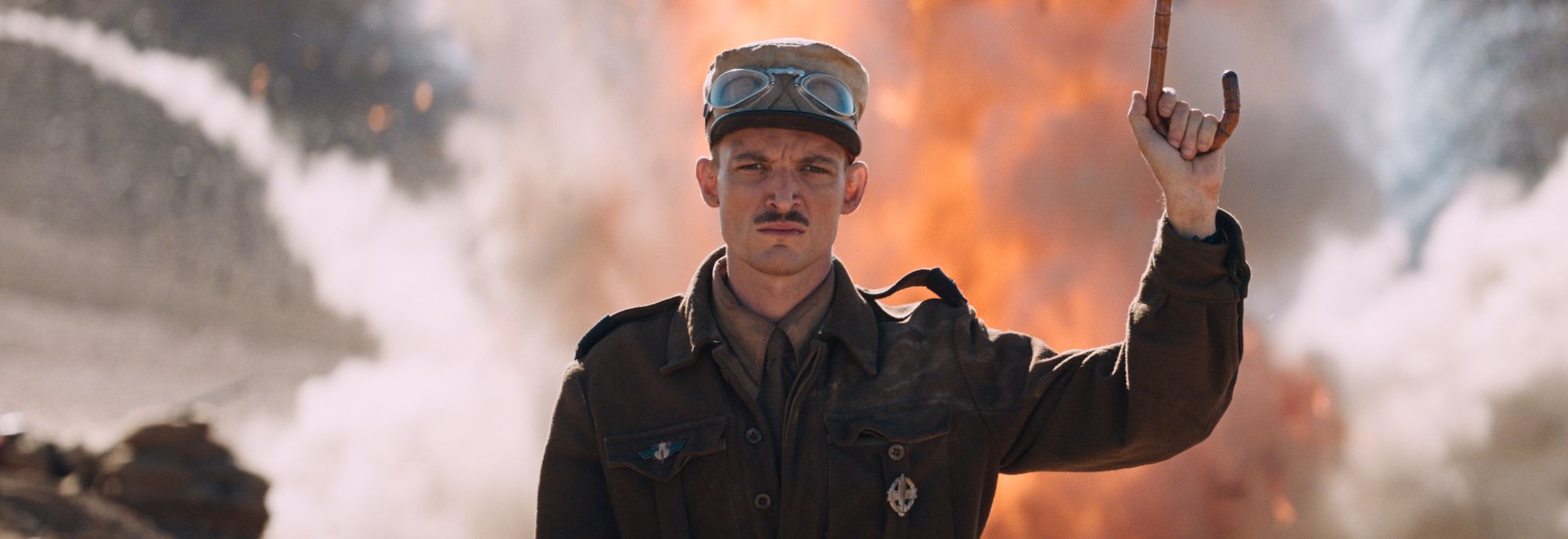 Niels Schneider as Général Philippe Leclerc de Hauteclocque
Image courtesy of: Entertainment Film Distributors
Based, again, on Julian Jackson’s peerless biography, the film depicts the General’s transition from a nearly-marginalised figure in the overall Allied plan for victory to one whose claims for leadership of France become irresistible. Indeed, although there are some fine battle scenes – notably of the armoured division of the Free French hero General Philippe Leclerc de Hauteclocque holding off a German Panzer advance outside Tunis and then, once it receives air support from the RAF, breaking through – the enemy in the film seems mainly to be within.
De Gaulle must see off an American-backed plan for his rival and technical superior General Henri Giraud to lead both the French forces and the provisional French government in Algiers, where we see former Vichy officials rounding up ‘Gaullists’ and locking them up.
Even more than in part one Simon Abkarian almost becomes de Gaulle
But de Gaulle is having none of it. He expresses his distaste for Giraud forcefully, initially refusing to serve with him, and then accepting a joint presidency only to sabotage it. He respects Giraud’s military skills but despises him for surrounding himself with Pétainistes. Leclerc’s victory proves the worth of the Free French and forces Roosevelt – depicted as de Gaulle’s main opponent, with Churchill obediently behind him – to back de Gaulle rather than Giraud. Indeed, the people who come out worst in this film are the Americans, which may reflect attitudes to that country in 2026 more than those in 1944.
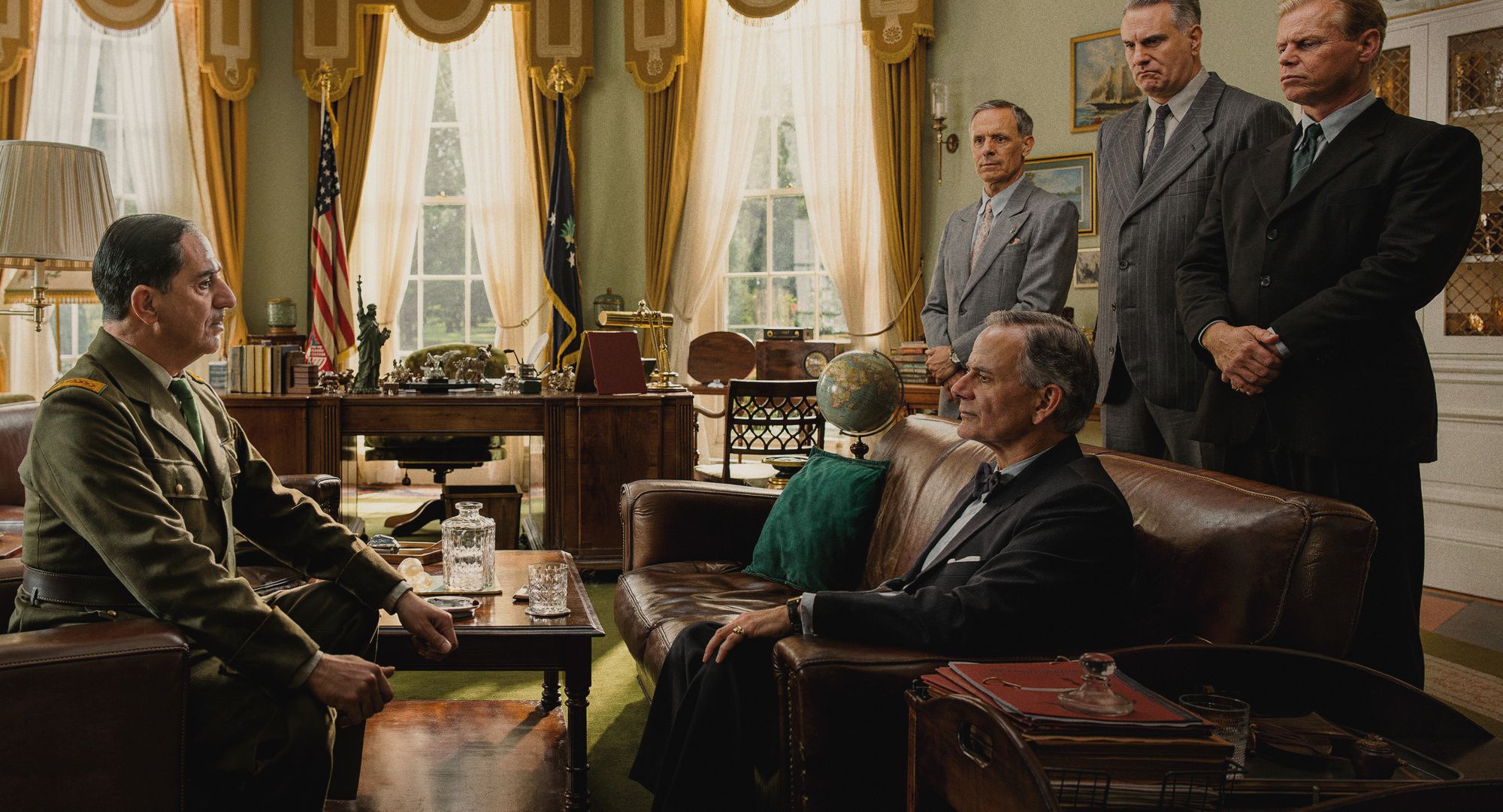 L-R: Simon Abkarian as De Gaulle and Campbell Scott as Roosevelt
Image courtesy of: Entertainment Film Distributors
De Gaulle’s role after D-Day is treated strangely. He was not alerted to the invasion plan until very late in the day, and his chagrin is superbly conveyed by Abkarian. Once he reaches France he has Eisenhower overrule a previous order that would have prevented Leclerc from leading the liberation of Paris. De Gaulle was determined the French themselves would liberate their capital, and they did: but not portrayed in the film is de Gaulle’s famous speech on liberation day in which he told his compatriots that “you have liberated yourselves”. It was of course true only up to a point: the liberation of Paris by Free French troops had only been possible because of the massive, and bloody, sacrifices by countless Allied soldiers all the way from the invasion beaches. Perhaps it is an episode on which the director decided it was best not to dwell.
 De Gaulle was a rare figure who believed his own publicity and was not thwarted by doing so. Beyond the conceit that France had liberated itself, he also maintained that France had not been defeated in 1940, but had fought on; and in the film, when on liberation day, he is asked to proclaim the republic, he retorts that the republic never went away and therefore there was nothing to proclaim. He was a titan of self-belief and he, and his country, profited from it, even if at times his hold on reality was tenuous. Thanks to the occasional indulgence of his allies, he made his own reality.
The film, like its predecessor, is not to be missed. There are three other sterling performances beyond Abkarian’s: Thierry Lhermitte, one of France’s finest comic actors, brilliantly playing it straight as Giraud; Felix Kysyl as the heroic Jean Moulin; and Anamaria Vartolomei as Livia, an everywoman French resistance heroine working in Moulin’s cell. De Gaulle’s turbulent political life remains to be portrayed beyond the war: I hope Baudry will be tempted to film it.
Professor the Lord Blackwater is a Conservative peer
De Gaulle: Liberté
Directed by: Antonin Baudry
Written by: Antonin Baudry, Julian Jackson & Bérénice Vila
Venue: Selected cinemas
