"An extraordinary and uncomfortable book": Baroness Hayter reviews 'Unbroken Chains'
Zanzibar 1888: Africans rescued from slavery in front of the British consulate | Image by: Sueddeutsche Zeitung Photo / Alamy
4 min read
Without minimising Europe’s shameful role, this chilling book exposes the extent of the historic slave trade within Africa and across the Middle East
This extraordinary, uncomfortable book on the dismal history of the trade in human souls opens with a 1781 quote from Elizabeth Freeman (a telling surname) vouching that, when she was enslaved, she would have given her whole life for just one minute as a free woman on God’s earth.
No more chilling reminder is needed of the psychological as well as physical toll of this subjugation.
But this is not the book House readers might expect. It is not about the Caribbean and Americas and our own shameful role. Rather, it describes how slavery wasn’t invented by the West, nor in the 19th century.
Martin Plaut’s childhood in Cape Town was surrounded by descendants of slaves who had never left the continent. His detailed sources evidence that slavery wasn’t imposed from outside Africa, can’t be conflated with colonialism and was far more extensive than the transatlantic trade later introduced by the Portuguese and then other Europeans.
Between 650 AD and 1900, 40 million Africans were enslaved – not simply at the hands of foreign powers. Africans themselves engaged in this terrible trade centuries before any international intervention, with enslavement beginning on the banks of the Nile.
Even after Europeans became the exploiters, they depended on coastal Africans to capture and supply the men and women from the interior. And while the European slave trade lasted several hundred years, intra-Africa slavery lasted over 5,000 years. Indeed, at the time of the American civil war in the 1860s, the Sokoto Caliphate alone had a slave population equivalent to that of the USA.
Plaut believes that we should all face the horrors that were wrought on millions but that the stony silence of one part of the world needs to end
Trade across the Indian Ocean was as significant as that across the Atlantic, lasted longer, and the scale was at least as great as that to the Americas and the Caribbean (perhaps 12.6 million over 11 centuries in the former; 11.3 million over 400 years in the latter).
During the 19th century, 115,000 east Africans were taken to Iran, with a similar number to Arabia. The rulers of Madagascar became enormously wealthy from enslavement until the 1820s, which was also widespread in the Ottoman Empire – with perhaps 1.2 million Africans making up to one-fifth of its population in the 16th century.
Oman enslaved people from deep within Africa in the clove plantations of Zanzibar (up to 100,000 by the 1830s), with the country playing such a large role that Plaut suggests it made the greatest impact on the history of slavery as the trade became a cornerstone of the Oman’s existence.
What happened within Africa long preceded the transatlantic trade, with forced movement across the Sahara, the Red Sea and the Indian Ocean before European involvement. It is neither discussed nor acknowledged by the individual countries, or by the African Union and the Arab League.
 International agencies exhibit the same reluctance. Unecso’s ‘Slave Route’ project only examines the transatlantic trade, and neglects to acknowledge the trans-Sahara route where 14 million sub-Saharan captives were made to trek to the Islamic world from the seventh to the 20th century. Millions died en route, and the survivors were forced to work in agriculture, the army, housework or as sex slaves – some sold to Oman, Persia, India and beyond.
Plaut believes that we should all face the horrors that were wrought on millions but that the stony silence of one part of the world needs to end. His uncomfortable book is one contribution to that debate. It will be attacked either for whitewashing our own role in slavery (which it doesn’t) or for stirring up unwelcome memories. But for historians, that should never be a reason for silence.
Baroness Hayter is a Labour peer
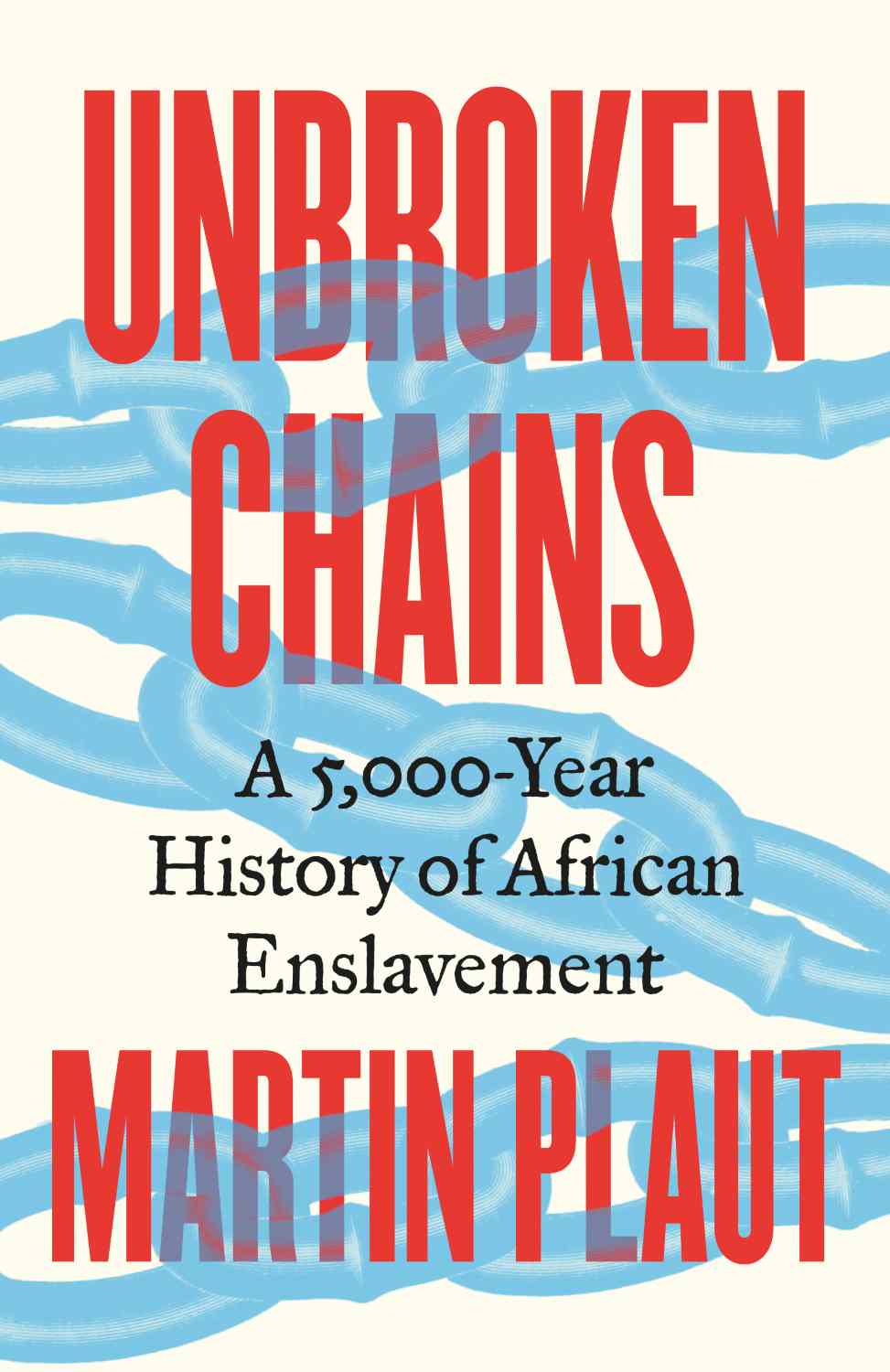
Unbroken Chains: A 5,000-Year History of African Enslavement
By: Martin Plaut
Publisher: Hurst & Co
