"Point-perfect performances": Barry Gardiner reviews David Hare's 'Grace Pervades'
Ralph Fiennes as Henry Irving and Miranda Raison as Ellen Terry | Photography by: Marc Brenner
5 min read
A superbly acted contemplation on theatre and the acting profession, this play may appeal more to the cognoscenti, but the one-liners are worth the ticket price alone
This is a play about what a play is about. It is an examination of theatre and the acting profession.
That I took an instant dislike to Teddy was a tribute to Jordan Metcalfe’s point-perfect interpretation of the arrogant Edward ‘Teddy’ Gordon Craig who opens the play recalling his mother, the superstar of Victorian drama, Ellen Terry with the question, “What is it like to be a genius?”
Not that he seems a great fan of his mother, remarking that “if one is still an actor at 40, you need to ask yourself some serious questions”. It is a line that the 78-year-old David Hare must have enjoyed writing, and one which the audience fully appreciated the nuance of.
The play’s title, Grace Pervades, is another blague privée intended for the theatrical cognoscenti. It refers to a less than kind contemporary review, that said of her performances “Grace pervades the hussy”. Not much used in modern parlance, “hussy” is a word to which Terry’s daughter Edith, ‘Edy’, would have taken great exception. Her own dramatic productions were focused on achieving social revolution and the advancement of the suffrage movement.
 Ruby Ashbourne Serkis as Edith Craig (centre) | Photography by: Marc Brenner
In fact, living at the bottom of her mother’s garden in a lesbian ménage-à-trois with the occasional “sympathy frig” by Vita Sackville West, Edy might well have had the word applied to herself. However, it must be considered the more remarkable that in the prurient Victorian age, Ellen Terry – whose string of affairs began at the age of 14 – could be deemed such a national sweetheart.
Her amorous liaisons did not prevent her becoming the best-paid woman in England. On one of her American tours, she earned the modern equivalent of £24,000 a week – and just as well. Edy slyly tells us, when disparaging her brother’s theatrical disasters, that “Teddy’s Vikings of Helgeland lost more in a week than Ellen made in a year!”
David Hare has lost none of his powers
Teddy believes in “a theatre without actors” and in real life became (in retrospect, it must be said) a noted theoretician of drama and performance, revered by the likes of Konstantin Stanislavski and Peter Brook. A self-righteous, arrogant womaniser who had an affair with Isadora Duncan, we are told by sister Edy that in his own short acting career, the other spear carriers in Hamlet threw him off the battlements at the end of one rehearsal!
Now, the man himself: Henry Irving. Or do I mean Ralph Fiennes? It is difficult to tell. Irving regarded the theatre with the utmost seriousness. Meticulous in his preparation, he boasts that his is “a company of equals in which I am the boss”. He admits to Ellen that he is “atrabilious” (yes, I had to look it up too) and “an evening in my company can sometimes be very grim”, yet this is the man who single-handedly transformed 19th-century theatre into a respected art form. On stage he was the charismatic epicentre from which no eye turned, except to alight on Ellen Terry.
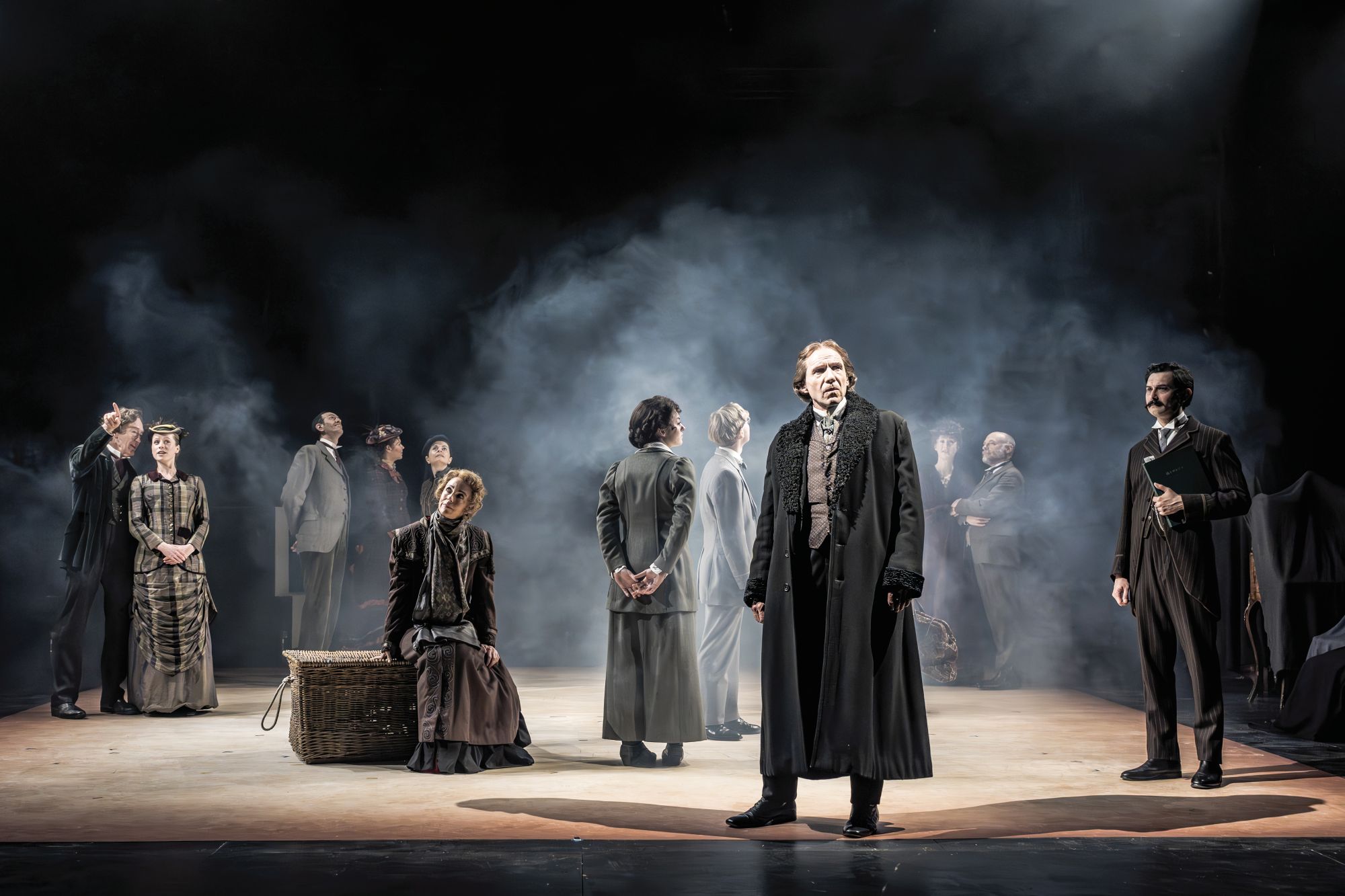 Ralph Fiennes as Henry Irving, and ensemble cast | Photography by: Marc Brenner
Ellen (played by Miranda Raison) was his theatrical and life partner for 27 years. She was “the day to his night”. She it was who persuaded him to direct his gaze away from declamation at the audience and to the other actors on stage. With her, Irving ran the Lyceum Theatre, overpaying his actors, accumulating debt, but entrancing audiences.
“You see everything as tragic,” she tells his Malvolio, “but Twelfth Night is supposed to be a comedy!” For him, theatre always comes first. For her, life does. She just happens to be spectacularly good at being an actress. “We have taken this forsaken art form and taken it to a level it has never aspired to,” he tells her. “To you, the theatre is everything. I’d rather be a successful human being,” she retorts.
 In a moment of purity and tenderness, he admits, “A faltering actor until 40, you were the instrument of my transformation.” I cannot remember if it is he or she who then says, “Together we made a harmony we could not make apart.” But of course it does not matter.
And this is the heart of David Hare’s contemplation on what it is to be a player, and what this strange art form is. He gives us four very different approaches in Teddy, Edy, Ellen and Irving. The minimalist, Teddy; the purposeful utilitarian, Edy; the escapist, Ellen; and Henry Irving, for whom the theatre is inextricable from life itself.
If you love theatre, go – these are some of our finest actors paying obeisance to the nobility of their calling and the giants on whose shoulders they stand.
If you do not count yourself a thespian, still go – Hare has lost none of his powers, and some of his one-liners are worth the price of the ticket all on their own.
Barry Gardiner is Labour MP for Brent West
Grace Pervades
Written by: David Hare
Directed by: Jeremy Herrin
Venue: Theatre Royal Haymarket, London SW1 – until 11 July 2026
