'A fascinating opportunity': the Earl of Clancarty reviews "Turner & Constable: Rivals & Originals"
1834-35: JMW Turner, 'The Burning of the Houses of Lords and Commons' | Image courtesy of the Cleveland Museum of Art/Bequest of John L. Severance 1942.647
4 min read
A cleverly curated exhibition marking the 250th anniversary of the birth of these two rival English artists, don't miss this chance to go along and compare their pivotal work – and maybe even pick a winner
Organised to mark the 250th anniversary of the births of JMW Turner and John Constable in 1775 and 1776 respectively, a new exhibition at Tate Britain cleverly puts the two artists up against each other in a kind of Beatles/Stones or Oasis/Blur contest. But, as with those ‘rivals’, there is no simple winner. Indeed, for all the individual qualities both artists possessed, the faults of one are sometimes the faults of the other.
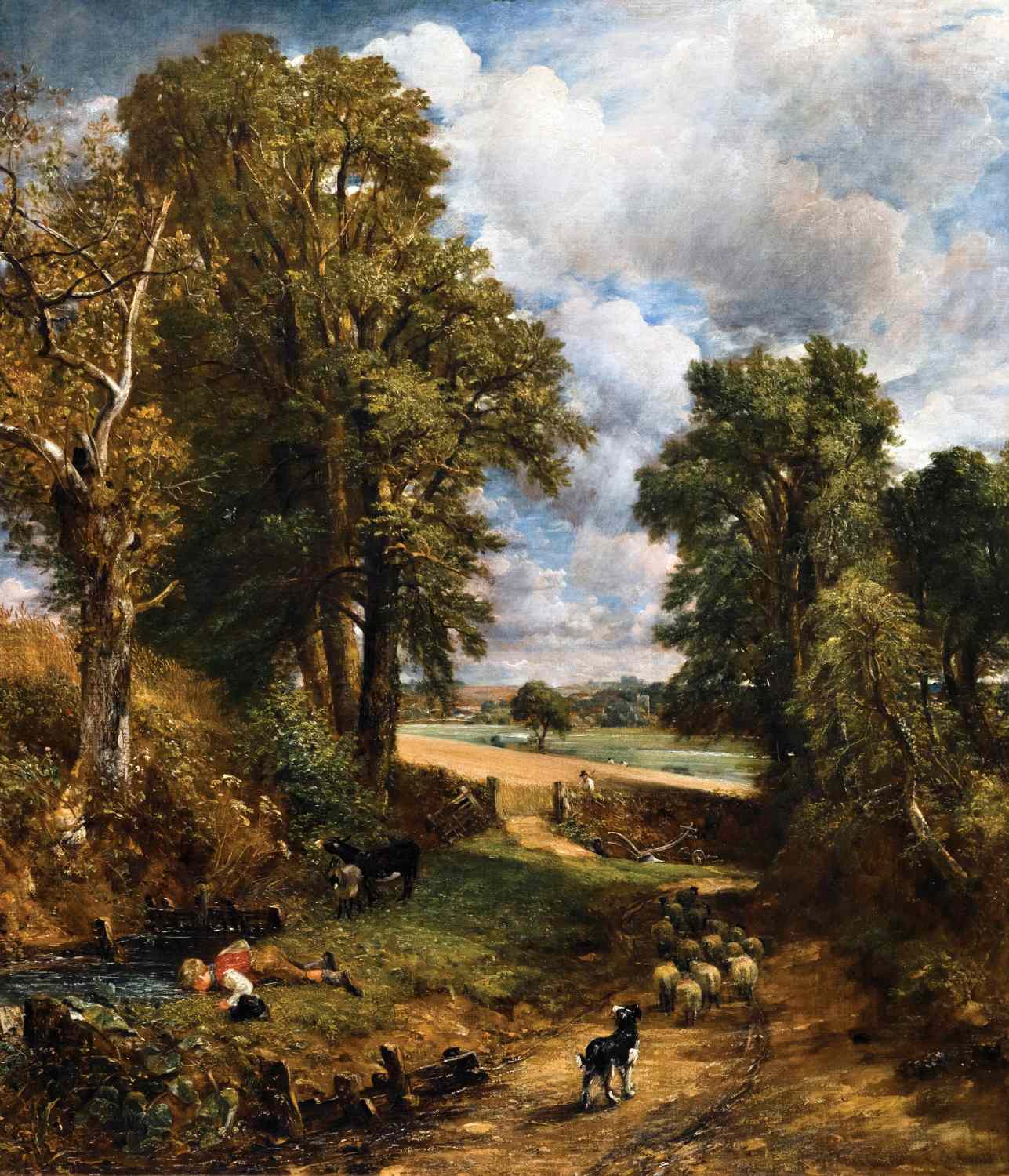 1826: John Constable, The Cornfield | Image: Alamy
In particular, neither artist was a great figure painter despite their early passable self-portraiture. Ultimately, the best paintings of both artists are those where figures are either ditched or marginalised. Considering the popularity of Flatford Mill (1817) or The Leaping Horse (1825), this may be a controversial view, but for me the standout pictures for Constable are his cloud studies and for Turner his late paintings, where the emphasis is most directly on the elements and, more interestingly, nature’s relationship to the human world.
Much of the work is familiar from our national collections, but a fair number have been loaned to Tate Britain, in particular from America. The price of admission is worth it alone for Turner’s extraordinary The Burning of the Houses of Lords and Commons (c.1834-5), where the mass of watching crowds have been effectively reduced to spectral ghouls, faces lit only by the fire itself.
The exhibition is organised chronologically to reflect the trajectories of both careers side by side, with the largest oil paintings to the smallest sketchbooks on display, alongside paintboxes and palettes. Even Turner’s spectacles and Constable’s sketching chair are here.
The price of admission is worth it alone for Turner’s extraordinary The Burning of the Houses of Lords and Commons
Things start to take off in the 1820s. Constable’s Rainstorm over the Sea (1824) as seen from the beach at Brighton is no ‘bucket and spade’ vision. Turner’s Staffa, Fingal’s Cave (1832), a remarkable picture from this mid-period, shows equally fearsome weather: a single orange dot of light on an otherwise darkened hull echoes the sun which the artist described as “getting towards the horizon, burst through the raincloud, angry”.
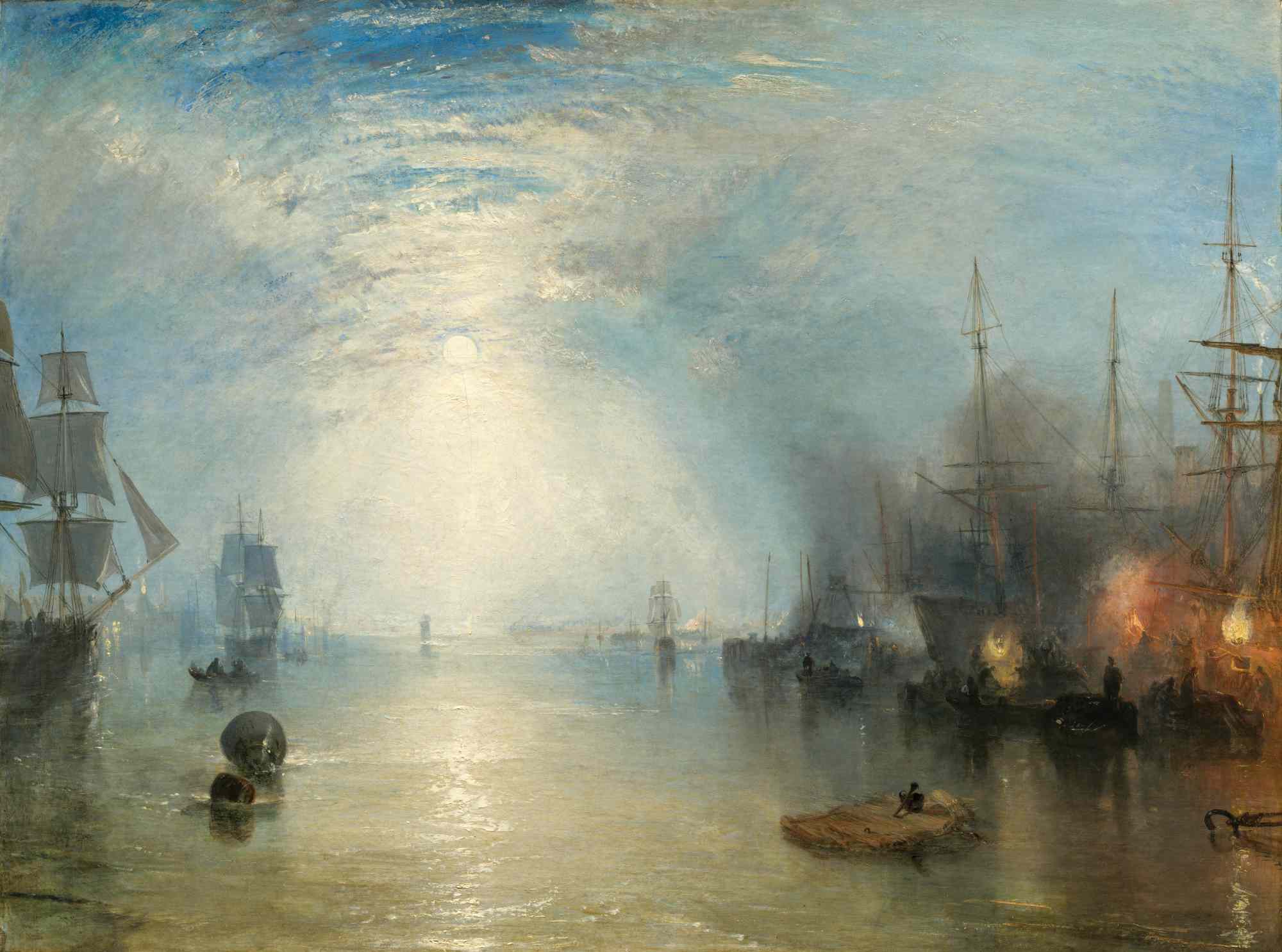 1835: JMW Turner, Keelmen Heaving in Coals by Moonlight |Image courtesy of the National Gallery of Art, Washington, Widener Collection
But whereas Turner continued to experiment and explore wildly differing terrain across Europe, for the most part Constable stuck to the softer Suffolk landscape he knew. Unlike Turner, Constable (himself from a middle-class background) never dispensed with the (often working-class) figures in his large oils, a feature which – because of the unquestioned assumption of their place in the world – gives these paintings a sentimentalised air. Though one can almost forgive the figures in The Cornfield (1826), as the composition is so brilliantly completed by the turning head of the dog – a trick also effectively used in The Hay Wain (1821, not in this exhibition).
 Still, one of Constable’s best works is the drawing Fir Trees (1833) in which two trees – one straight, one straggly – stand, rather humorously, side by side (and not a figure in sight).
What would these two artists be painting if they were alive today? Turner would be in the English Channel in a stormy sea, tackling the misery of migrants on a small boat. Constable would still be painting bucolic landscapes, while somewhere in the background a St George’s flag is flying.
Earl of Clancarty is a Crossbench peer
Turner & Constable: Rivals & Originals
Curated by: Amy Concannon with Nicole Cochrane and Bethany Husband
Venue: Tate Britain until 12 April 2026
