"Provocative schoolboy humour": Lord Clancarty reviews 'Gilbert & George: 21st Century Pictures'
'School Playground': Gilbert & George, 2008 | © Gilbert & George. Image courtesy White of Cube
3 min read
They may still be contrary but the trademark style of the Lords of Misrule of the modern art world is starting to feel a touch nostalgic
What strikes you most immediately about the work in the new Gilbert and George exhibition – beyond the size of the pictures and their garish colourfulness – is its aggressive contrariness. Over the years Gilbert Proesch and George Passmore, who famously declared themselves a single artist, have become, at least to a certain extent, the court jesters, certainly the Lords of Misrule of the art world.
That contrariness is a conscious stance: their stated aim is to “bring out the bigot from inside the liberal and conversely to bring out the liberal from inside the bigot”.
The pictures presented here are in the photography-based medium that has become their trademark style over the last 40 years. In the 1970s, such pieces were largely in black and white, with occasional hand-painting in colour. They now work digitally – mainly in colour but with some black-and-white elements.
Personally, I miss the artists’ hand present in their earlier work
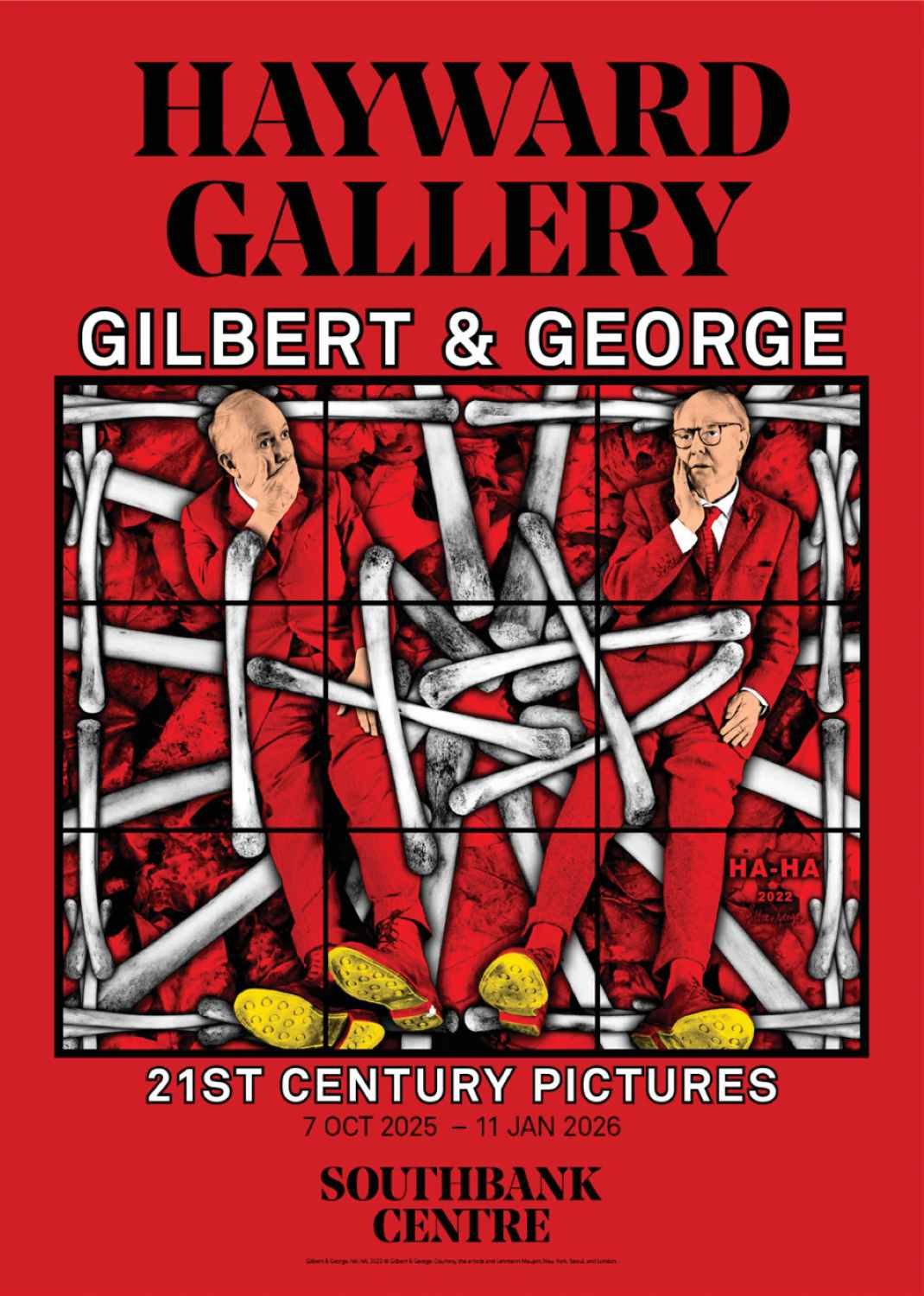
All the pieces are partitioned with black frames, which gives a kind of ‘spiritual’ stained glass window effect to the work, an effect heightened by the choice of colour and strong contrasts. Here there is contrariness again, considering that they have spoken out against institutionalised religion.
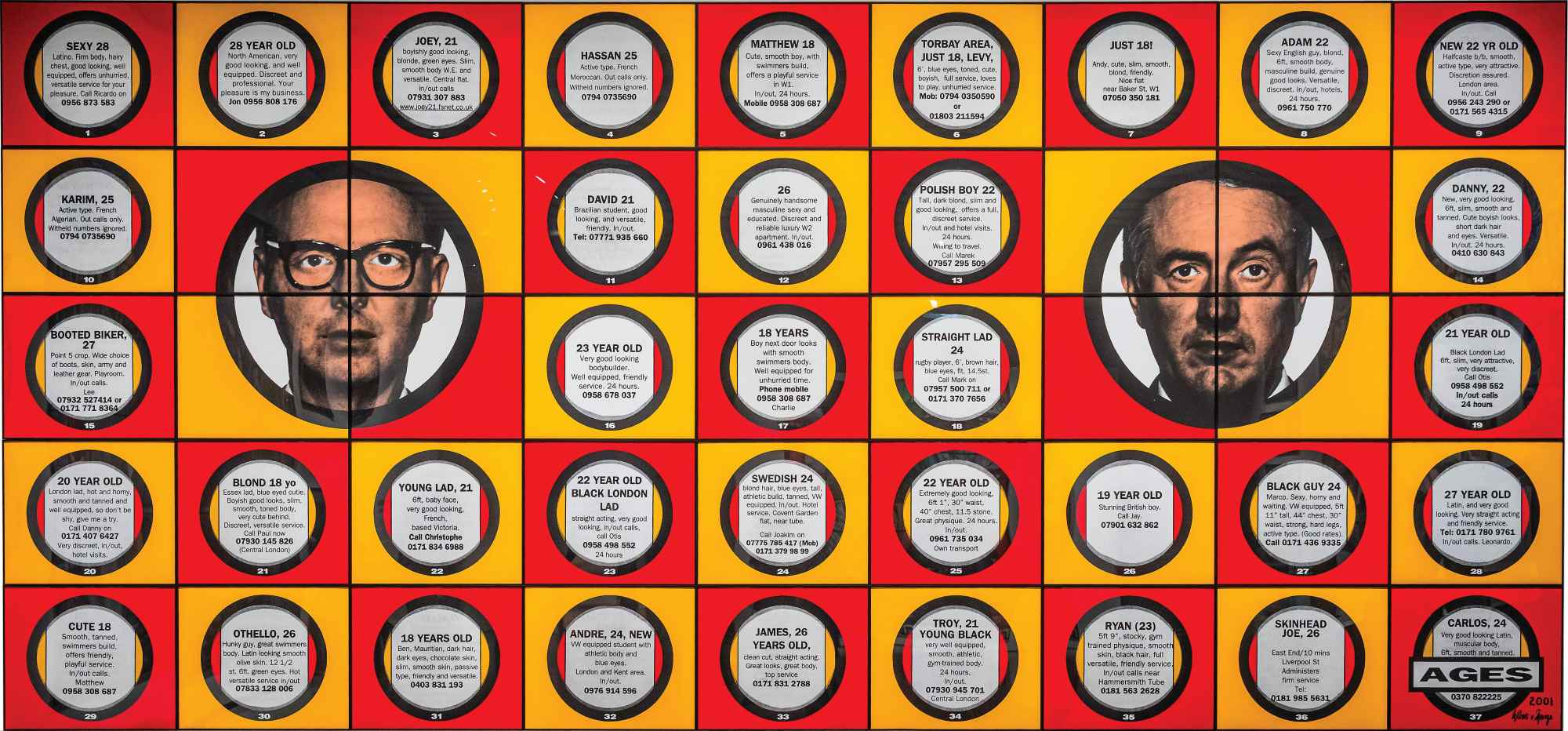 Ages, Gilbert & George, 2001 | Image by: Guy Bell/Alamy Live News
Much of the content of the work has been raided from their own local area, London’s East End, where they have lived since 1968 (following their meeting at St Martin’s School of Art the previous year). The work is packed with texts, objects and (mostly young) people. Some of the references are ‘in your face’; some are sly. Sex, religion and social commentary all figure. There are multiple headlines from newspapers. One picture, Murder, contains 64 headlines (I counted them) containing the word ‘murder’. Ages features numerous personal ads, each one referencing the age of the person advertising themselves – the youngest 18.
Gilbert and George themselves feature in many of the pieces, sometimes with their own images doubled, often grimacing, or looking bored, or catatonic – all of this inevitably lending a surrealist, grotesque feel to the work.
 One of the effects looking at these pictures had on me – despite the provocative schoolboy humour (or even perhaps because of it) – was the sense of nostalgia they are beginning to evoke. The arguably uncomplicated multiculturalism, the old red telephone and post boxes feel already a part of a bygone age. That sense of a conservative Ealing comedy style wistfulness has always been an aspect of their work.
Personally, I miss the artists’ hand present in their earlier work, such as the drawings of themselves looking lost in a bucolic wooded landscape (which in actuality never felt that far from central London).
Infamously – another taunt of the ‘establishment’ – they backed Brexit against the majority of those who worked in the arts. Gilbert, originally from Italy, said he did not want to live “in a glass case”. Except the years since the referendum in 2016 have only confirmed how much it is the UK that is the glass case, penalising young artists wishing to extend their reputation beyond these shores.
Earl of Clancarty is a Crossbench peer
Gilbert & George: 21st Century Pictures
Curated by: Rachel Thomas, with Suzanna Petot, Hannah Martin and Ananya Jain
Venue: Hayward Gallery, London SE1 until 11 January 2026
