A flawed production that still manages to thrill: Paul Kohler reviews: 'David Bowie: You’re Not Alone'
'David Bowie: You’re Not Alone' | Image by: PA Images
5 min read
Despite inflexible seating, disappointing acoustics and questionable omissions, I would still recommend this immersive celebration of a creative genius
Visiting the Lightroom’s latest retrospective, I found myself reflecting on the first line of David Bowie’s early single Changes: “Still don’t know what I was waiting for.” And, to be honest, I still don’t know what to make of You’re Not Alone.
But that, I suppose, is all part of Bowie’s enigma – be it sexual, musical, intellectual or artistic.
Before David Bowie there was David Jones who, in 1964 at the tender age of 17, first appeared on TV as the founder of the Society for the Prevention of Cruelty to Long-Haired Men – spouting banalities on the BBC’s Tonight programme, with all the earnestness of one of today’s social media influencers, intent on becoming famous for no other reason than for being famous. His first forays into music were equally unpromising, with the similarly banal Laughing Gnome giving no hint of the brilliance to come.
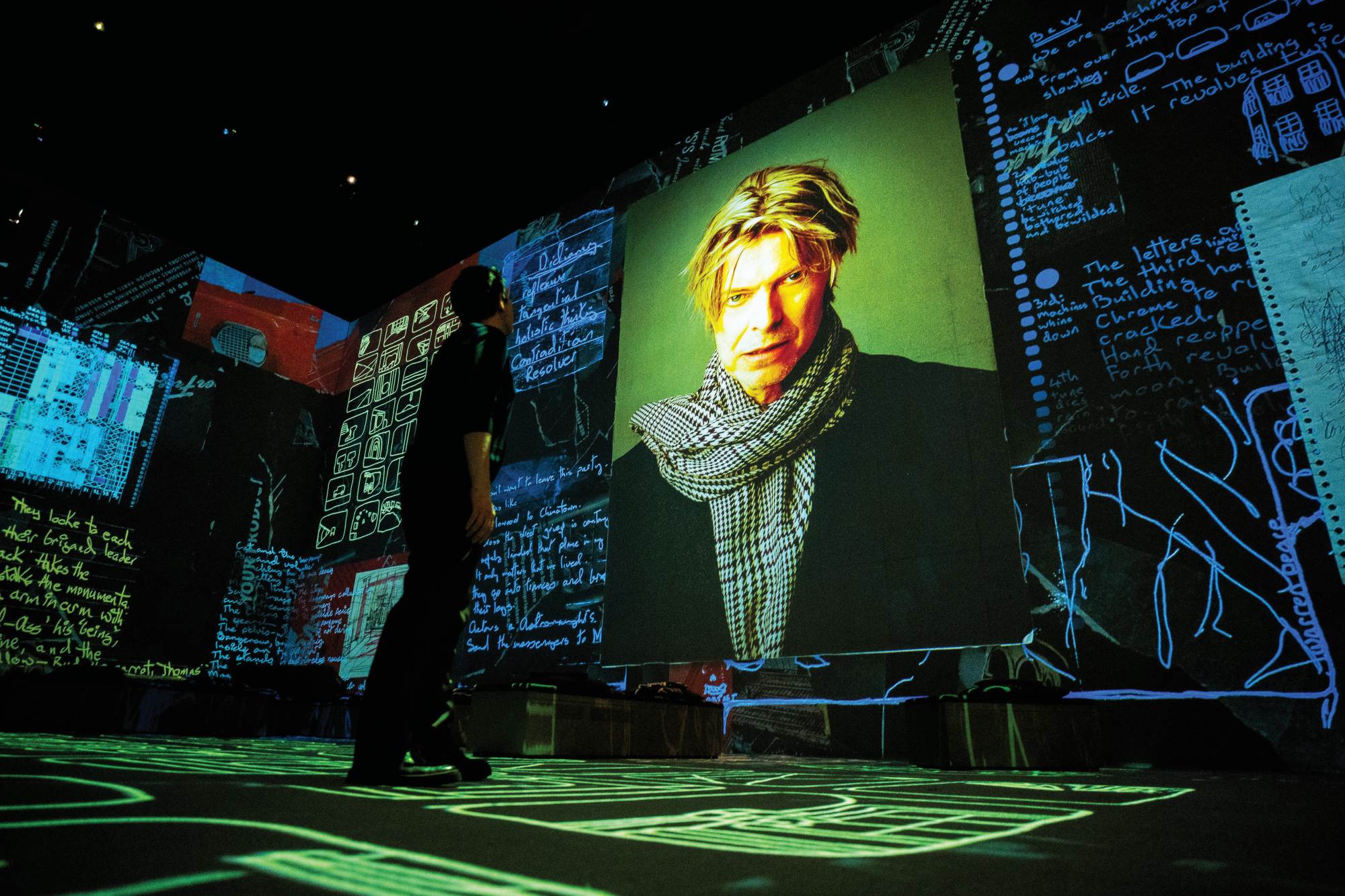 'David Bowie: You’re Not Alone' | Image by: PA Images
None of this made it into the Lightroom’s hour-long experience, however, in a show that portrays little of the artist as a young man – beyond a glimpse of where he spent his formative years in Bromley – and delves no further back into his musical catalogue than Space Oddity. That initially seemed a strange omission, as I’ve always thought his all-consuming desire for fame, an ambition that existed long before David Jones became David Bowie, is critical to properly understanding the ‘man who sold the world’ to achieve it.
But as the curators of what is at times a thrilling experience – despite disappointing sound quality and inflexible seating that makes it hard to enjoy its 360-degree aspect – would doubtless argue, such criticism misses the point. This is an immersive event, which is at its best when bringing the audience not into David Jones’ world but into the various worlds of David Bowie – of which there were many.
It underplays his intellect and musicality
I began this review quoting from his prophetic single released six months before the album Rise and Fall of Ziggy Stardust and the Spiders from Mars and Bowie’s metamorphosis into Ziggy. Changes is about artistic reinvention, a parody of a nightclub number, with a distinctive piano riff played by Yes’ Rick Wakeman, then a session musician. It was taken from the 1971 album Hunky Dory. Its cover is an homage to the Hollywood glamour of Marlene Dietrich, Lauren Bacall and Greta Garbo, featuring Bowie as “the actor” (as he describes himself on the sleeve notes) at the start of his experimentation with character, sexuality and gender – between the psychedelia of ‘Major Tom’ and the glam rock of Ziggy Stardust.
These were the first of many, short-lived personas Bowie adopted over a 50-year career; foretold with incredible perception, foresight and no little strategic planning in this, one of his earlier compositions. But as Bowie laments in Changes, it was an approach born as much out of frustration as fulfilment for “every time I thought I’d got it made, it seemed the taste was not so sweet” – something the show has neither the time nor appetite to explore, in what is most deliberately a celebration, and not a critical appraisal.
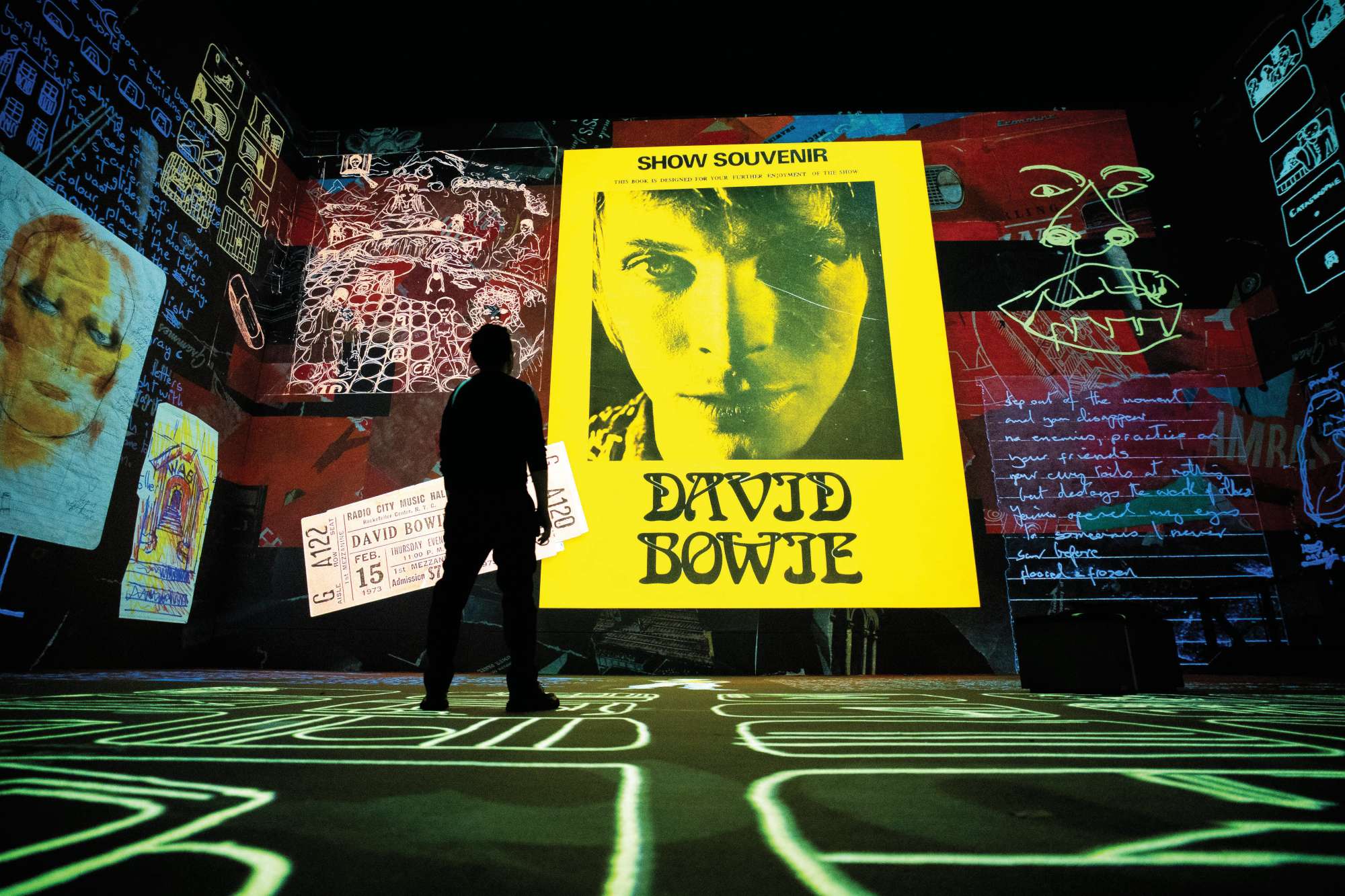 'David Bowie: You’re Not Alone' | Image by: PA Images
Bowie was fascinated by, and in his songwriting sometimes borrowed, the cut-up technique of William S Burroughs, in which sentences are cropped from a linear text and rearranged to create a new narrative. The show replicates this approach with a non-linear format in which themes, conversations and performances intertwine in a non-chronological infinite loop that has no beginning, nor end, and where Bowie is left to do most of the talking.
Yet, while this captures his intellectual and musical curiosity, it underplays his intellect and musicality.
The show appears to accept without question, for instance, Bowie’s self-deprecating assertion he is not an original thinker but one who synthesises the music and ideas of others – an aside which seriously underplays Bowie’s genius. Wakeman, for example, a far more technically gifted musician than Bowie ever aspired to be, has in interviews praised the brilliant invention of the chord sequencing in Life on Mars – on which Wakeman provided the accomplished piano accompaniment but, as he himself concedes, could never have written.
 Admittedly, given the curators’ clearly vindicated decision to eschew narration, it would not have been easy to include the Wakeman footage in this show. However, that’s no excuse for editing out Bowie’s prophetic words, in the 1999 Newsnight clip they include from his interview with Jeremy Paxman, where he describes the “exhilarating and terrifying” potential of the internet as an “alien life form”, rather than just a tool, which would transform and fragment society, truth and content.
That interview captured the brilliance of the man who once said, “tomorrow belongs to those who can hear it coming”.
That ultimately was Bowie’s genius and why, despite my quibbles, I recommend you experience both his ‘sound and vision’ at London’s Lightroom.
Paul Kohler is Liberal Democrat MP for Wimbledon
David Bowie: You’re Not Alone
Directed by: Mark Grimmer and Tom Wexler
Produced by: Lightroom
Venue: Lightroom, London, N1
