'Irrepressible': Barry Gardiner reviews 'Hadestown'
Desmonda Cathabel (Eurydice) and the cast of Hadestown | Image: © Brinkhoff-Moegenburg
5 min read
Any play about a journey out of hell is going to appeal to us denizens of Westminster – and this fabulous show does not disappoint
Musician Daniel Higham’s brassy bell-muted trombone sets us off on the Road to Hell. We are on a railroad line somewhere between the dustbowl of deep-south 1920s America and Ancient Greece in 2,000 BC. Hermes, the messenger of the gods, rides that trombone through the opening number to introduce us to the assortment of gods and mortals in the story.
“It’s an old song, but we’re going to sing it again,” she says, and the Three Fates provide the brilliantly harmonised commentary as a world-buffeted Eurydice drifts into the railway café where a head-in-the-clouds musician called Orpheus is waiting tables. Dreamer that he is, he not only falls instantly in love with her, but introduces himself as “the man who is going to marry you”. For a post-Me-Too audience, this is an original sin for which no journey into hell could atone – and that was before he missed his high G-sharp. The Fates, on the other hand, were vocally superb and Laura Delany (another understudy on the night) had a soprano voice we need to hear more of.
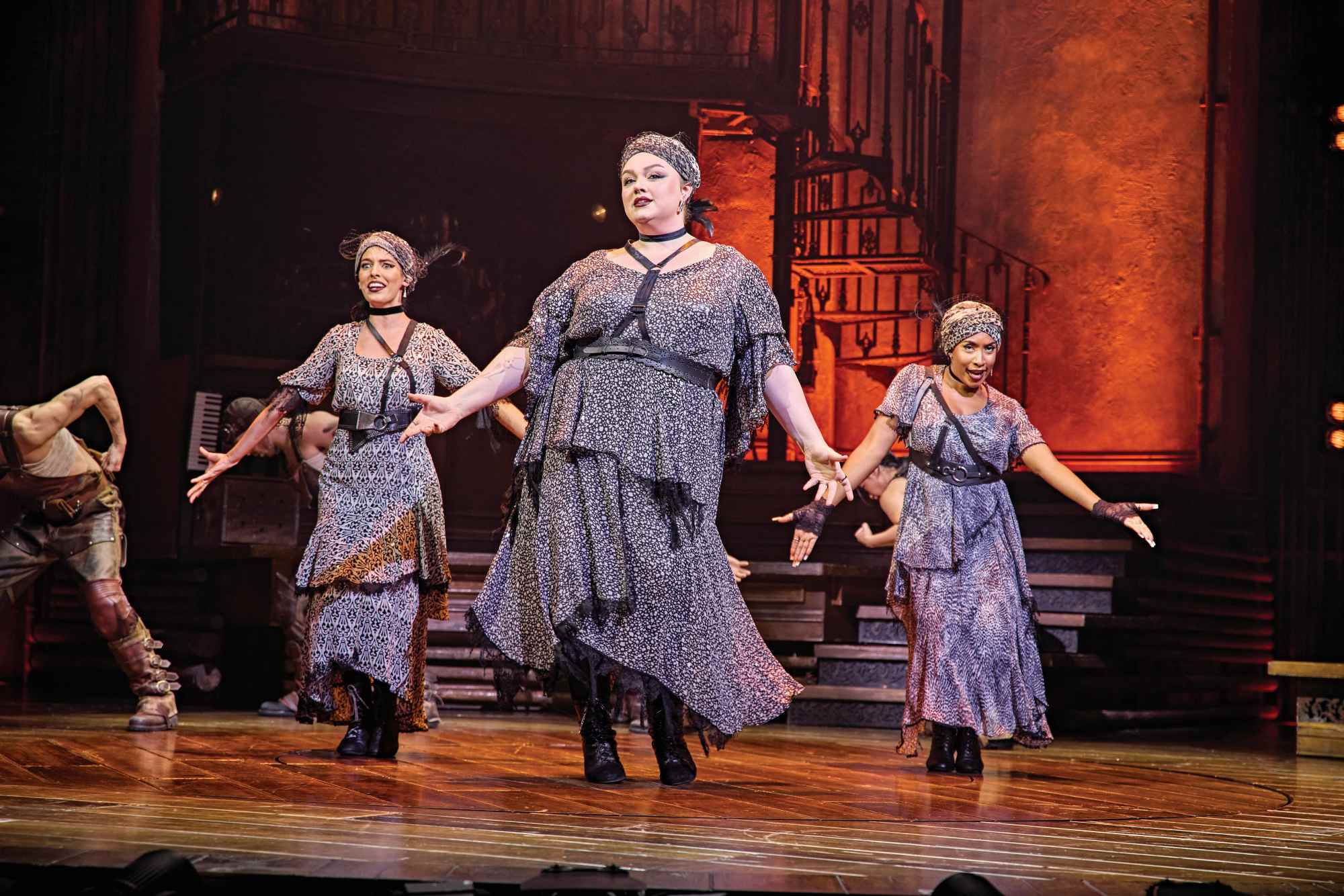 Allie Daniel, Melanie Bright and Lauran Rae as the Fates
Image: © Brinkhoff-Moegenburg
The chemistry between the two young lovers never really takes off and I suspect that, being both composer and librettist, Anaïs Mitchell also realised that the classic Eurydice story was a little maudlin for modern tastes. Her inspired idea was to jazz it up with the myth of another young girl abducted by the king of the underworld: Persephone. I remember this Persephone from my childhood. She was the fun aunty who turned up to family celebrations already fully fuelled by the hip flask tucked down her bra and insisted on revealing just too many family secrets as she stubbed out her cigarettes in the butter dish. Michelle Andrews’ point perfect Persephone was another understudy that made you not miss the principal.
We are left marvelling at David Neumann’s choreography
One can only sympathise with Eurydice, who finds being married to a penniless dreamer difficult to reconcile herself with. Hanging around while hubby finishes the one-hit-wonder he says will change the world proves less attractive than the contract she is offered by the King of Hadestown. And who can blame her, when the contract is rolled up in the delicious bass-baritone of Chris Jarman’s Hades? He offers her all that can be mined from the earth – the riches of coal and oil, gold and jewels – but the contract has small print and she becomes his wage slave and dons the uniform of the workers in the mine.
The first half closes powerfully as Hades, Eurydice and the workers perform one of the show’s great hits, Why We Build The Wall. No nodding tribute, this, to Pink Floyd. It is a deep statement about power and the manipulation of identity. And as the first half closes, we are left marvelling at the way David Neumann’s choreography with giant lamps has morphed the workers into the machine itself.
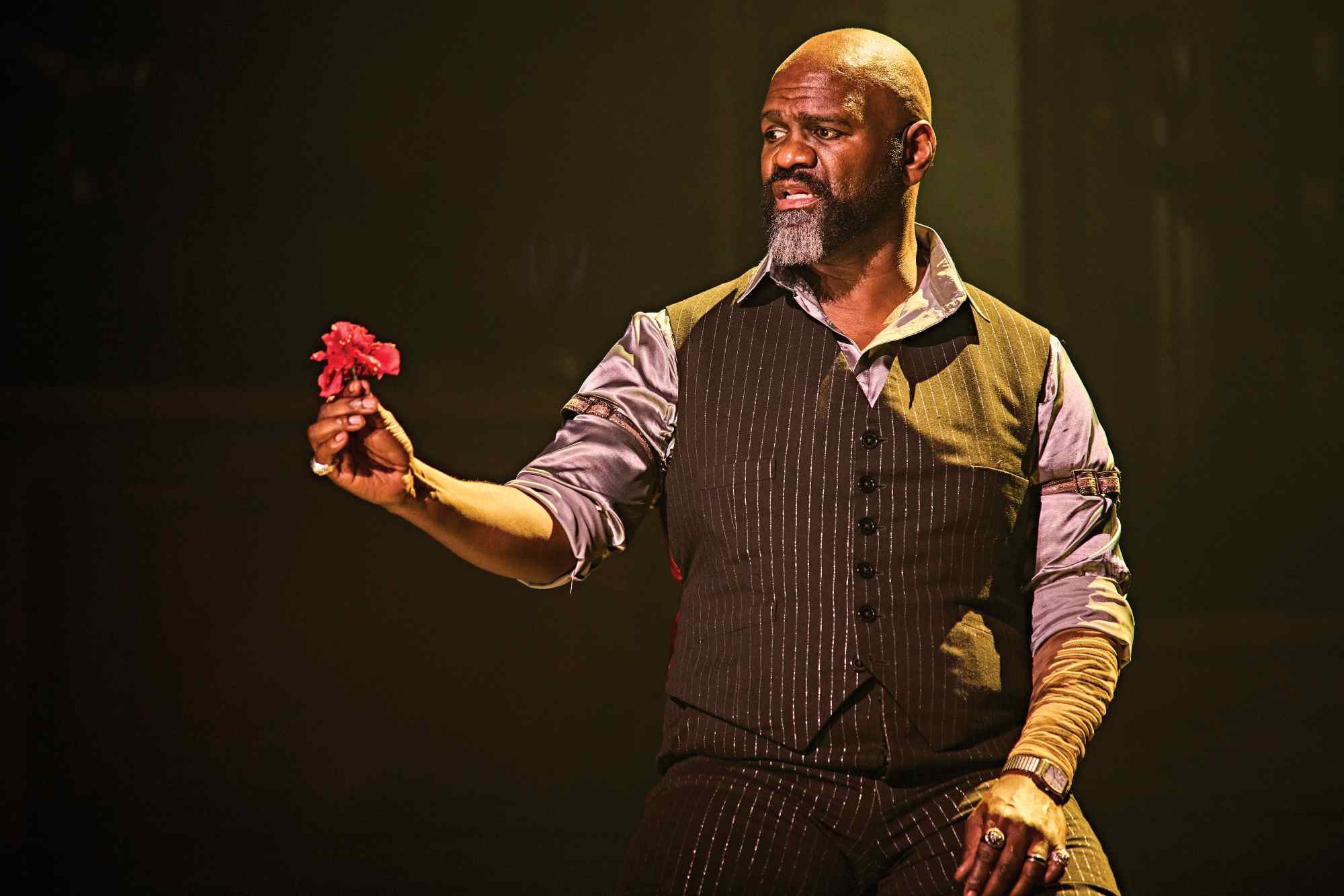 Chris Jarman as Hades | Image: © Brinkhoff-Moegenburg
A drunken Persephone opens the second half of the show with a barnstormer of a performance as the bored housewife of Hades flirting with the workers and bemoaning their joint fate:
“I don’t know about you, boys
But if you’re like me then hanging around
This old manhole is bringing you down”
The Queen of Hades understands their longing but can only offer them moonshine whiskey as a substitute for the sunshine that they crave.
When Orpheus – remember him? – takes the train to Hadestown to rescue Eurydice with his now completed masterpiece of a song, we realise that she is not the only one who needs rescuing, and the real story of the second half emerges.
“What are you afraid of?” Persephone demands of Hades.
“He’s just a boy in love…
He has the kind of love for her that you and I once had.”
And as she pleads with her husband to let Eurydice go, Persephone heals the rift in her own marriage. Their embrace is the one you feel Orpheus and Eurydice lack. A healing embrace – an acceptance that the world must contain both light and darkness. You get the feeling that they fight like hell in this marriage, but they really do love each other.
 By contrast, Orpheus when confronted by Hades with the contract Eurydice signed weakly replies,
“If it’s true and there’s nothing to be done
And the girl I love is gone
I’ll be on my way.”
You feel like standing up in the front row and screaming, “Stop being such a wimp!”
Does Orpheus manage to sing Eurydice out of Hadestown? You’ll have to go and find out for yourself – but do go. It is a fabulous, irrepressible show.
Barry Gardiner is Labour MP for Brent West
Hadestown
Music & lyrics by: Anaïs Mitchell
Directed by: Rachel Chavkin
Venue: Lyric Theatre, London W1, until 27 September 2026
